Android security mitigations are designed to break exploit reliability. Instead of relying on a single defensive feature, Android layers protections across memory management, application isolation, code execution, and kernel behavior so attackers must overcome multiple barriers at once.
One thing I pay attention to when reading Android vulnerability reports is whether the issue is merely exploitable in theory or realistically exploitable on modern devices. That distinction matters much more today than it did years ago.
Modern Android systems assume memory corruption bugs will continue to exist. The operating system is no longer built around the idea of perfect software. Instead, Android increasingly focuses on containment, unpredictability, and forcing attackers into unstable conditions.
That shift changed exploitation from a relatively direct process into a layered reliability problem.
Takeaways
- Android defenses work as overlapping layers rather than isolated protections.
- Modern mitigations mainly target exploit reliability, not vulnerability existence.
- Stack protections, heap hardening, ASLR, and sandboxing interrupt different attack stages.
- Attackers often need mitigation bypasses before memory corruption becomes useful.
Android Security Changed From Prevention to Resistance
Older software security models often focused heavily on preventing vulnerabilities entirely. That goal still matters, but modern Android security design increasingly assumes some vulnerabilities will survive.
The defensive strategy changed because large operating systems process enormous amounts of complex input continuously. Browsers, media frameworks, wireless services, graphics engines, and applications all interact with untrusted data.
I think Android’s more realistic assumption now looks something like this:
Some bugs are inevitable, so exploitation itself must become unreliable and expensive.
That mindset explains why modern mitigations focus heavily on memory unpredictability, execution restrictions, isolation boundaries, and privilege containment.
The goal is not only stopping crashes. The goal is disrupting the chain attackers need after corruption occurs.
Code Signing Tries to Control What Can Execute
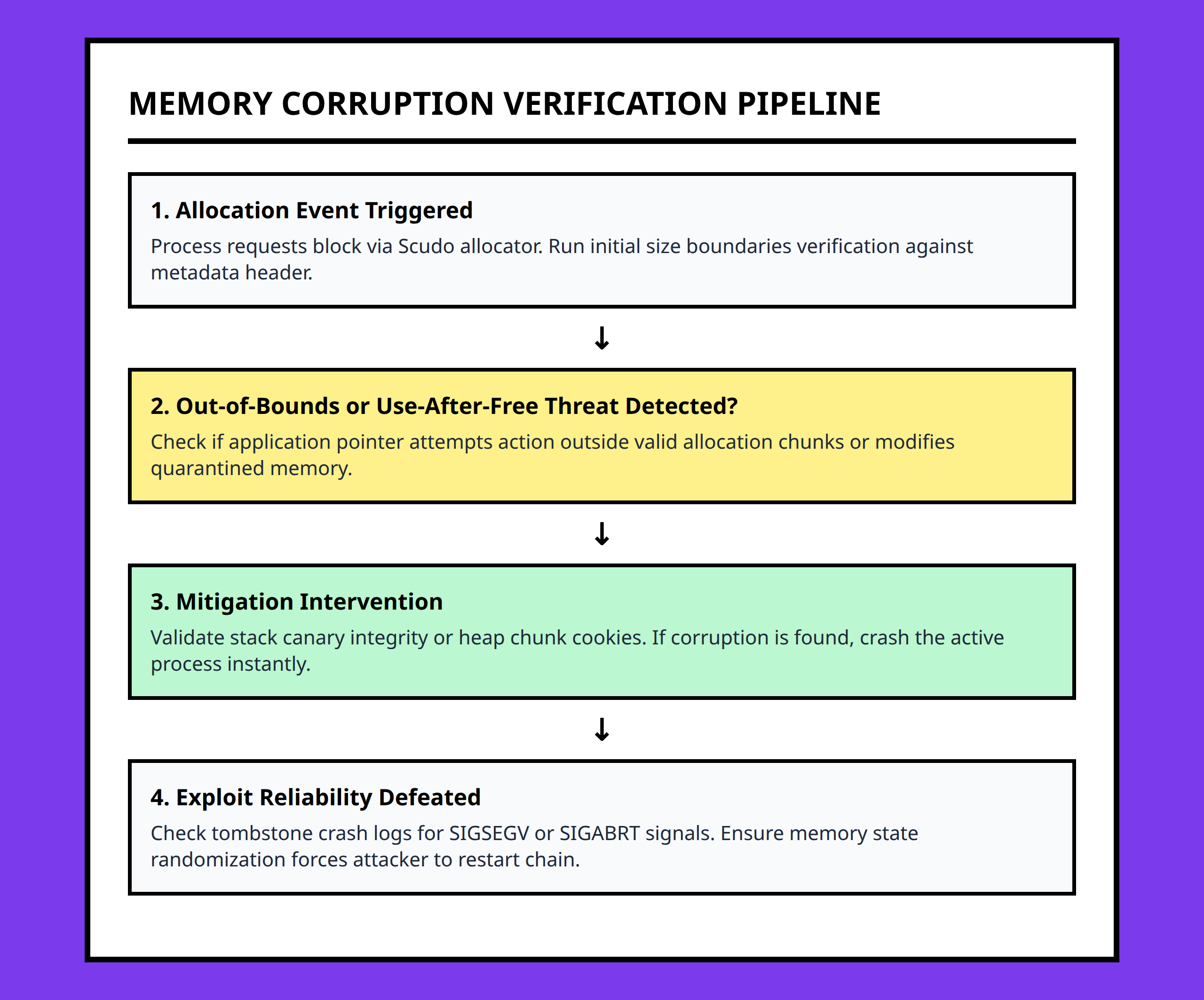
One important mitigation layer is code signing.
Android uses signing mechanisms to verify application integrity and establish trust relationships between software components. Signed code helps the operating system determine whether applications come from recognized sources and whether updates match expected identities.
From an exploitation perspective, code signing matters because attackers often want to execute unauthorized code inside trusted environments.
If the system strictly controls executable content, exploitation becomes more difficult.
I think code signing is most useful when viewed as part of a broader trust model rather than a standalone defense.
Signing does not prevent vulnerabilities inside legitimate applications. A signed browser or system service may still contain exploitable bugs. What signing changes is the operating system’s ability to reject untrusted binaries or unexpected modifications.
That distinction matters because attackers frequently need additional techniques once direct code injection becomes restricted.
Stack Protections Interrupt Traditional Overflow Behavior
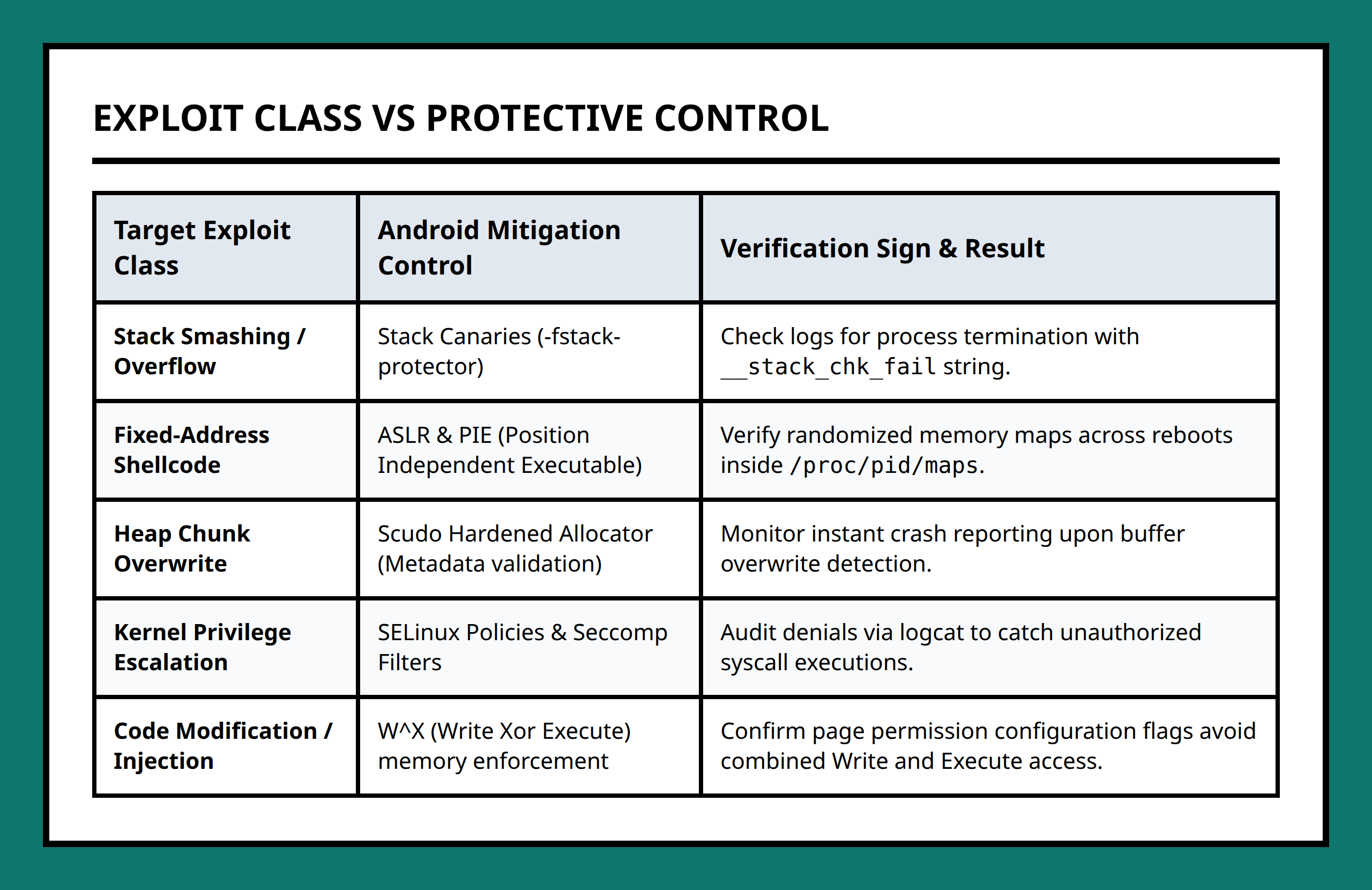
Traditional stack exploitation often depended on predictable memory layouts and direct return-address corruption.
Modern Android defenses complicate that process significantly.
Stack protection mechanisms aim to detect or interrupt corruption before execution flow becomes fully controllable. These protections often monitor whether sensitive stack structures change unexpectedly during execution.
I usually think of stack defenses as early warning systems around critical execution state.
A vulnerable function may still overflow memory, but exploitation reliability changes if the operating system detects corruption before the attacker gains meaningful control.
A realistic situation might involve a malformed media file triggering a stack corruption bug inside a parsing component. On older systems, the corruption may directly redirect execution. On hardened systems, stack integrity checks may terminate the process before the exploit chain completes.
The vulnerability technically still exists. The exploit path becomes less reliable.
ASLR Makes Memory Layout Harder to Predict
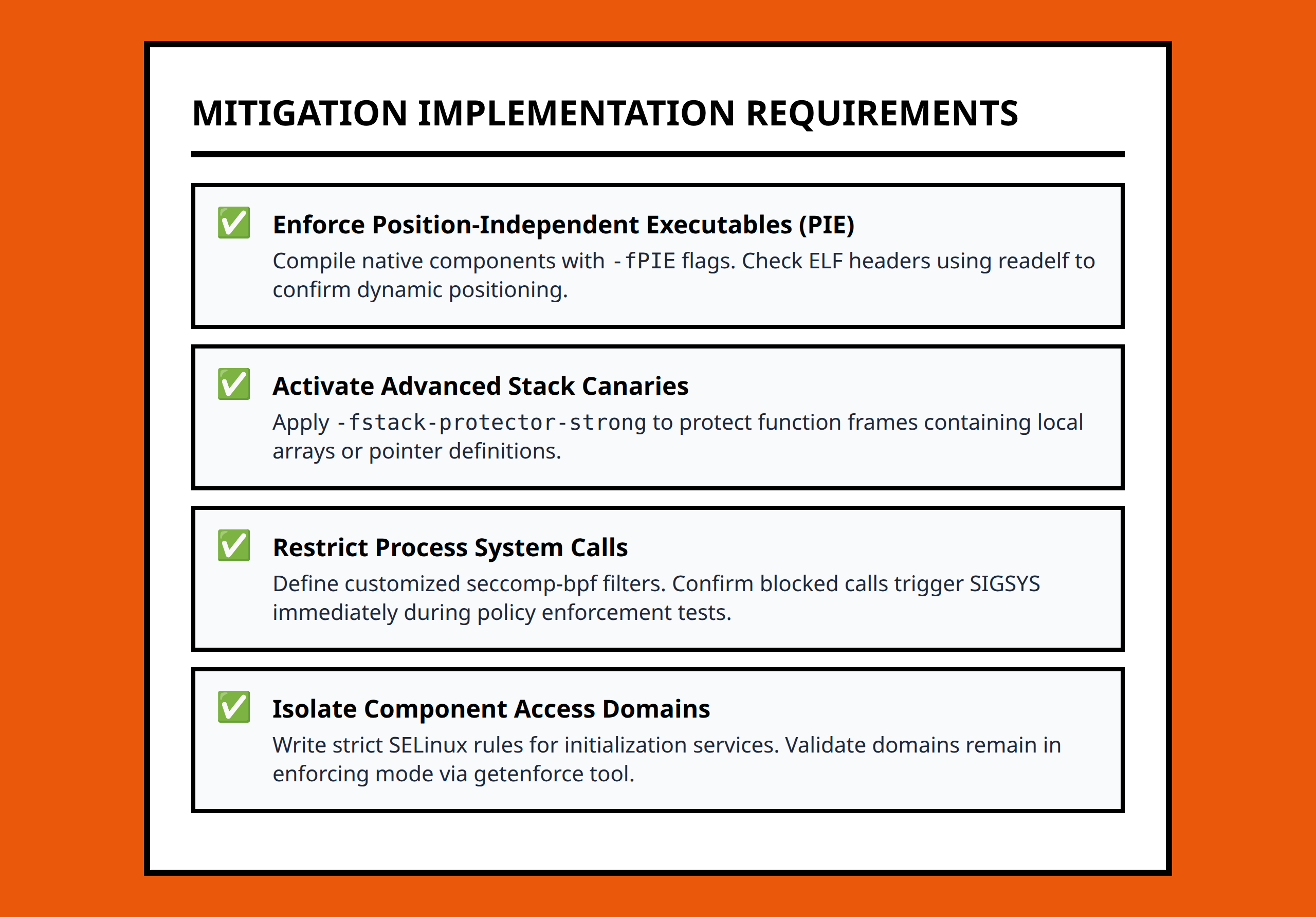
Address Space Layout Randomization, usually shortened to ASLR, changes where memory regions appear during execution.
That unpredictability matters because many exploitation techniques rely heavily on knowing where important structures exist in memory.
Without reliable addresses, attackers have a harder time:
- Redirecting execution flow
- Finding reusable code sequences
- Targeting critical structures
- Building stable exploit chains
I think ASLR is one of the clearest examples of Android shifting exploitation into a probability problem.
Instead of removing vulnerabilities directly, ASLR forces attackers to work inside uncertain memory conditions.
That uncertainty changes exploit reliability dramatically.
A memory corruption bug may behave perfectly during one execution attempt and fail completely during another because randomized memory placement changes surrounding conditions.
This is why modern exploit development often involves information leaks alongside corruption itself. Attackers frequently need ways to recover memory layout information before reliable exploitation becomes possible.
Heap Hardening Targets Dynamic Memory Abuse
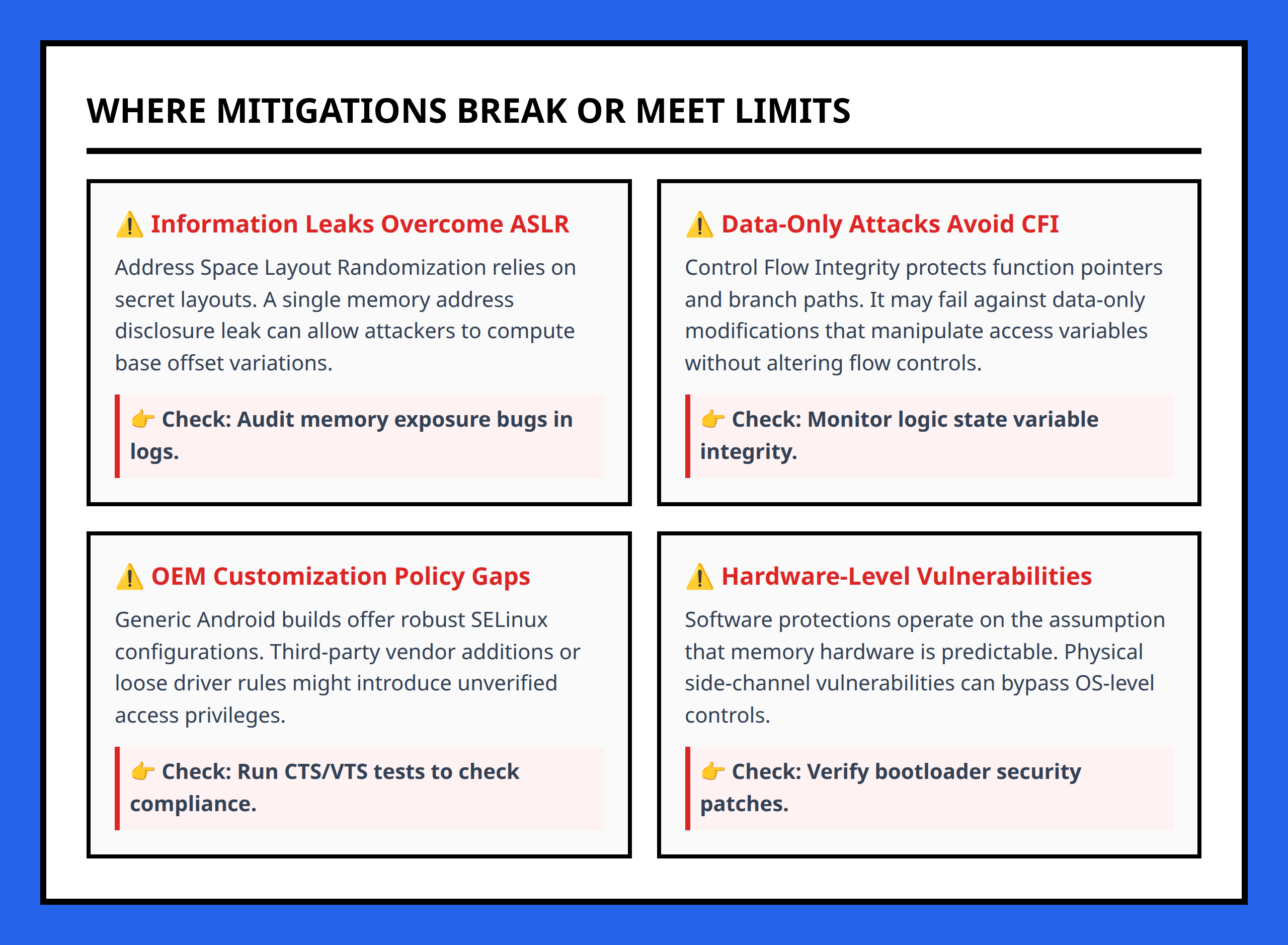
Heap exploitation became increasingly important as traditional stack exploitation grew harder.
Android responded by strengthening heap management behavior.
Heap hardening techniques try to reduce predictable allocator behavior, detect corruption patterns, and limit unsafe memory reuse.
This matters because heap exploitation often depends on carefully shaping memory layout through repeated allocations and frees.
I pay close attention to allocator behavior because dynamic memory management sits underneath many modern applications continuously.
Browsers, graphics engines, messaging systems, and media frameworks all create large numbers of heap allocations during normal operation.
If attackers cannot reliably predict allocator behavior, turning corruption into controlled execution becomes harder.
The important point is that heap hardening usually increases exploit complexity rather than eliminating all heap vulnerabilities entirely.
Sandboxing Limits Damage After Compromise
Android sandboxing approaches exploitation differently from memory protections.
Instead of preventing corruption directly, sandboxing tries to contain what compromised processes can reach afterward.
Applications and services operate inside restricted environments with controlled permissions and limited access to other system components.
I think sandboxing represents one of Android’s most important architectural shifts because it accepts that compromise may eventually happen somewhere inside the system.
The question becomes:
How much authority does the attacker gain after the initial compromise?
A browser renderer process with strong sandbox restrictions creates a different risk profile than a privileged system daemon with unrestricted access.
This containment model is why many advanced Android exploit chains historically required multiple vulnerabilities instead of just one.
Attackers often needed:
- An initial memory corruption vulnerability
- A sandbox escape
- A privilege escalation pathway
Each defensive layer forces attackers into additional complexity.
Kernel Protections Matter Because the Kernel Controls Everything Below
The Android kernel sits underneath application and framework layers, enforcing core process isolation, memory permissions, and system boundaries.
Kernel protections matter because compromising the kernel can weaken many higher-level defenses simultaneously.
Modern Android kernels include additional hardening mechanisms intended to:
- Restrict unsafe memory access
- Strengthen permission enforcement
- Reduce attack surface exposure
- Detect abnormal behavior
- Limit privilege escalation opportunities
I usually see kernel protections as foundational security controls rather than optional features.
If attackers reach kernel-level execution, many application-layer restrictions become far less meaningful.
That is one reason kernel vulnerabilities remain highly valuable operationally even as application-level mitigations improve.
Mitigation Bypasses Became Part of Modern Exploit Development
One important reality of Android security is that mitigations rarely stay absolute forever.
Researchers and attackers continuously study ways around defensive mechanisms.
I think this is why security discussions become misleading when protections are described as permanent solutions instead of resistance layers.
ASLR may be weakened by information leaks. Heap protections may still leave predictable allocation patterns under certain conditions. Sandboxes may contain reachable escape pathways.
That does not mean mitigations failed entirely.
What matters is that bypassing them usually requires additional effort, additional vulnerabilities, or additional precision.
Modern exploit development often looks less like finding one catastrophic flaw and more like chaining multiple weaknesses together carefully.
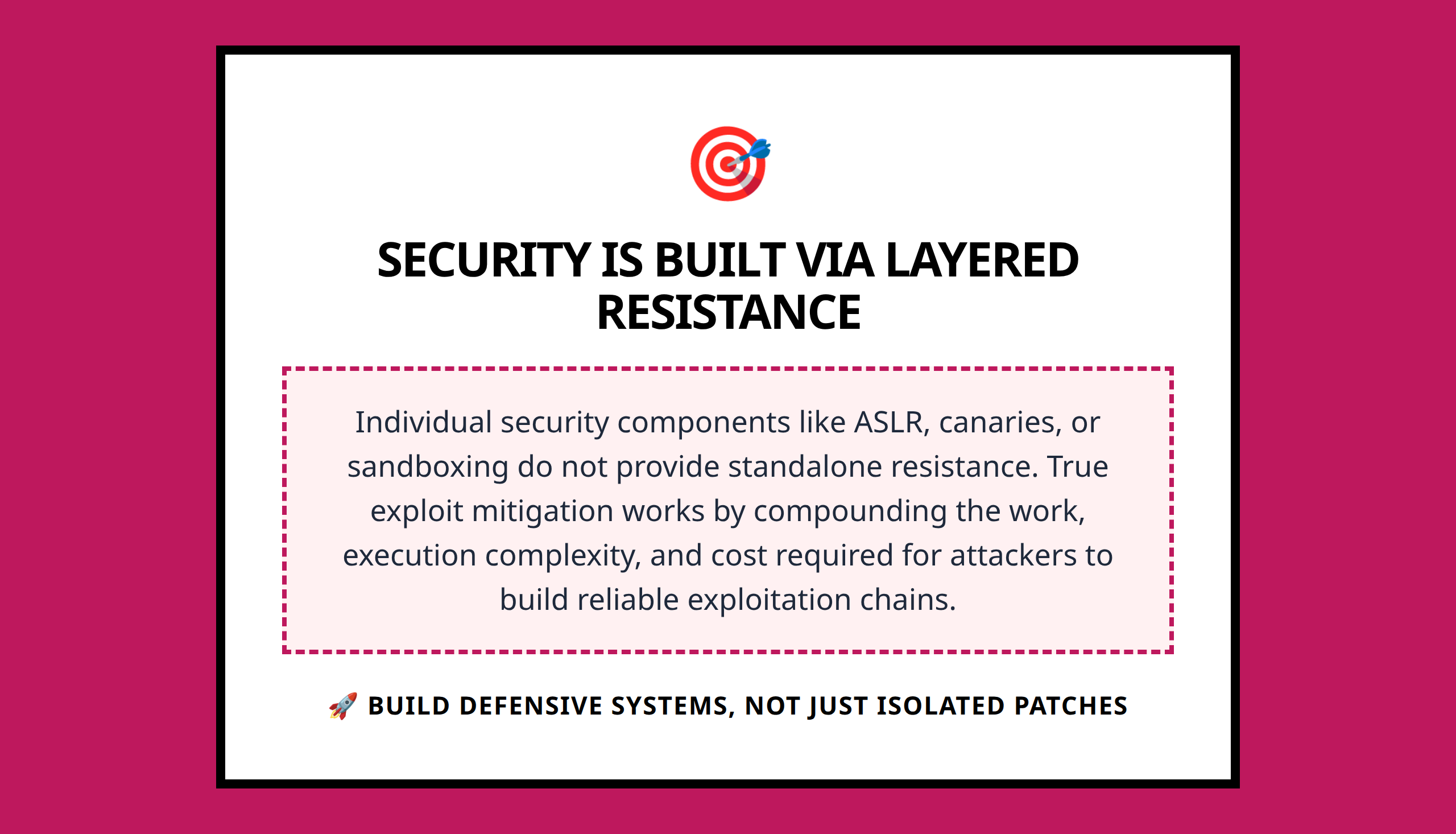
The Most Important Defense Is the Layering Itself
I think the biggest misunderstanding in Android security is expecting one mitigation to solve exploitation completely.
That is not how the defensive model works.
Android security becomes stronger because multiple mitigations overlap:
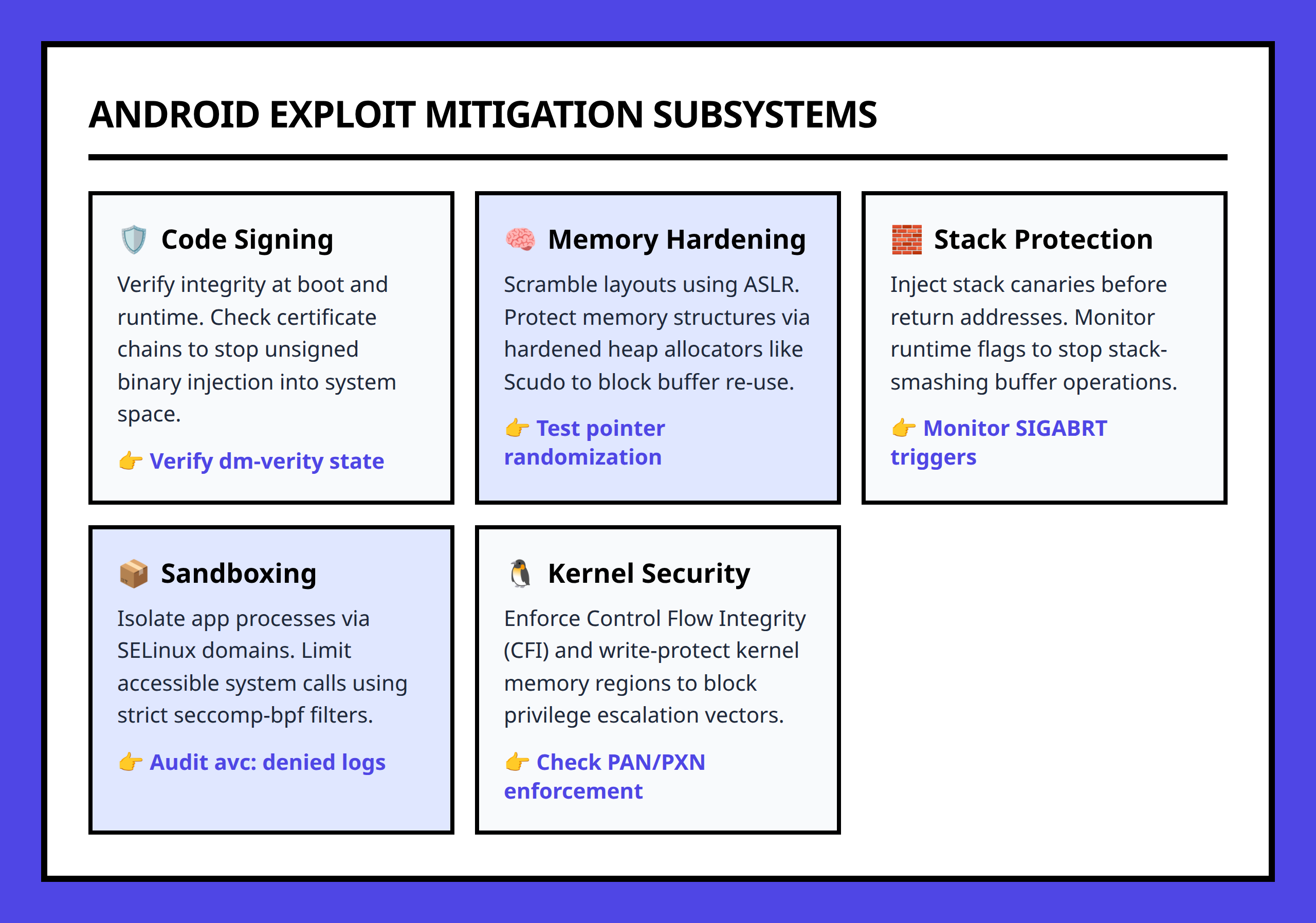
- Code signing restricts unauthorized execution
- ASLR disrupts predictable memory targeting
- Stack protections interrupt corruption paths
- Heap hardening destabilizes allocator abuse
- Sandboxing limits process authority
- Kernel protections reinforce low-level boundaries
Each layer assumes another layer might eventually fail.
That layered resistance model changes the economics of exploitation. Attackers often need more vulnerabilities, more precision, more environmental knowledge, and more stability than older systems required.
The operating system no longer assumes software will always behave safely. Instead, it tries to make unsafe behavior much harder to turn into reliable control.
- ASLR (Address Space Layout Randomization): A security technique that randomizes memory locations to make exploitation less predictable.
- Heap hardening: Defensive changes to memory allocation behavior intended to reduce reliable heap exploitation.
- Sandboxing: A method of isolating applications or processes to limit what they can access after compromise.
- Code signing: A trust mechanism that verifies software identity and integrity using cryptographic signatures.
- Privilege escalation: An attack where software gains more authority or access than originally intended.
- Kernel: The core part of the operating system responsible for managing memory, processes, hardware access, and security enforcement.
- Allocator: A system component that manages how memory is assigned and released during program execution.
- Mitigation bypass: A technique used to weaken or work around a security protection.
References:
- https://www.youtube.com/watch?v=ey_5urNAp9k
- https://www.youtube.com/watch?v=Rq52WMi-Ats
- https://www.youtube.com/watch?v=EkL1sDMXRVk
- https://developer.android.com/privacy-and-security/security-tips
- https://medium.com/@hiren6997/5-modern-android-security-practices-you-cant-ignore-in-2025-6560558be99e
- https://docs.samsungknox.com/admin/fundamentals/whitepaper/samsung-knox-mobile-security/system-security/defeat-exploit/
- https://www.bitsight.com/blog/android-exploits-vulnerabilities-cisa
- https://www.guardsquare.com/blog/android-security-threat-best-practices
- https://android-developers.googleblog.com/2018/06/compiler-based-security-mitigations-in.html
- https://medium.com/android-alchemy/the-2026-android-security-playbook-practical-techniques-to-prevent-data-leaks-and-reverse-89778d6519f1
- https://source.android.com/docs/security/overview/updates-resources
- https://surfshark.com/blog/do-i-need-antivirus-for-android
- https://keepandroidopen.org/cta/
- https://www.vu.edu.au/about-vu/news-events/vu-blog/10-easy-ways-to-protect-yourself-from-cyber-attacks
- https://www.cybersecurity-insiders.com/top-5-android-cyber-threats-of-2025-what-you-need-to-know/