Cognitive biases rarely feel irrational while they are happening. Most of the time they feel fast, obvious, emotional, and correct. The hard part is noticing when your brain is simplifying reality in ways that quietly push you toward the wrong conclusion.
I used to think bad decisions mostly came from missing information. The older I get, the less I believe that. A lot of poor decisions happen because the brain wants speed, certainty, comfort, or emotional protection long before it wants accuracy.
That matters because most modern mistakes are not life-or-death emergencies. Yet many of us still react as if they are. We answer emails too quickly, defend weak opinions too aggressively, panic during market drops, trust stories more than data, and become overly confident after a few lucky outcomes.
The pattern behind these mistakes is surprisingly consistent. Once I started looking for the mechanisms underneath them, I noticed the same distortions appearing again and again.
Takeaways
- Most cognitive biases come from fast mental shortcuts that evolved for survival, not accuracy.
- Biases often protect self-esteem, simplify reality into stories, or lock in snap judgments.
- The best correction is usually a deliberate pause before acting.
- You can often detect bias by checking your emotional certainty, not just your logic.
Your Brain Was Built for Survival Speed, Not Careful Judgment
The brain evolved to make rapid decisions under pressure. That was useful when humans faced immediate physical threats. If something moved in the bushes, hesitation could be dangerous.
Modern life creates very different problems. Most decisions now involve uncertainty, delayed consequences, social interpretation, probability, or long-term tradeoffs. Those situations reward careful thinking, but the brain still defaults toward speed.
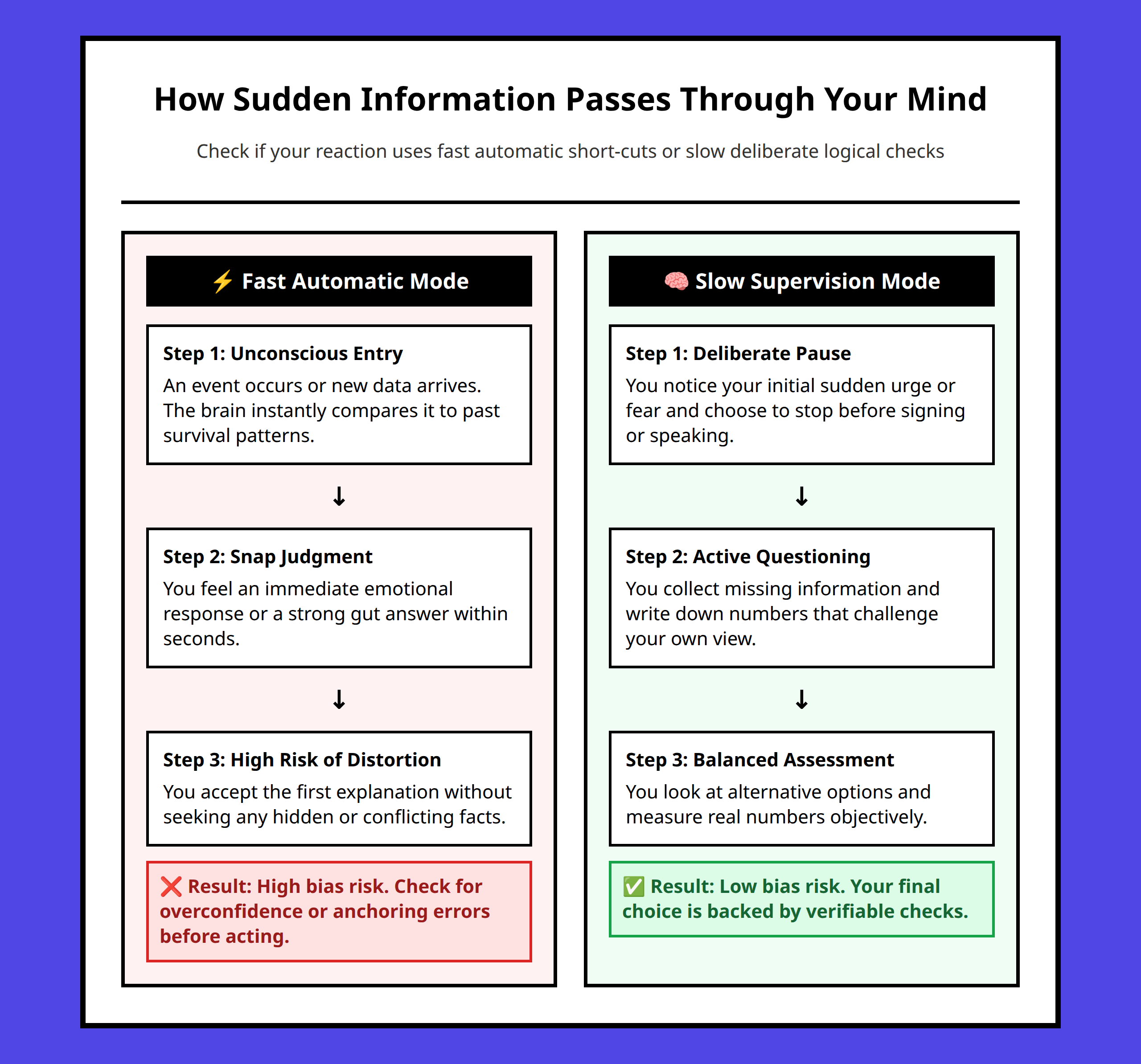
I find it useful to think of the brain as having two modes.
The first mode is fast, instinctive, and automatic. It jumps to conclusions quickly. The second mode is slower and more analytical. It takes effort and time, which is exactly why people often avoid using it unless something forces them to stop.
The trouble is that fast thinking feels confident. A rushed judgment can feel emotionally convincing long before it has been properly examined.
You can see this in ordinary situations:
- A manager reads one negative message from a client and immediately assumes the whole project is failing.
- An investor sees a stock rise for two weeks and starts believing they have special market insight.
- A student performs well on one exam and suddenly feels fully prepared for the next one.
In each case, the brain creates a simple interpretation before enough evidence exists to support it.
That does not mean fast thinking is useless. Many daily tasks depend on it. The problem appears when instinctive reactions quietly take over decisions that actually need slower reasoning.
The Three Patterns I Look for Most Often
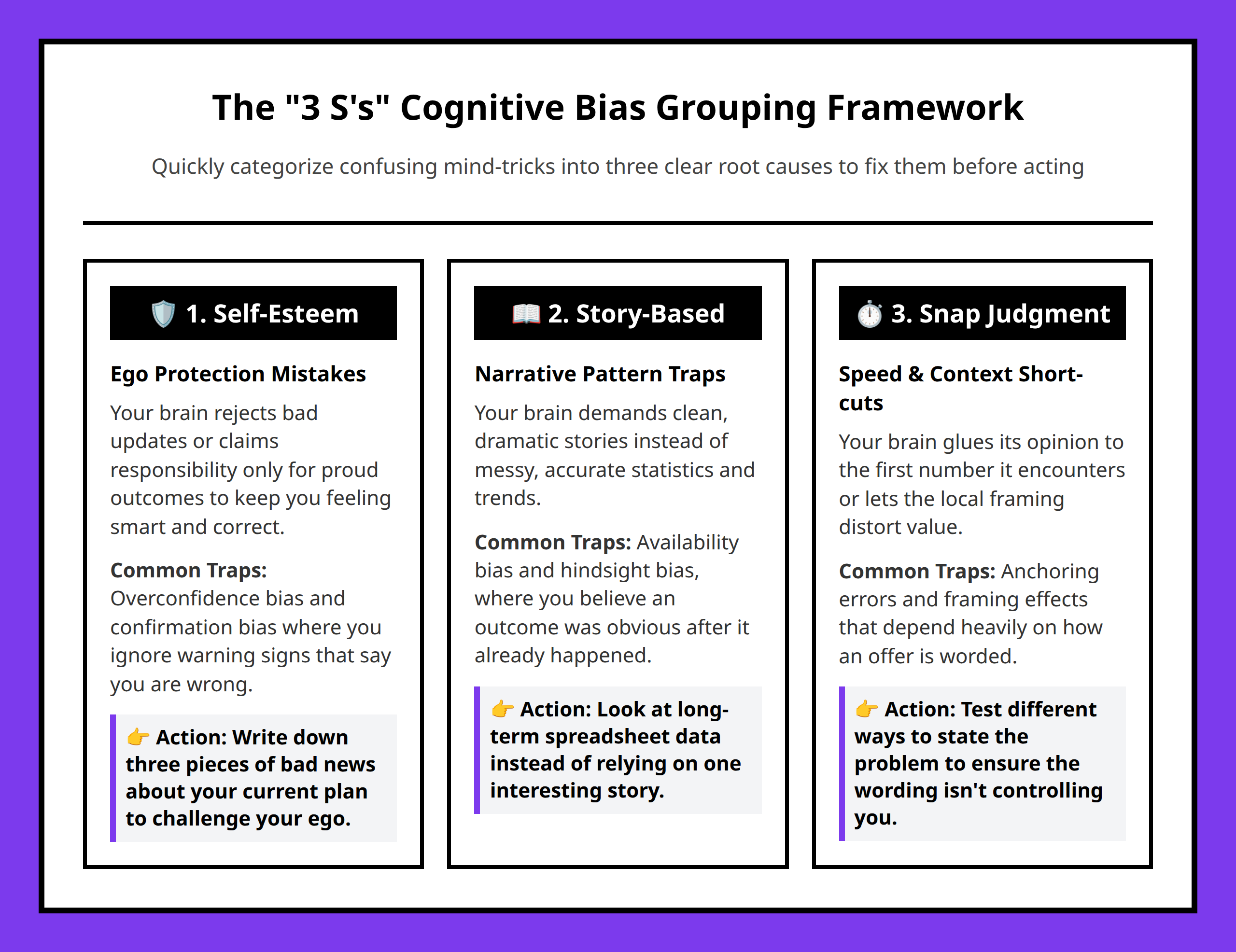
One reason cognitive biases become overwhelming is that there are so many of them. Hundreds have been identified. Memorizing long lists is rarely practical.
I prefer using a simpler framework built around three recurring patterns:
- Self-esteem protection
- Stories instead of statistics
- Snap judgments
These three tendencies explain a surprising amount of human behavior.
1. Self-esteem protection
People naturally want to feel competent, intelligent, and justified.
That creates distortions almost immediately. Good outcomes become evidence of skill. Bad outcomes become evidence of bad luck, unfair circumstances, or unusual exceptions.
I notice this most after success. Failure usually forces reflection. Success often shuts it down.
Imagine someone who made money during a strong market rally. It becomes easy for them to believe they are highly skilled at investing, even if nearly everything was rising at the same time.
The dangerous part is not confidence itself. The dangerous part is believing positive outcomes automatically prove good judgment.
When I catch myself feeling unusually certain after a win, I try to ask a harder question:
Would I still believe this decision was smart if the result had gone badly?
That question often exposes how much hindsight and ego are shaping the interpretation.
2. Stories instead of statistics
The brain prefers clean narratives over messy probabilities.
People like explanations that feel coherent and emotionally satisfying, even when the evidence is weak.
This happens constantly in business, politics, investing, and personal relationships.
A company succeeds and people immediately create a polished story explaining why its leadership was brilliant. Another company fails and people build an equally confident narrative about poor management.
But reality is usually more chaotic than the story makes it appear.
I try to become cautious whenever an explanation sounds too neat. Real systems are often complicated, uncertain, and partly random.
One useful warning sign is when somebody explains a complicated outcome with complete certainty and no acknowledgment of uncertainty, luck, or competing factors.
3. Snap judgments
The brain anchors quickly and then defends the initial conclusion.
This happens so fast that many people mistake the first emotional reaction for objective analysis.
A common example appears during negotiations or pricing.
If someone sees a $200 shirt first, a later $50 shirt suddenly feels reasonable, even if $50 is still expensive for a shirt. The first number changes the perception of the second one.
The original anchor does not need to make sense. It only needs to appear first.
I see similar effects when people form quick opinions about coworkers, products, investments, or public figures. The initial impression becomes the reference point for everything that follows.
Once that happens, new evidence often gets interpreted in ways that protect the original judgment.
Bias Usually Feels Like Certainty
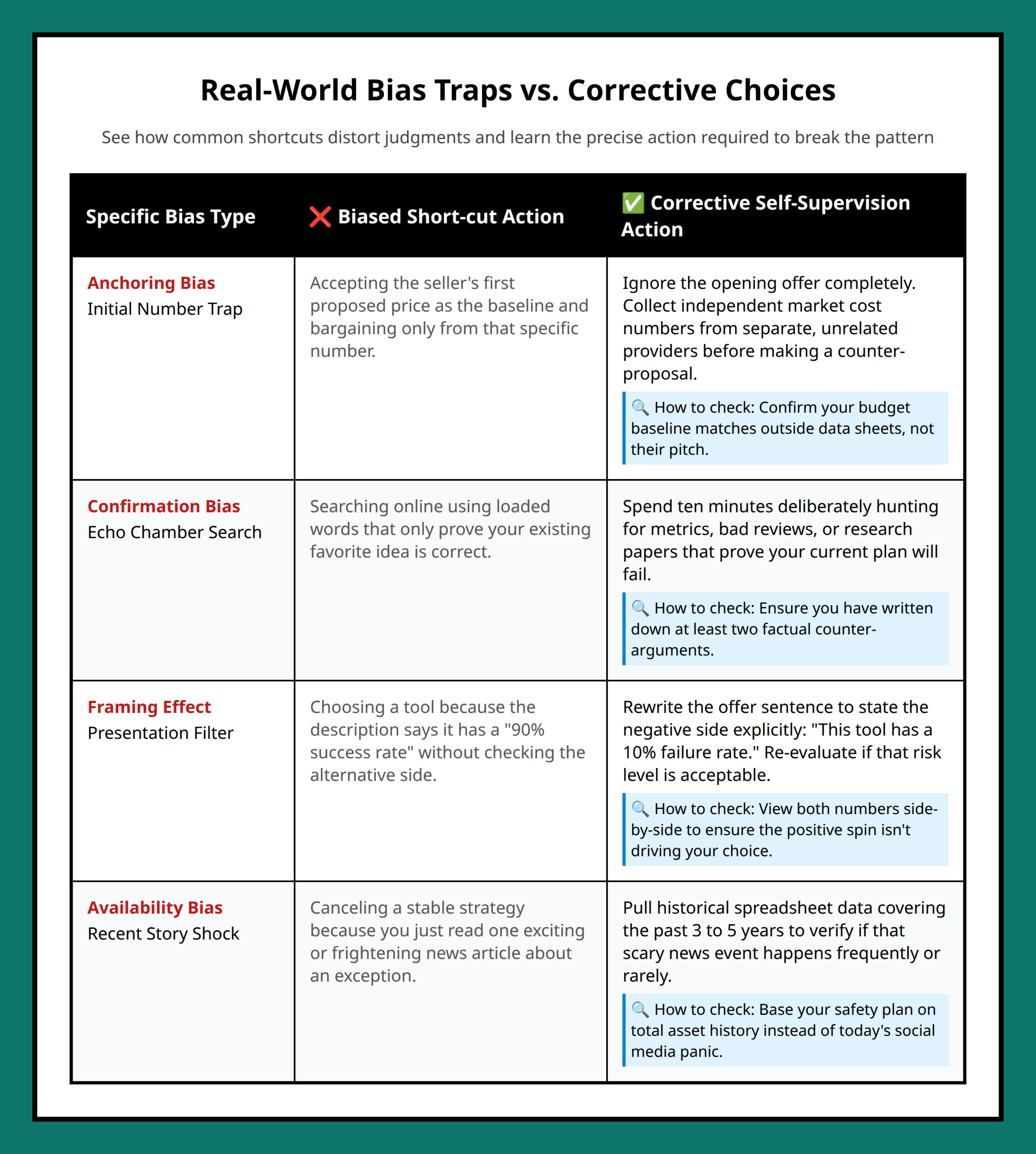
One of the hardest parts about cognitive bias is that it rarely feels irrational in the moment.
Most biases feel emotionally smooth.
The brain likes conclusions that reduce tension and uncertainty. That emotional relief can create the illusion that a judgment is correct.
I have learned to pay attention to emotional speed. If I instantly feel completely certain about a complicated situation, I usually slow down and examine it more carefully.
That does not automatically mean the conclusion is wrong. But fast certainty is often a signal that the brain is simplifying something aggressively.
Some practical warning signs include:
- Feeling defensive before hearing opposing evidence
- Wanting quick confirmation from people who already agree
- Treating one recent experience as a permanent pattern
- Ignoring probability because a story feels emotionally convincing
- Assuming good results automatically prove good judgment
- Making decisions while angry, stressed, exhausted, or emotionally charged
I do not treat these signs as proof that my thinking is wrong. I treat them as indicators that slower thinking may be necessary.
Physical State Quietly Changes Judgment Too
People often treat thinking as purely mental, but decision quality is heavily influenced by physical state.
Stress, fatigue, hunger, frustration, and sleep deprivation all affect how the brain processes information.
That matters because cognitive biases become stronger when mental energy drops.
A tired person is more likely to rely on shortcuts. A stressed person is more likely to jump toward certainty. An emotionally overwhelmed person is more likely to protect existing beliefs instead of evaluating new information carefully.
I notice this most late at night or during stressful work periods. Small problems start looking larger. Ambiguous messages sound hostile. Risk feels harder to evaluate calmly.
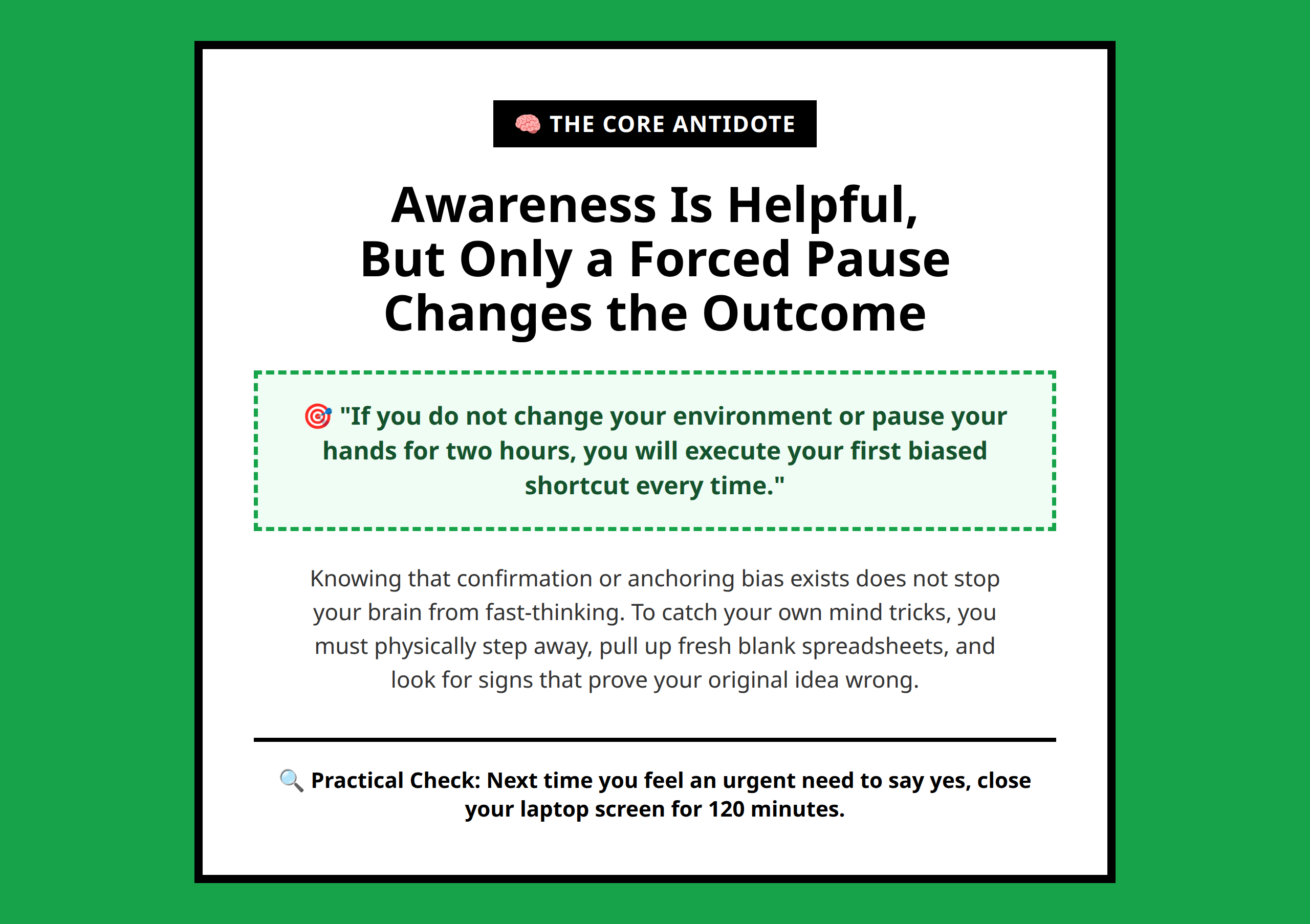
Sometimes the smartest decision is simply delaying an important judgment until the brain is functioning more clearly.
That pause sounds simple, but many avoid it because immediate reactions feel productive. In reality, quick reactions often create extra damage that later requires cleanup.
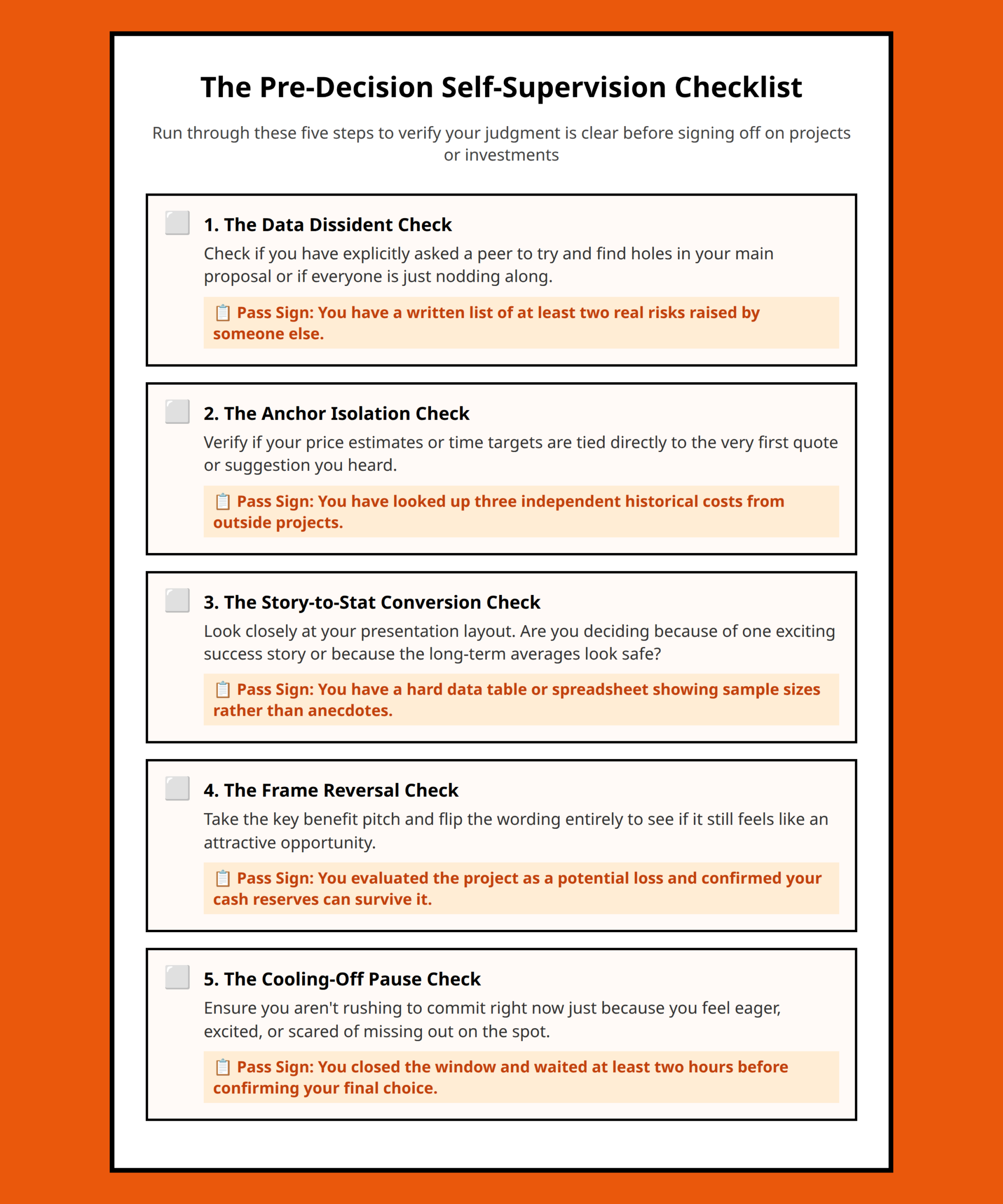
How I Try to Slow My Thinking Before Important Decisions
I do not believe cognitive biases can be eliminated completely. They are part of normal human thinking.
The practical goal is catching them early enough to reduce their influence.
When a decision feels important, I try to create a small interruption between reaction and action.
That interruption might include:
- Waiting before responding emotionally
- Writing down alternative explanations
- Looking for evidence that contradicts my first impression
- Separating outcome quality from decision quality
- Checking whether stress or exhaustion is shaping the reaction
- Asking what assumptions feel emotionally attractive
Even a short pause changes the quality of thinking.
The goal is not to become cold or emotionless. Emotions contain useful information. The problem begins when emotions quietly replace analysis.
I also think it helps to stop treating every instinctive thought as part of your identity.
The brain produces fast reactions automatically. Some are insightful. Some are biased, impulsive, defensive, or unfair. Slower reflection is often the more accurate representation of who a person actually wants to be.
The Real Skill Is Not Intelligence. It Is Self-Supervision
Many intelligent people still make terrible decisions because intelligence alone does not protect against cognitive bias.
In some cases, intelligence simply helps people defend weak conclusions more confidently.
The more useful skill is self-supervision.
That means noticing when the brain is protecting ego, simplifying reality into stories, or rushing toward certainty before enough evidence exists.
I think this is why a deliberate pause matters so much. Most cognitive distortions lose some of their power once they are examined directly.
The pause does not need to be dramatic. Sometimes it is just enough space to ask:
Am I reacting to reality, or to the story my brain created about reality?
That question alone can prevent a surprising number of bad decisions.
- Cognitive bias: A predictable mental distortion that affects judgment and decision-making.
- Fast thinking: Automatic, instinctive thinking that reacts quickly but can oversimplify situations.
- Slow thinking: More deliberate and analytical thinking that evaluates information carefully.
- Anchoring: A bias where the first piece of information becomes a reference point that shapes later judgments.
- Confirmation bias: The tendency to favor information that supports existing beliefs while ignoring conflicting evidence.
- Hindsight bias: The tendency to believe past events were more predictable after they already happened.
- Overconfidence bias: The tendency to overestimate personal ability, judgment, or knowledge.
- Narrative fallacy: The habit of creating simple stories to explain complicated events.
- Availability bias: A bias where recent or memorable information feels more important than it actually is.
References:
- https://www.youtube.com/watch?v=6s-ErMcuqLQ
- https://www.youtube.com/watch?v=zq6s2TK3JVc
- https://www.youtube.com/watch?v=Q5eTVOFTPM8
- https://hbr.org/2015/05/outsmart-your-own-biases
- https://medium.com/illumination/a-practical-guide-to-handling-cognitive-biases-effectively-7895739f4f62
- https://www.health.harvard.edu/blog/how-to-recognize-and-tame-your-cognitive-distortions-202205042738
- https://www.gyst.com.au/blog/cognitive-biases-impact-leadership-decision-making
- https://pmc.ncbi.nlm.nih.gov/articles/PMC10071311/
- https://health.clevelandclinic.org/cognitive-bias
- https://mbs.edu/news/how-to-override-unconscious-bias-to-make-better-decisions
- https://www.reddit.com/r/PsychologyTalk/comments/1kc11i4/how_do_we_recognize_and_overcome_cognitive_biases/
- https://www.quora.com/What-specific-strategies-can-individuals-employ-to-recognize-and-overcome-their-own-cognitive-biases-when-forming-opinions-on-complex-social-issues
- https://www.quora.com/What-are-some-ways-to-overcome-our-own-cognitive-biases-while-trying-to-convince-others-they-are-wrong-about-theirs-especially-when-it-comes-to-politics-How-can-we-avoid-confirmation-bias
- https://www.verywellmind.com/what-is-a-cognitive-bias-2794963
- https://www.nea.org/recognizing-your-biases
- https://naviminds.com/cognitive-bias/
- https://www.betterup.com/blog/cognitive-bias
- https://pmc.ncbi.nlm.nih.gov/articles/PMC8763848/