Human beings naturally prefer stories over statistics. A clear narrative feels emotionally satisfying and easier to remember, even when the underlying evidence is weak, incomplete, or misleading.
I think this explains a surprising amount of bad judgment in investing, business, media, and everyday decision-making. People rarely struggle because they cannot access information. More often, they struggle because a compelling story feels more convincing than uncertainty, probability, or incomplete data.
The difficult part is that stories do serve a useful purpose. Narratives help people organize complex events into something understandable. Without them, reality would feel chaotic and hard to navigate.
The problem begins when the brain starts confusing a satisfying explanation with an accurate explanation.
Takeaways
- The brain naturally prefers coherent stories over uncertain statistical thinking.
- Narratives create emotional certainty even when evidence is weak.
- Confirmation bias, hindsight bias, and framing often grow out of narrative thinking.
- Probabilistic thinking becomes harder when a story already feels emotionally complete.
Why the Brain Wants Stories So Badly
Human beings are pattern-seeking creatures.
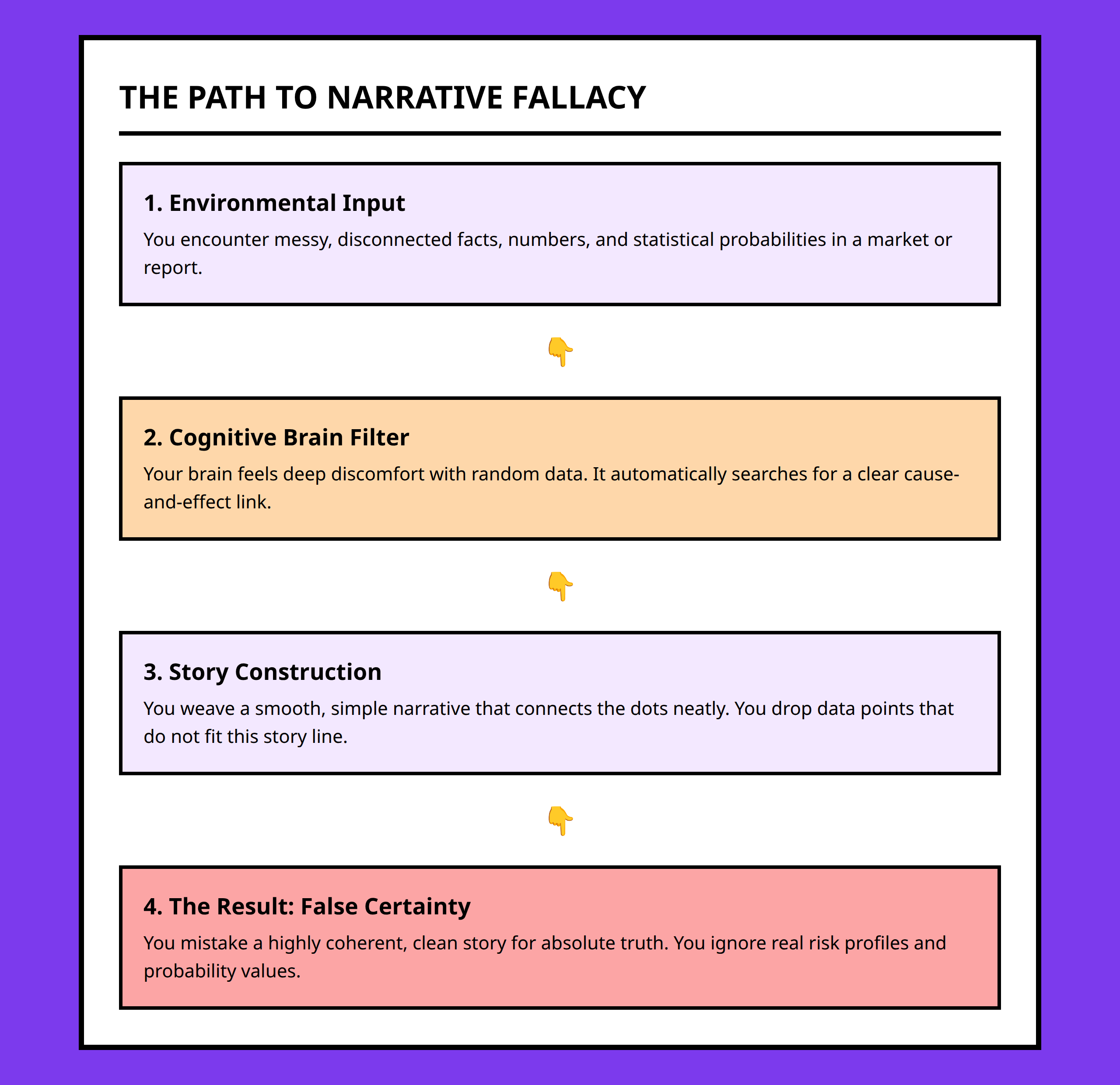
The brain constantly tries to connect events into understandable sequences with causes, meanings, and explanations. Stories simplify complexity into something emotionally manageable.
I think many people underestimate how automatic this process is.
When something major happens, the mind immediately starts asking:
- What caused this?
- Who is responsible?
- What does this mean?
- How does this fit into a larger pattern?
Those questions are natural. The problem is that reality often contains randomness, incomplete information, and overlapping causes that do not fit neatly into a simple narrative.
Stories reduce that discomfort.
A messy situation becomes easier to tolerate once it feels explainable.
That emotional relief is part of why narrative thinking becomes so persuasive even when the evidence underneath the story is weak.
Stories Feel More Convincing Than Statistics
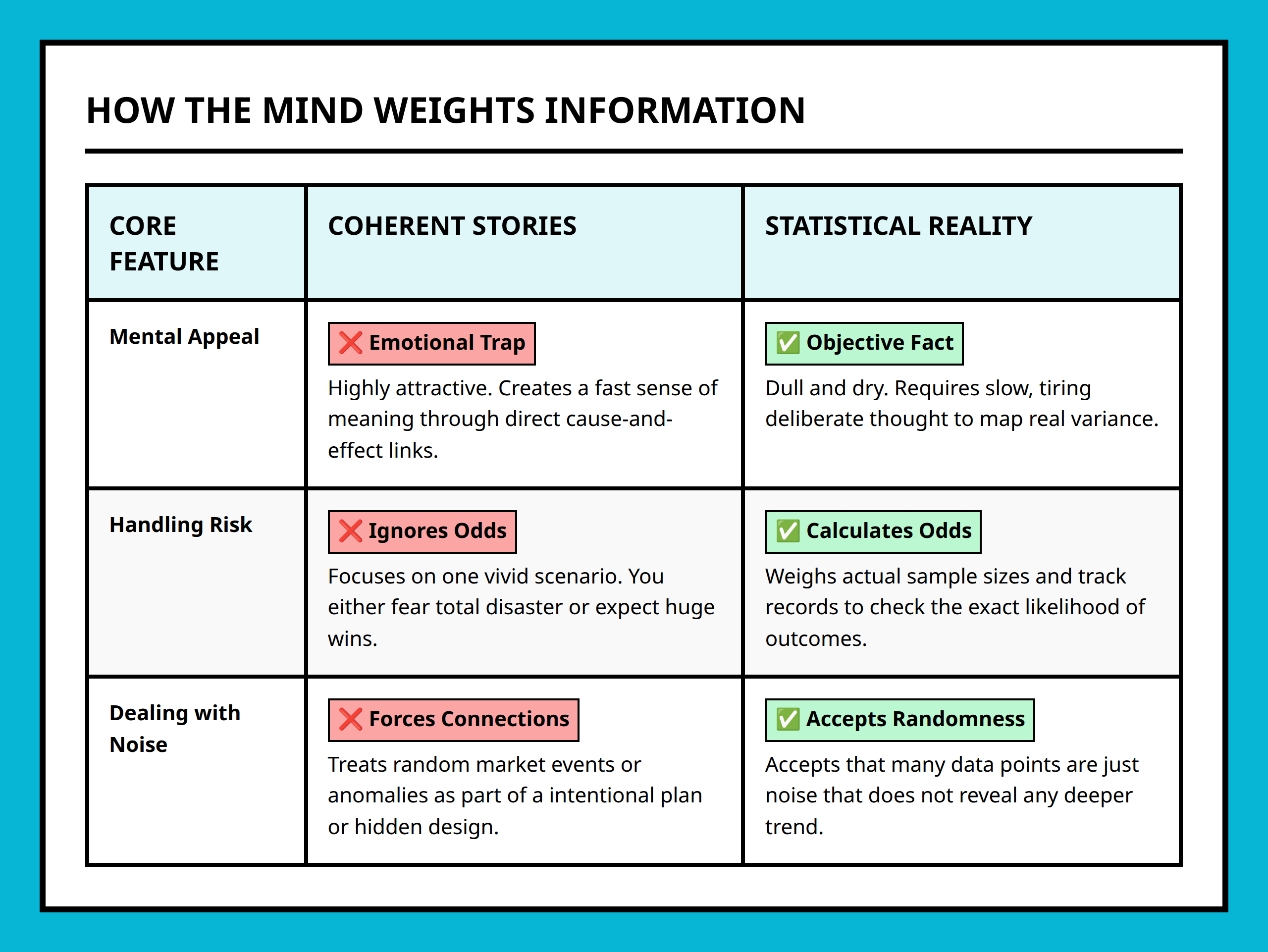
Statistics require interpretation. Stories already feel meaningful.
I notice this difference most clearly when people discuss uncertain outcomes like business success, investing, or social trends.
A statistical explanation usually sounds cautious:
“Several factors probably contributed, and luck may have played a role.”
A narrative explanation sounds cleaner:
“The company succeeded because the founder was visionary and ignored conventional thinking.”
The second explanation often feels more satisfying even when the first one is probably closer to reality.
The narrative creates emotional clarity. It turns uncertainty into confidence.
This is one reason stories spread faster than nuanced analysis. The brain prefers coherence over ambiguity.
A vivid story about one dramatic event can easily overpower broader statistical evidence because stories feel concrete and human while probabilities feel abstract.
Narrative Thinking Creates False Certainty
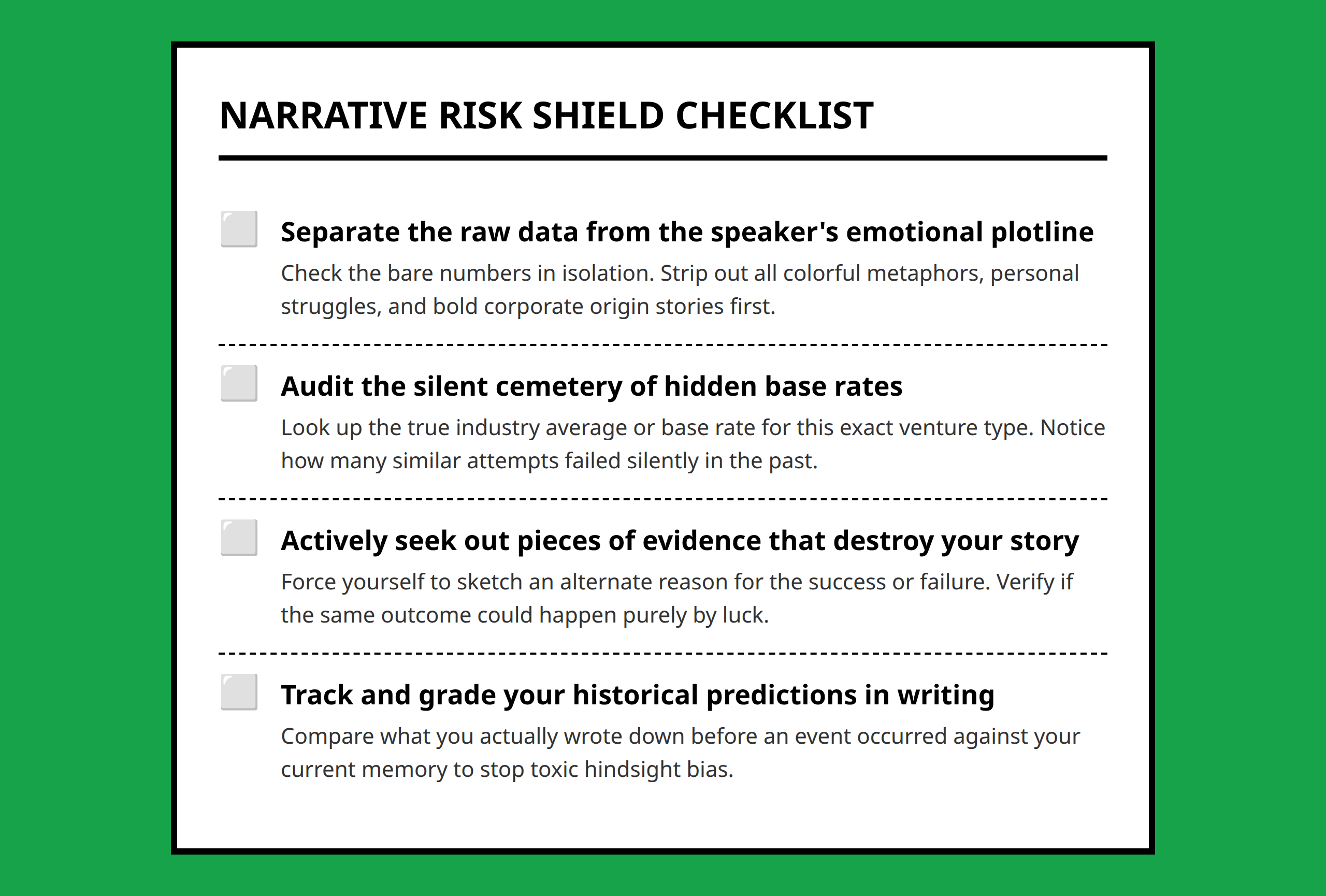
One of the biggest dangers of narrative-driven thinking is that it creates the illusion of understanding.
Once a story feels coherent, people often stop questioning it.
I think this is especially risky after major successes or failures.
Imagine a startup grows rapidly over two years. Very quickly, people begin building stories around the outcome:
- The leadership was exceptional.
- The culture was innovative.
- The strategy was inevitable.
- The founders understood the future better than competitors.
Some of those explanations may contain truth. But successful outcomes often involve many hidden variables, including timing, luck, market conditions, and randomness.
The narrative usually appears after the result becomes visible.
That sequence matters because people often mistake retrospective storytelling for predictive understanding.
Once the outcome is known, the brain rewrites uncertainty into inevitability.
This creates false confidence about future predictions because the story feels cleaner than reality ever was.
Why Narrative Fallacy Connects to Other Cognitive Biases
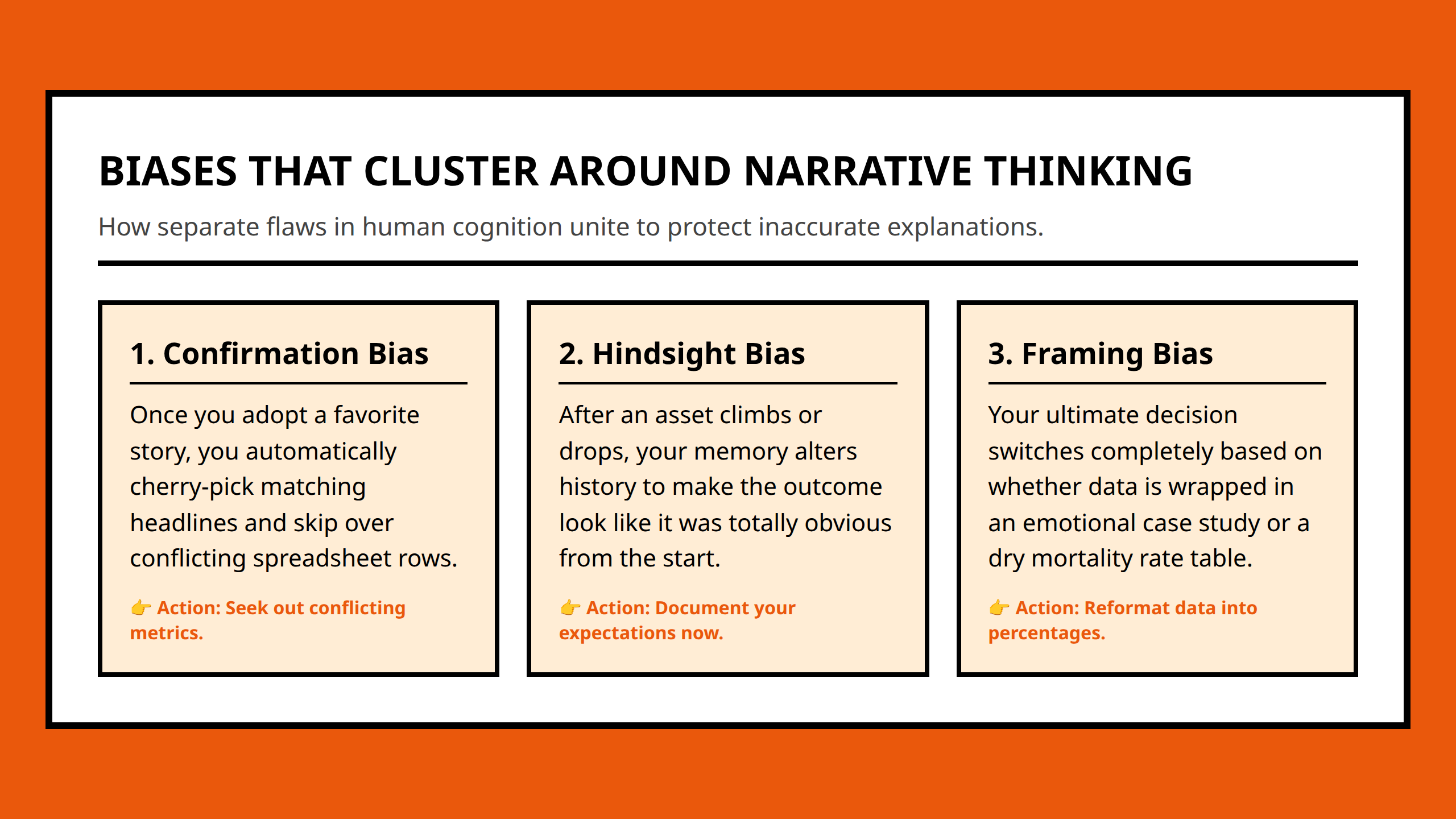
Narrative thinking rarely operates alone.
Many common cognitive biases become stronger because the brain wants a story that feels emotionally complete.
Confirmation bias is one example.
Once people adopt a narrative, they often start filtering information selectively. Evidence supporting the story feels important. Contradictory evidence feels less convincing or gets ignored completely.
I notice this frequently when people become emotionally attached to a market prediction, business idea, or public figure. The original story quietly becomes the lens through which all new information gets interpreted.
Hindsight bias also connects strongly to narrative thinking.
After events happen, people often reconstruct the past in ways that make the outcome seem predictable all along.
A complicated chain of uncertainty suddenly becomes a neat explanation with obvious warning signs and clear causes.
Framing works similarly.
The same facts can produce different interpretations depending on the story surrounding them. Emotional presentation changes how information feels before logical analysis fully begins.
In many cases, the brain is not evaluating isolated facts objectively. It is evaluating how well those facts fit an emotionally satisfying narrative.
The Brain Often Confuses Pattern Recognition With Understanding
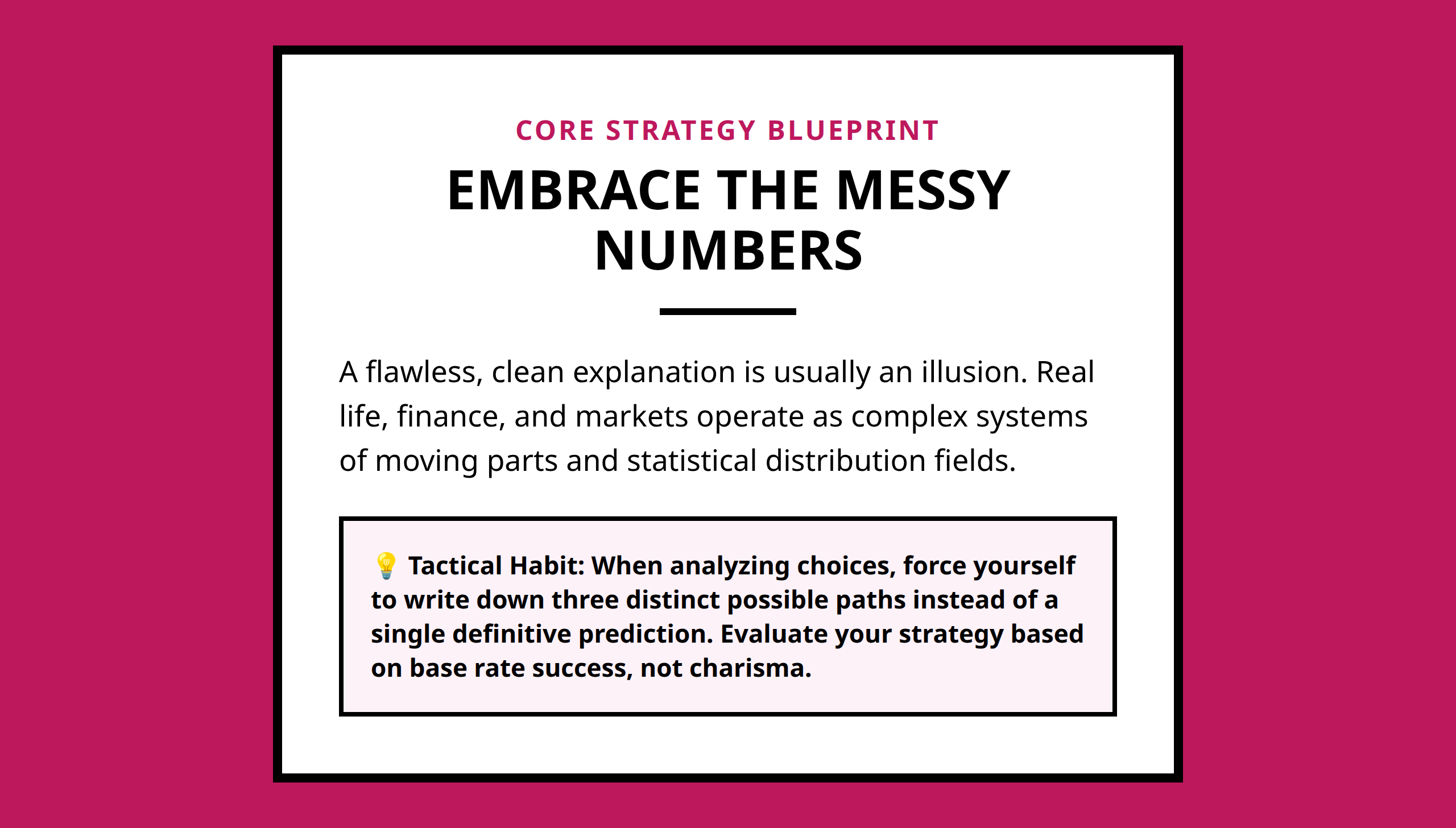
Humans are remarkably good at finding patterns, even when patterns barely exist.
That ability helped survival historically because recognizing meaningful threats and opportunities mattered.
But the same instinct can create distorted conclusions.
I think this becomes especially dangerous when people start treating coincidence or short-term trends as proof of deeper meaning.
For example, an investor may experience several successful trades in a row and begin building a story about personal market insight. A manager may see one productivity trend and assume a permanent organizational pattern exists.
The brain quickly transforms limited observations into larger explanations.
That transformation feels intelligent because the story creates structure. But structure is not the same thing as proof.
Sometimes events really do reflect meaningful patterns. Sometimes they mostly reflect randomness that the brain organized into narrative form afterward.
Why Probabilistic Thinking Feels Emotionally Unsatisfying
Probability forces people to live with uncertainty.
That is uncomfortable for many minds.
I think this is why probabilistic thinking often loses emotionally against storytelling. Probability admits limits:
- The outcome may change.
- Multiple explanations may exist.
- Luck may matter.
- The evidence may still be incomplete.
Stories remove much of that discomfort by creating a sense of resolution.
A narrative gives people the emotional feeling that reality now makes sense.
But emotional satisfaction and accurate judgment are not always aligned.
I try to become cautious whenever an explanation feels too perfect, too complete, or too emotionally neat.
Real systems are often messier than the stories built around them.
How I Try to Resist Narrative-Driven Thinking
I do not think human beings can stop using stories completely. Narratives are part of how people organize experience.
The more practical goal is learning when stories are replacing careful thinking.
When I encounter a highly convincing explanation, I try to slow down and ask a few questions:
- What uncertainty is being ignored?
- Could luck or randomness explain part of this outcome?
- Does the story sound clearer because the result is already known?
- Am I evaluating evidence or simply reacting to narrative coherence?
I also think it helps to separate explanation from prediction.
Many stories sound persuasive after events occur. That does not mean the same people could have predicted the outcome beforehand with equal confidence.
The brain loves explanations that feel inevitable. Reality usually contains far more uncertainty than those explanations admit.
That is why probabilistic thinking matters even though it feels emotionally weaker than storytelling. It forces people to stay aware of uncertainty instead of replacing uncertainty with comforting narratives.
- Narrative fallacy: The tendency to create simple stories that explain complex events too neatly.
- Confirmation bias: Favoring information that supports existing beliefs while ignoring conflicting evidence.
- Hindsight bias: Believing past events were more predictable after they already happened.
- Framing: Presenting information in a way that changes interpretation without changing the facts themselves.
- Probability: The likelihood that a certain outcome will happen.
- Probabilistic thinking: Evaluating situations in terms of uncertainty, likelihood, and possible outcomes rather than certainty.
- Cognitive bias: A predictable mental shortcut or distortion that affects judgment and decision-making.
References:
- https://www.reddit.com/r/PersuasionExperts/comments/1mam5yf/why_do_stories_persuade_us_better_than_facts/
- https://www.reddit.com/r/PersuasionExperts/comments/1mam5yf/why_do_stories_persuade_us_better_than_facts/n5fipaf/
- https://www.forbes.com/sites/chriswestfall/2020/10/28/why-storytelling-beats-statistics-but-only-100-of-the-time/
- https://velvetchainsaw.com/2019/01/17/we-prefer-stories-to-stats-the-dark-side-of-stories/
- https://medium.com/@contact.zsolt.farkas/why-stories-beat-facts-even-when-theyre-wrong-63b421c6c918
- https://paulitaylor.com/2019/08/16/why-story-will-always-beat-statistics/
- https://www.psychologytoday.com/au/blog/beyond-school-walls/202504/mistaking-anecdotes-for-facts
- https://cepr.org/voxeu/columns/stories-statistics-and-memory
- https://archive.nytimes.com/opinionator.blogs.nytimes.com/2010/10/24/stories-vs-statistics/
- https://www.library.hbs.edu/working-knowledge/looking-to-leave-mark-memorable-leaders-tell-stories-dont-spout-statistics
- https://www.linkedin.com/pulse/why-stories-better-than-facts-factsfacts-robert-bartram
- https://womensleadership.stanford.edu/resources/voice-influence/harnessing-power-stories
- https://medium.com/@santosh_64510/people-forget-facts-but-remember-stories-the-power-of-narrative-in-human-connection-6886e004140b