Reciprocity is one of the strongest social forces in human behavior. Even small gifts, favors, or gestures can create feelings of obligation that quietly influence decisions in marketing, relationships, negotiations, and everyday interactions.
I used to think persuasion mostly worked through logic. The more I paid attention to real behavior, the more obvious another pattern became: people often respond less to arguments than to social obligation.
That obligation does not always feel manipulative. In many cases, reciprocity helps societies function smoothly. People cooperate, share resources, help each other, and maintain trust partly because returning favors feels morally correct.
The problem begins when that instinct gets engineered deliberately.
Takeaways
- Reciprocity creates psychological pressure to return favors or kindness.
- Even small gifts can increase compliance and cooperation.
- Manipulative reciprocity works by creating emotional obligation before a request appears.
- Recognizing the obligation mechanism helps separate genuine generosity from strategic influence.
Why Reciprocity Exists in the First Place
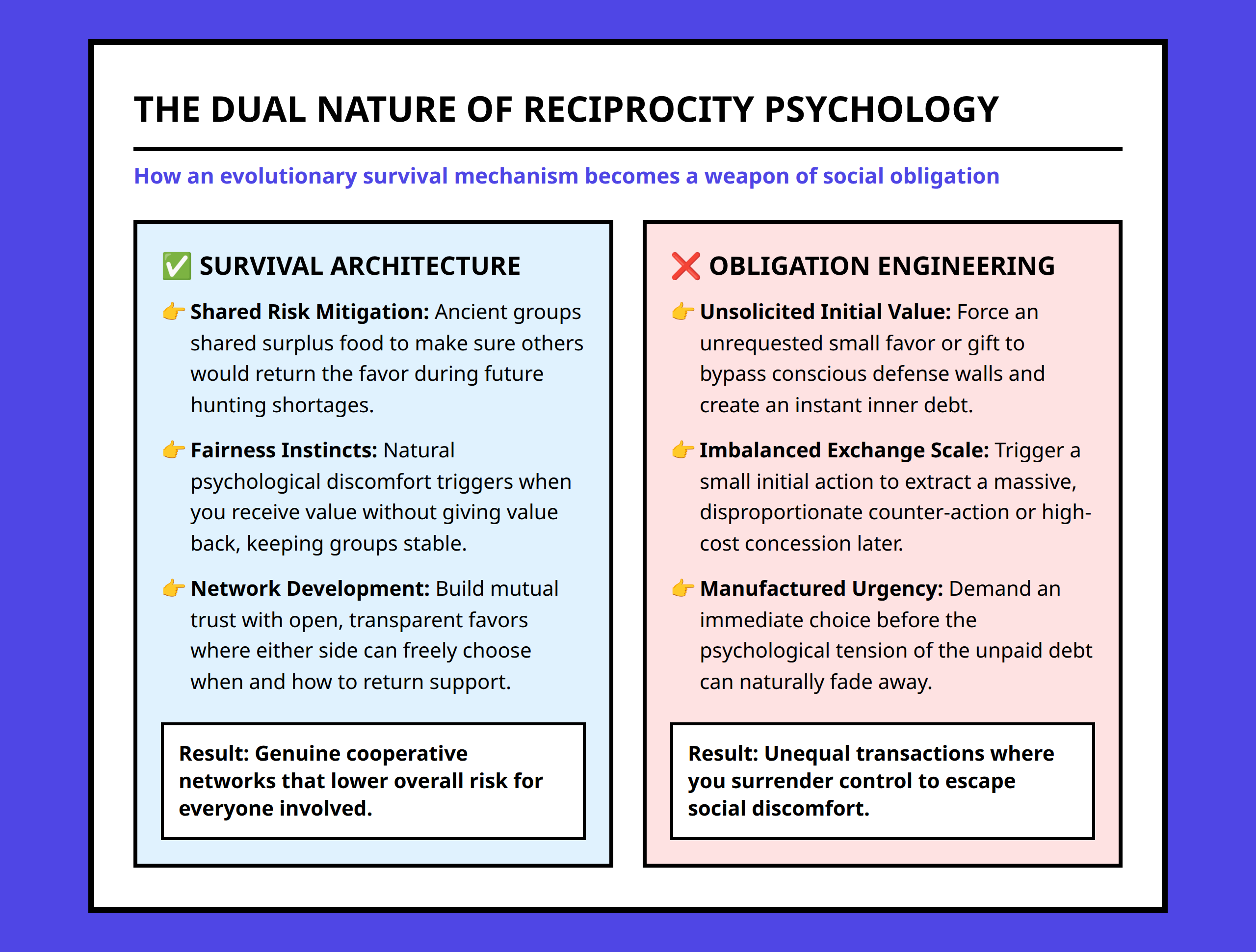
Reciprocity is deeply connected to human survival and cooperation.
For most of human history, people depended heavily on social groups. Sharing food, resources, protection, and support improved the chances of survival. Groups worked better when generosity was eventually returned instead of exploited.
Over time, fairness and obligation became emotionally powerful social instincts.
I think this is why reciprocity often feels automatic rather than rational. People usually do not sit down and calculate whether they “should” return a favor. The pressure appears emotionally almost immediately.
A coworker helps someone finish a difficult project late at night. Later, when that coworker asks for assistance, saying no suddenly feels uncomfortable even if the request creates inconvenience.
The obligation is not only logical. It feels social and emotional.
That emotional reaction is exactly what makes reciprocity so influential.
Why Small Gifts Can Produce Surprisingly Large Reactions
One of the most interesting parts of reciprocity psychology is that the original favor often does not need to be large.
Small gestures can still create meaningful psychological pressure.
I notice this effect most in ordinary situations people barely question anymore.
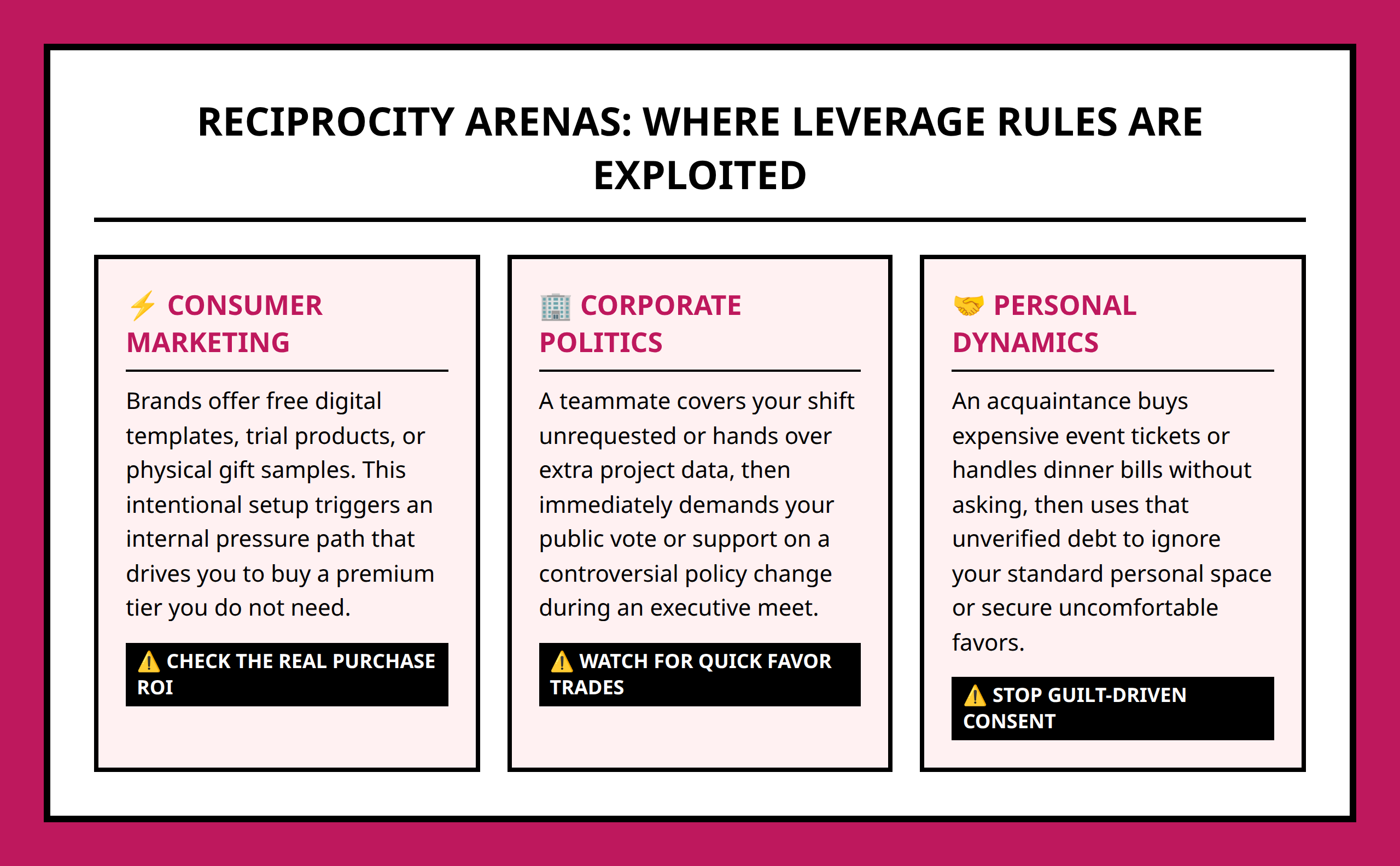
A store gives free samples. A website offers a “free” guide before asking for an email address. A salesperson provides unexpected help before introducing a product recommendation.
The exchange may look harmless on the surface. But the sequence matters.
The favor arrives first. The request arrives later.
Once someone receives something, many people begin feeling subtle pressure to respond cooperatively. Refusing afterward can feel socially uncomfortable even when the person never requested the original favor in the first place.
This is one reason free gifts often work better than aggressive persuasion. The emotional dynamic changes from confrontation to obligation.
The Holiday Card Experiment Reveals How Automatic Reciprocity Can Be
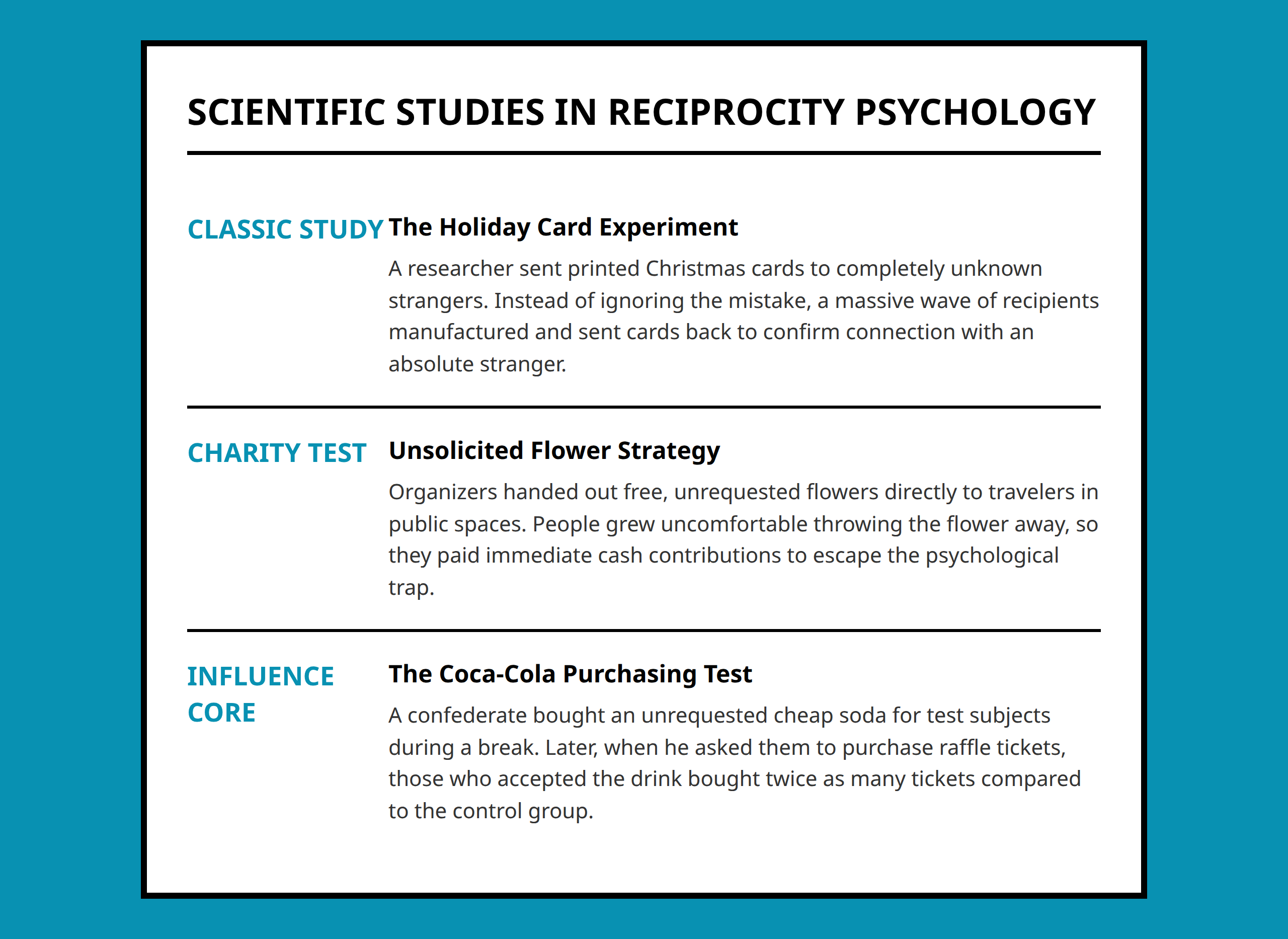
One fascinating example of reciprocity involves holiday cards.
In one experiment, people received holiday cards from strangers they did not know personally. A surprising number still responded by sending cards back.
What makes this example interesting is how little conscious analysis was involved.
The recipients were not carefully evaluating whether the relationship justified the effort. Many simply reacted to the social signal automatically.
I think this shows how deeply reciprocity is embedded in behavior. Even weak social gestures can trigger a desire to respond in kind.
The mechanism works because people generally want to avoid appearing selfish, unfair, or ungrateful.
That desire influences behavior even when the original interaction was minimal.
Charities Often Use Reciprocity Before Asking for Donations
Reciprocity appears frequently in fundraising and charity campaigns.
Some organizations send small gifts along with donation requests. It may be address labels, greeting cards, or inexpensive items included inside the envelope.
The financial value of the gift is usually tiny. But psychologically, it changes the interaction.
The request no longer feels completely one-sided.
I think many people underestimate how much that small shift matters emotionally. Receiving something first creates a subtle feeling that ignoring the request may violate fairness norms.
The interesting part is that the gift often works even when recipients never asked for it.
The obligation mechanism activates anyway.
This does not automatically make the tactic unethical. Reciprocity can encourage generosity and social cooperation in positive ways. But it does show how easily obligation can be engineered.
Manipulative Reciprocity Often Hides Behind Kindness
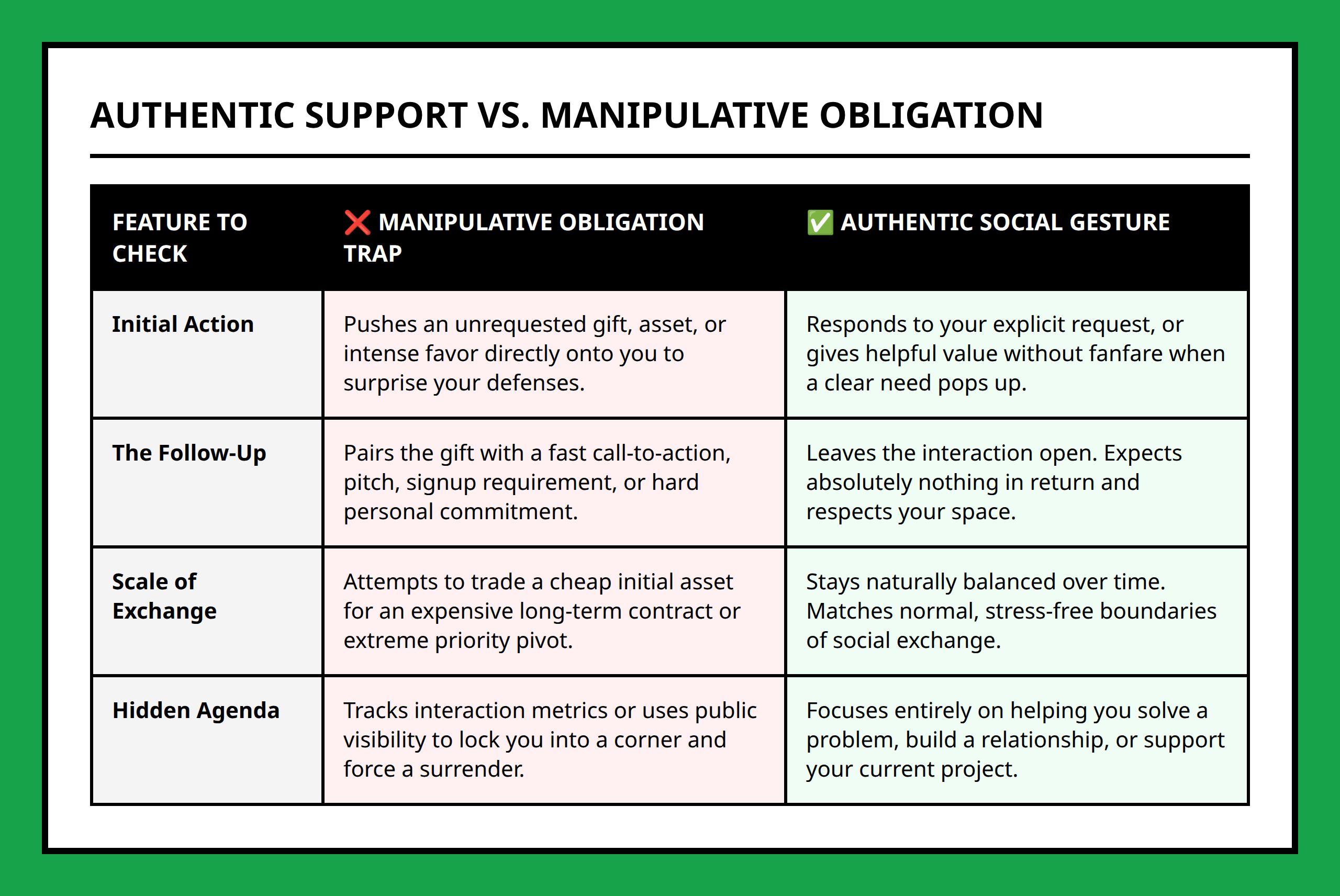
The hardest part about reciprocity is that manipulation rarely presents itself openly.
Most manipulative reciprocity starts with something that appears generous, friendly, or thoughtful.
That is what makes it psychologically effective.
I pay close attention whenever generosity feels unusually strategic or timed around a request.
For example, imagine a manager who rarely offers support suddenly becoming highly helpful right before asking employees to work unpaid overtime. Or imagine a salesperson investing heavy personal attention into a customer moments before closing pressure begins.
The kindness may still be real. But the timing changes the psychological environment.
Once obligation enters the interaction, people often become more willing to agree to things they otherwise would question more carefully.
This is especially true when someone fears appearing rude, selfish, or ungrateful.
Reciprocity Becomes Stronger When People Care About Social Identity
Reciprocity does not only operate through fairness. It also connects strongly to identity and reputation.
Most people want to see themselves as decent and cooperative.
I think this is why reciprocity pressure can feel surprisingly uncomfortable even during small interactions. Refusing to reciprocate may create internal tension because it conflicts with how people want to view themselves socially.
Imagine someone receiving repeated favors from a colleague while contributing very little in return. Even without open criticism, many people would begin feeling psychological discomfort.
The discomfort comes partly from fairness instincts and partly from identity protection.
People generally want to believe they are the kind of person who responds appropriately to generosity.
That self-image can become leverage when reciprocity is used strategically.
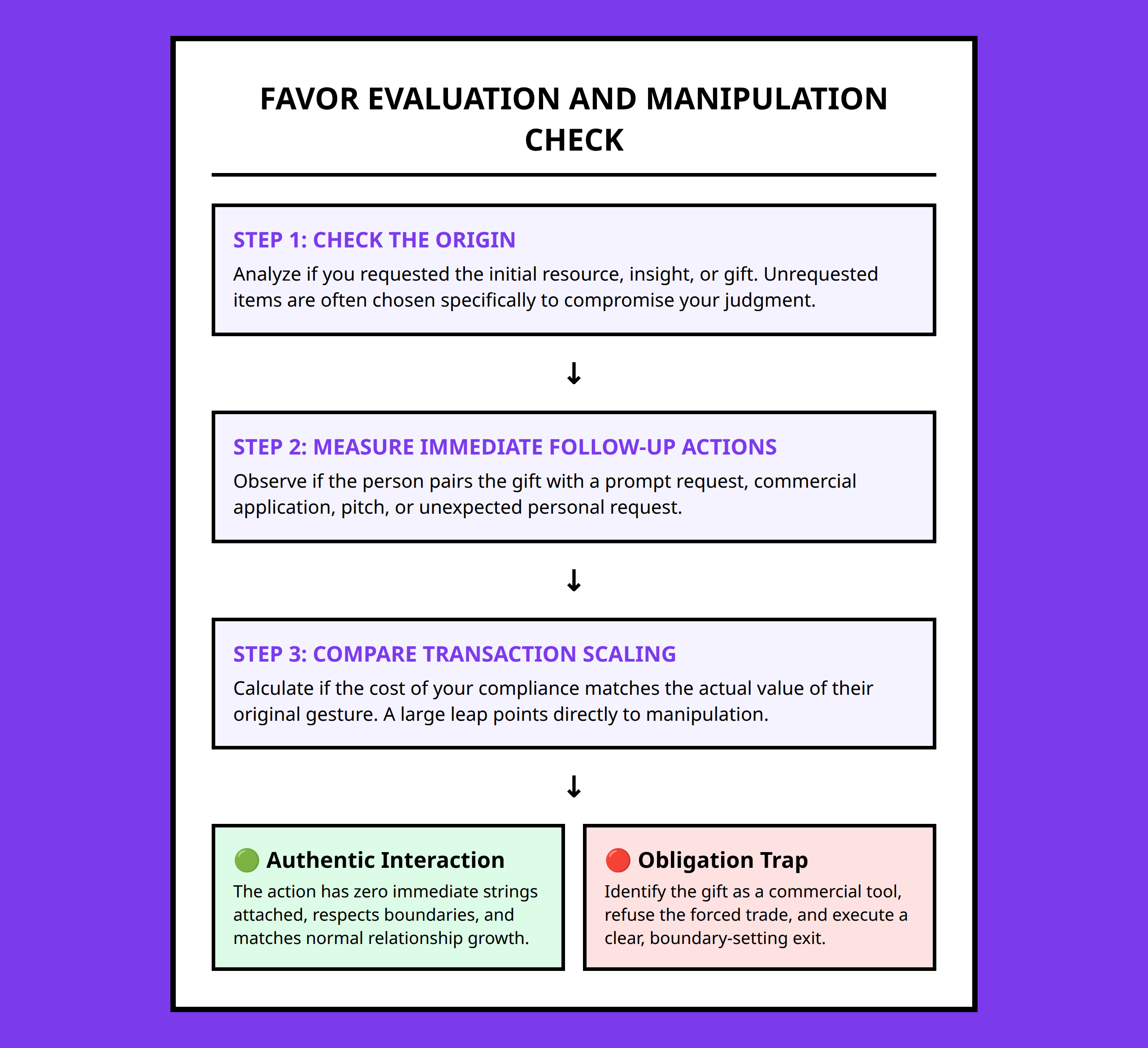
How I Try to Separate Genuine Generosity From Obligation Engineering
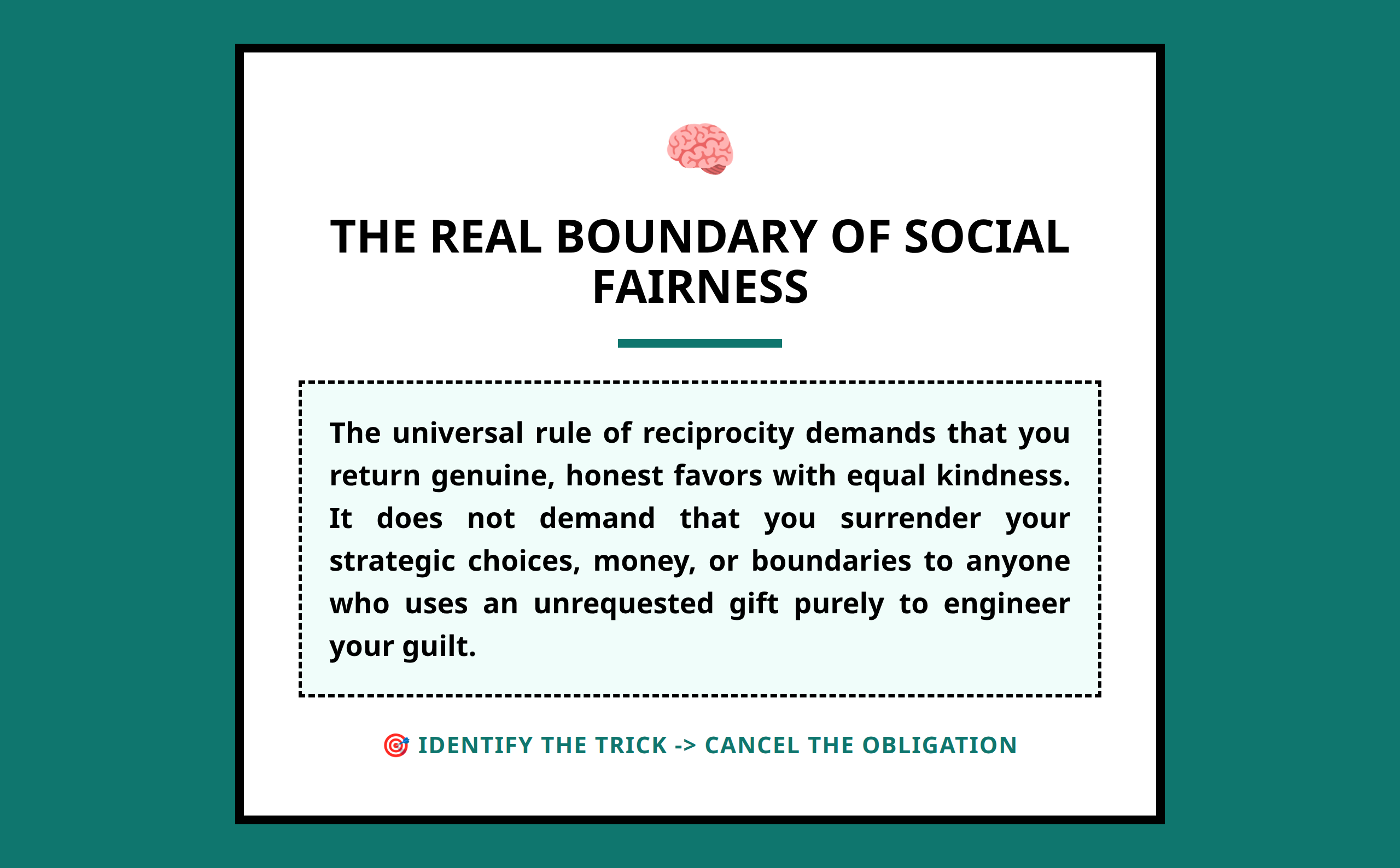
I do not think reciprocity itself is bad.
Healthy relationships, friendships, teamwork, and communities depend heavily on mutual support. Problems appear when obligation gets used to bypass careful judgment.
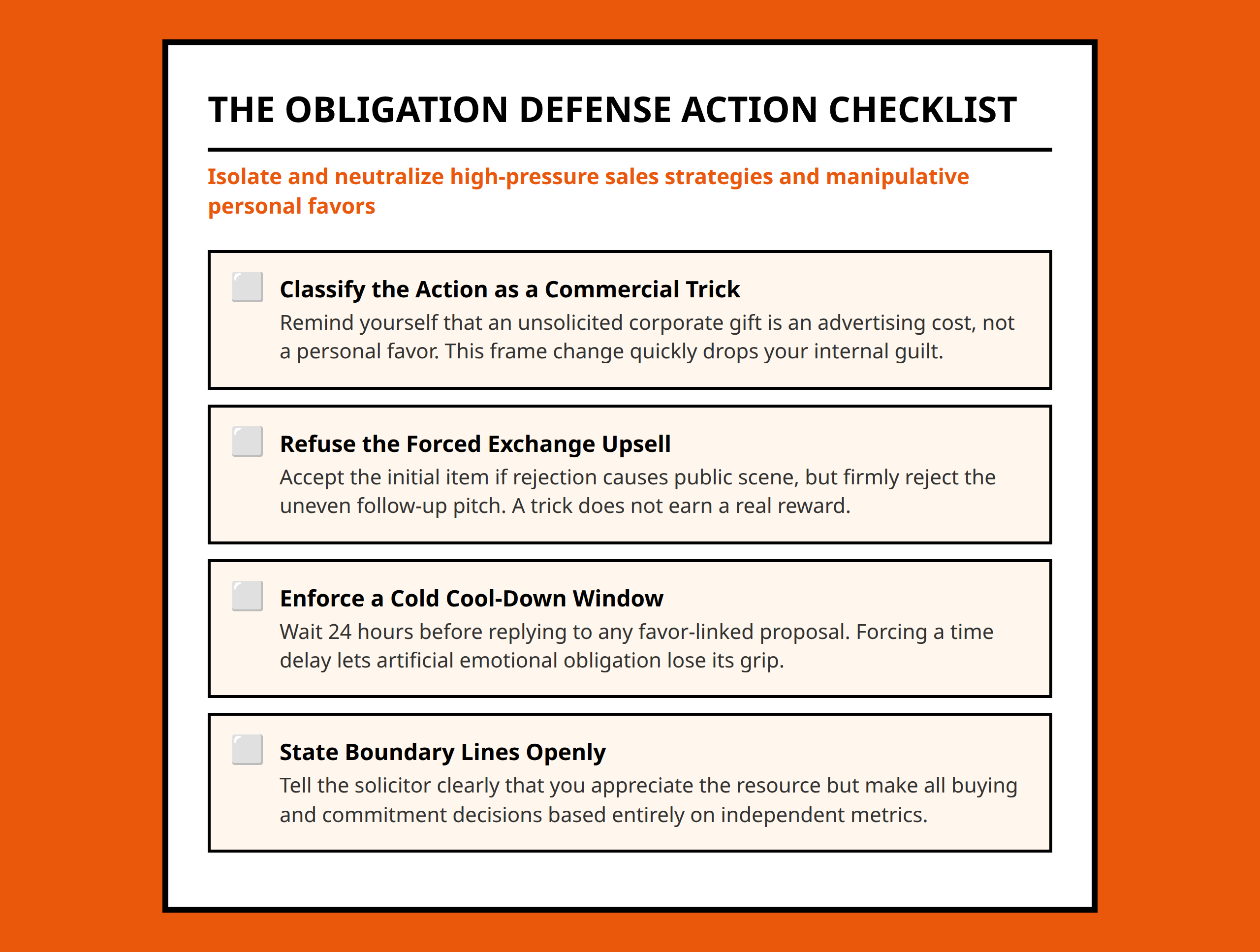
When I sense reciprocity pressure, I try to slow the interaction down mentally before responding.
I usually ask myself a few questions:
- Would I still agree if no favor had been given first?
- Was the generosity freely offered, or does it now feel transactional?
- Am I responding out of genuine agreement or social discomfort?
- Would refusing actually be unfair, or would it only feel awkward?
Those questions help separate gratitude from automatic compliance.
I also think it helps to remember that receiving kindness does not automatically create unlimited obligation.
A free sample does not require a purchase. A favor does not require abandoning personal boundaries. A gift does not erase the need for independent judgment.
Reciprocity becomes healthier when generosity remains voluntary on both sides instead of becoming emotional pressure disguised as kindness.
- Reciprocity: A social instinct where people feel pressure to return favors, gifts, or kindness.
- Psychological obligation: An internal feeling that a person “should” respond or repay someone socially.
- Compliance: Agreeing to a request, instruction, or suggestion.
- Social norms: Unwritten rules about acceptable behavior within groups or societies.
- Persuasion: Influencing another person’s attitudes, decisions, or behavior.
- Fairness instinct: The natural human tendency to value balance, cooperation, and reciprocal treatment.
- Transactional behavior: Interactions mainly driven by expected exchange or personal gain.
References:
- https://www.yotpo.com/blog/reciprocity-in-marketing/
- https://www.referralcandy.com/blog/reciprocity-marketing-examples
- https://researchportal.scu.edu.au/view/pdfCoverPage
- https://impulsebuyingpsychology.com/reciprocity/
- https://degordian.com/blog/reciprocity-in-marketing-what-is-it-and-how-to-use-it/
- https://www.profit.co/blog/behavioral-economics/the-law-of-reciprocity-in-business/
- https://www.fizz.co.uk/blog/reciprocity-creates-loyal-customers/
- https://psychologycorner.com/neuromarketing-and-behavioral-economics/the-reciprocity-principle/
- https://www.sybill.ai/blogs/law-of-reciprocity-in-sales
- https://www.researchgate.net/publication/283182887_Reciprocity_in_Relationship_Marketing_A_Cross-Cultural_Examination_of_the_Effects_of_Equivalence_and_Immediacy_on_Relationship_Quality_and_Satisfaction_with_Performance
- https://www.masterclass.com/articles/reciprocity-in-relationships
- https://pmc.ncbi.nlm.nih.gov/articles/PMC2943076/