Android fragmentation turns one operating system into thousands of slightly different platforms. That flexibility helped Android spread everywhere, but it also made security updates slower, less consistent, and harder to trust over time.
I’ve always found it interesting that Android’s biggest strength and one of its biggest security weaknesses come from the same place: openness. The system was designed so hardware makers, carriers, and developers could adapt it for different devices and markets. That decision helped Android grow incredibly fast.
But the moment multiple companies begin modifying the same operating system in different ways, security stops being a simple “Google releases a fix” problem. The update path becomes layered, delayed, and sometimes completely broken.
That’s the part many people miss when they hear about Android vulnerabilities. A patch can exist publicly for months while millions of devices still remain exposed.
Takeaways
- Android security updates depend on several companies, not just Google.
- Device customization creates compatibility and testing delays.
- Older Android versions remain active long after support weakens.
- Fragmentation increases both security exposure and developer complexity.
Android Was Built as an Ecosystem, Not a Single Platform
One of the most important things to understand about Android is that Google never controlled the entire stack in the same way a closed platform does. Android was built around partnerships with hardware vendors, semiconductor manufacturers, carriers, and software developers.
That structure mattered because Android had to work across a massive range of devices. Phones from Samsung, HTC, LG, Motorola, Sony, and many smaller manufacturers all used Android differently. Carriers also customized devices for their own networks and services.
From a business perspective, this openness was powerful. It allowed Android to spread into phones, tablets, televisions, embedded systems, and other devices very quickly.
From a security perspective, though, I think this created a long-term coordination problem that still shapes Android security today.
Every extra stakeholder added another layer between a security fix and the user who actually needed it.
Security Updates Stop Being Simple in a Fragmented Ecosystem
When people picture software updates, they often imagine a direct path:
- A vulnerability is discovered
- The operating system maker creates a patch
- Users install the update
Android rarely works that cleanly.
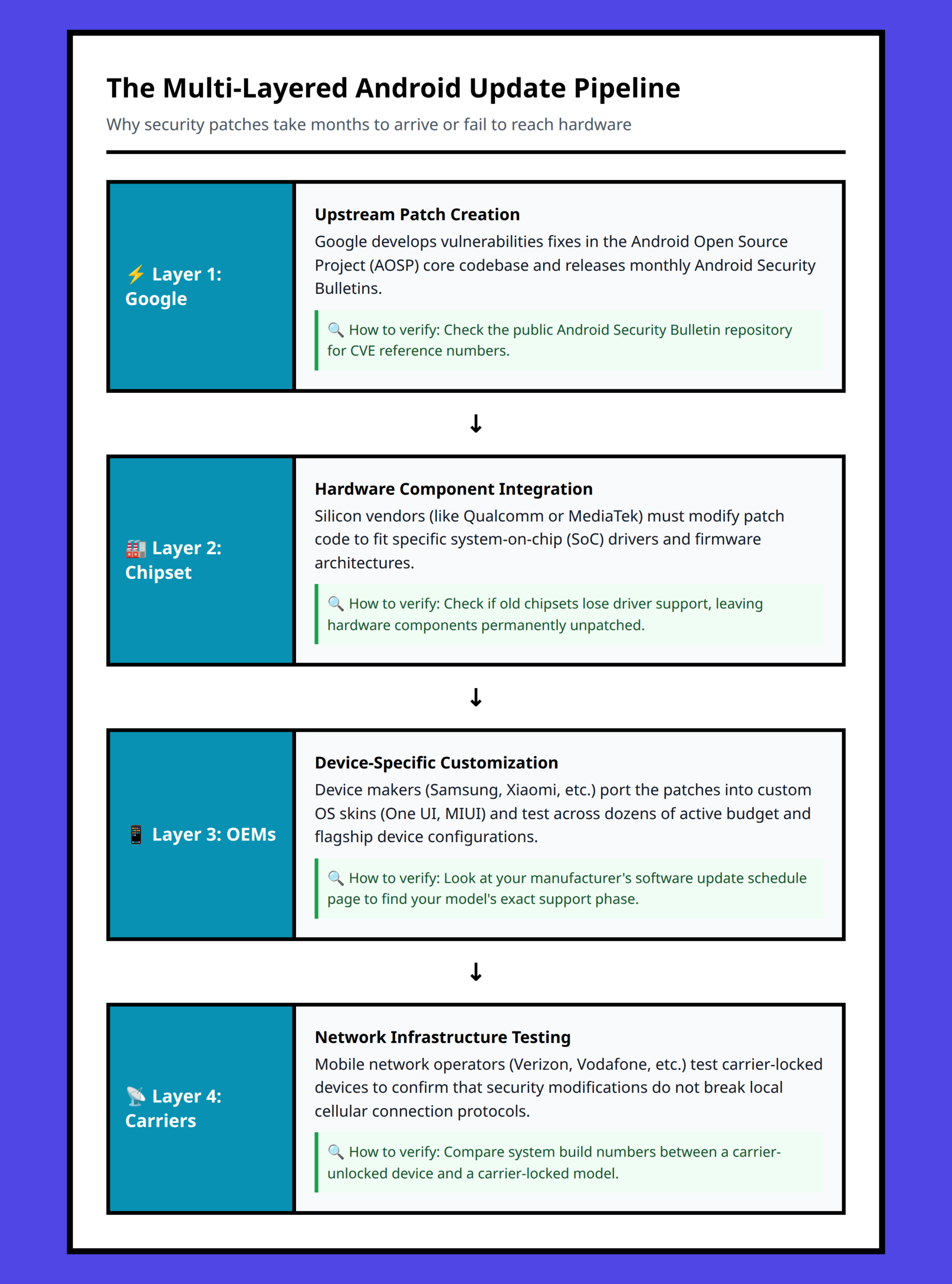
In practice, the process usually looks more like this:
- Google patches Android core code
- Chipset vendors adapt low-level drivers
- Phone manufacturers modify the update for their customized devices
- Carriers test and approve the software
- The update finally reaches users
Each stage introduces delay, compatibility risk, and business priorities that may not align with fast security delivery.
A manufacturer with dozens of active phone models may decide an older device is no longer worth maintaining. A carrier may postpone rollout because the update interferes with network software or bundled applications. Some devices never receive the patch at all.
This is where fragmentation becomes a security issue instead of just a software-management issue.
Compatibility Problems Slow Security Fixes Even More
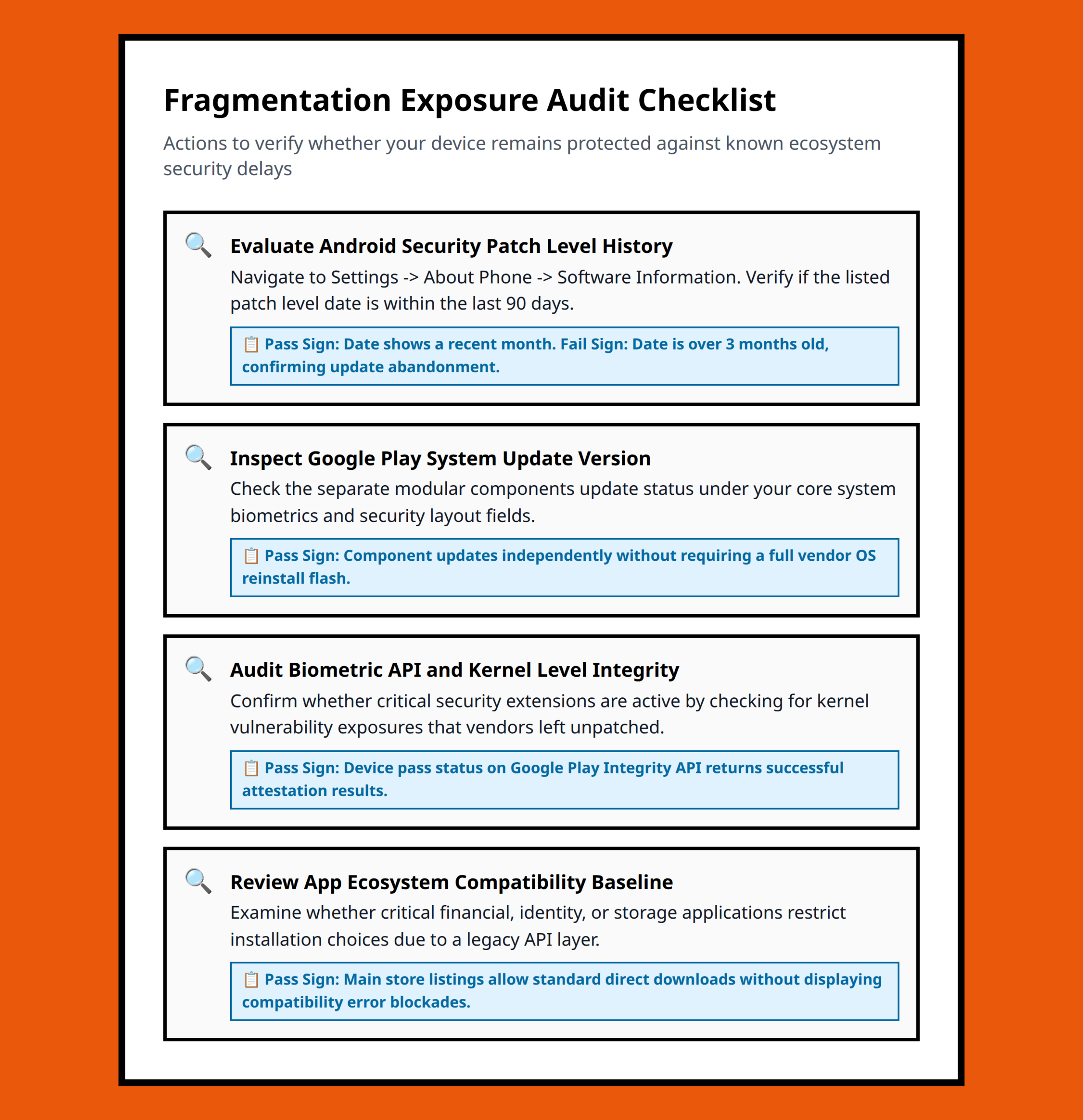
Android fragmentation is not only about different Android versions. It also involves hardware variation, vendor modifications, and custom software layers.
One phone may use a Qualcomm chipset. Another may use MediaTek or Samsung Exynos hardware. Manufacturers also change user interfaces, bundled apps, power-management systems, and kernel modifications.
That means a security patch cannot always be dropped into every device unchanged.
The patch has to be tested against different hardware combinations and vendor software changes. Sometimes fixing one problem introduces another. A patch that works correctly on one model may break battery management, radio communication, camera functionality, or driver compatibility on another.
I think this is one reason Android security discussions often become oversimplified online. People talk about “just update the phone” as if the ecosystem were technically uniform.
It is not.
Android became successful partly because manufacturers could customize it heavily. The downside is that those same customizations make long-term security maintenance harder and slower.
Old Android Versions Stay Active for Years
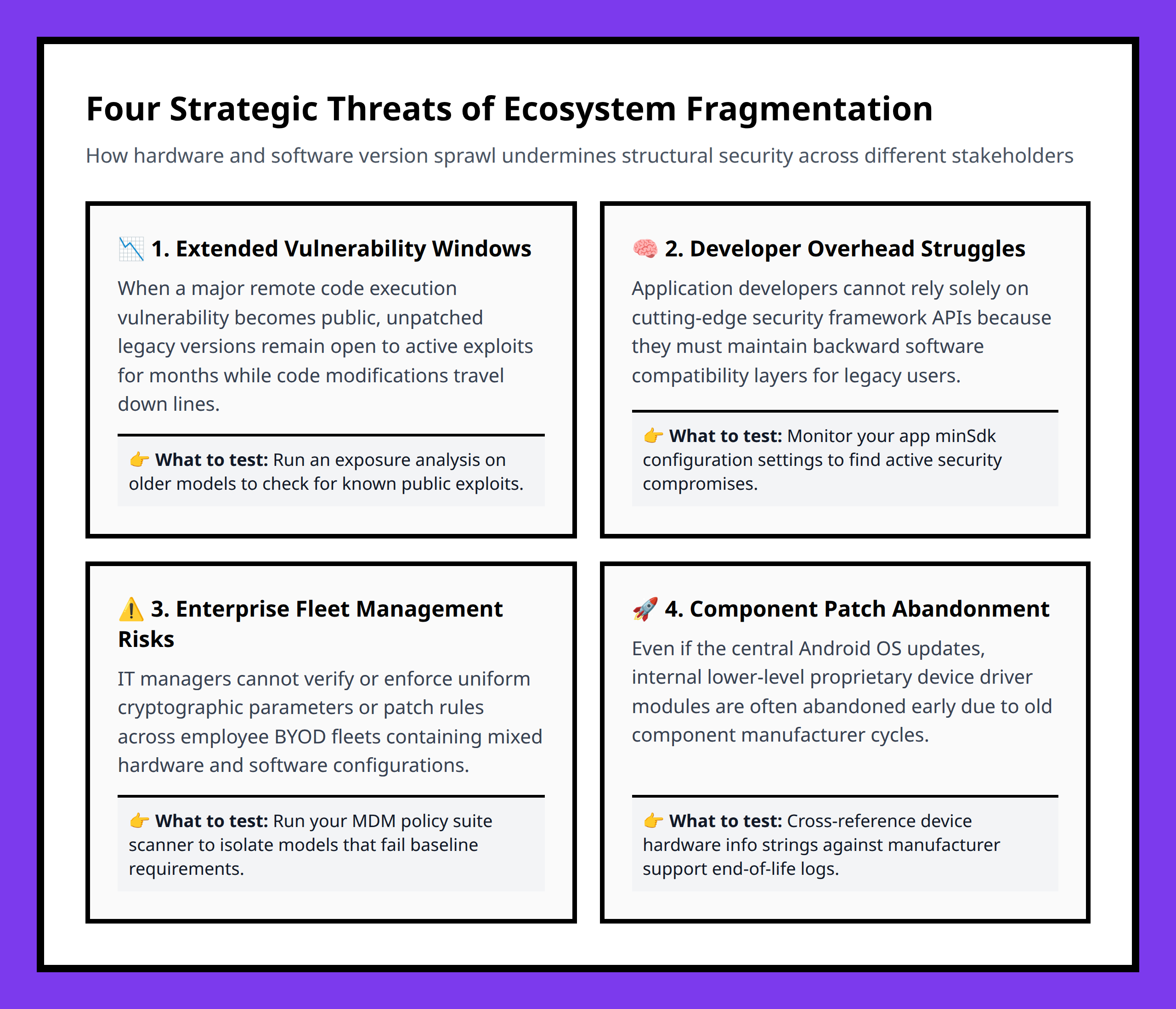
One of the most visible effects of fragmentation is version persistence.
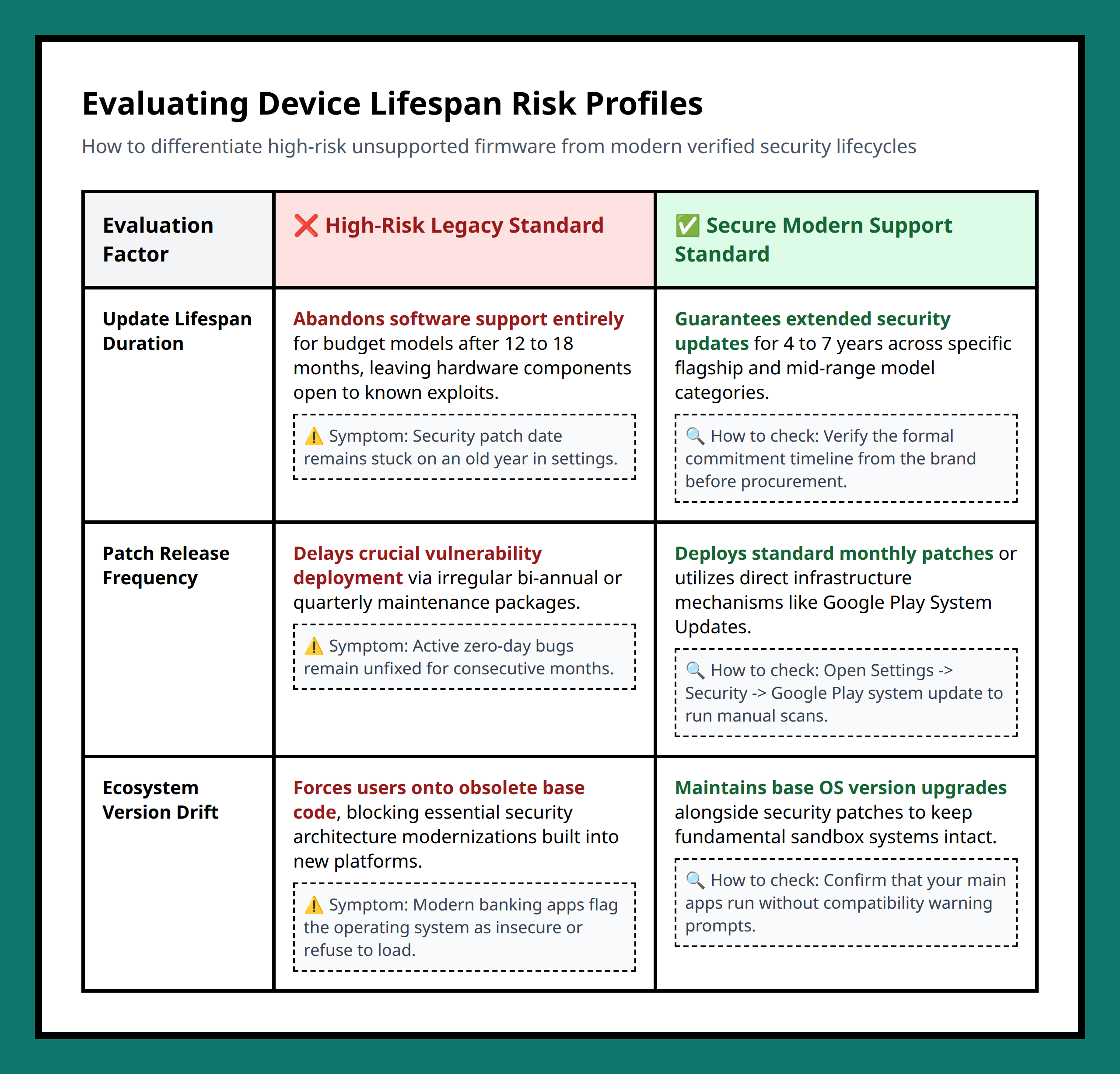
Even after Google releases newer Android versions, older releases continue running on large numbers of devices for years. Some users delay upgrades intentionally. Others simply own devices that no longer receive support.
This creates a strange security environment where known vulnerabilities remain useful long after disclosure.
A vulnerability may already be documented publicly, analyzed by researchers, and fixed upstream, yet attackers can still target unpatched devices because the ecosystem updates unevenly.
A common real-world situation looks like this:
A person buys a low-cost Android phone through a carrier contract. The phone works fine for messaging, banking, maps, and social apps. Two years later, the manufacturer quietly stops major updates. The user may never notice because the device still powers on and runs apps normally.
From the outside, nothing appears broken.
But underneath, the security posture slowly weakens as the gap grows between current Android protections and the outdated software still running on the device.
That slow decay is one of the hardest fragmentation risks to communicate because users usually experience it gradually, not dramatically.
Developers Also Pay the Price for Fragmentation
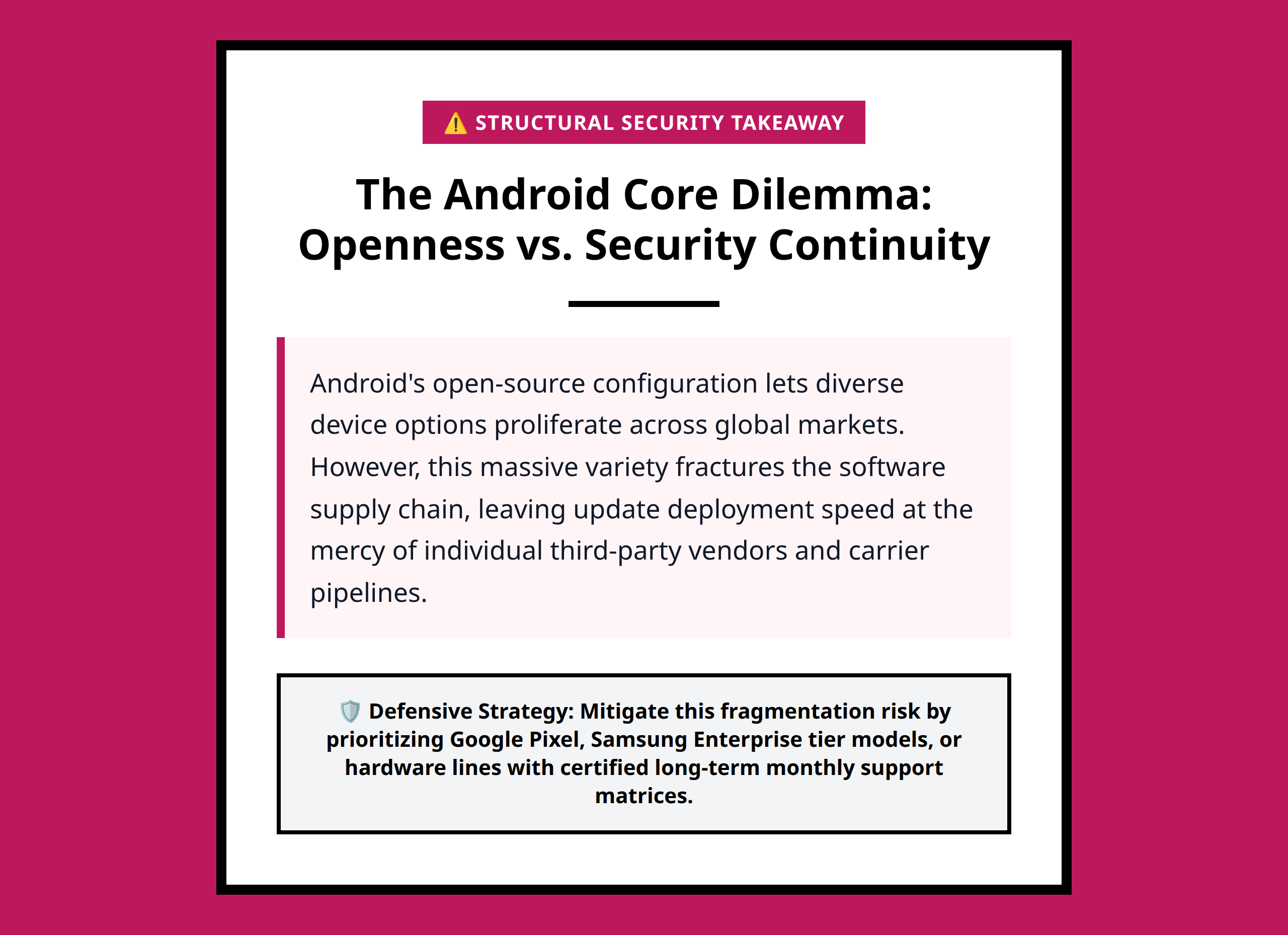
Fragmentation creates pressure not only for users but also for developers.
An Android developer cannot assume every user runs the same Android version, security model, API behavior, or hardware configuration. Applications often need to support older Android releases because large user groups still depend on them.
This complicates security decisions.
A developer may want to rely on newer protections introduced in recent Android versions, but older devices may not support them. That forces tradeoffs between compatibility and security modernization.
I think this is where fragmentation quietly shapes software quality in ways many users never see. Developers end up carrying defensive code paths, legacy support logic, and compatibility workarounds that would not exist in a more unified platform.
Every extra compatibility layer increases testing complexity and creates more room for mistakes.
Openness and Security Pull in Different Directions
Android’s openness is not inherently bad. In fact, it enabled enormous innovation.
Manufacturers could experiment with hardware designs. Developers gained access to a broad ecosystem. Consumers had more device choices across different price ranges.
But openness and centralized security control naturally push against each other.
A tightly controlled ecosystem can enforce updates more consistently because fewer parties control the software path. Android intentionally distributed that control across many organizations.
Once that happened, security became partially dependent on business coordination.
That distinction matters because security problems are rarely caused only by technical flaws. In fragmented ecosystems, delays, incentives, support policies, and operational complexity become part of the security model too.
I think that is the most important lens for understanding Android fragmentation. It is not simply “too many devices.” It is a chain-of-responsibility problem where every link affects whether protections actually reach users.
Why Fragmentation Still Matters Even as Android Security Improves
Modern Android security is significantly stronger than early Android releases. Sandboxing, exploit mitigations, application isolation, and update mechanisms have improved considerably over time.
But fragmentation changes how quickly those protections spread across the ecosystem.
That means Android security discussions should never focus only on whether a protection exists. The more important question is often:
How widely and how quickly does the ecosystem adopt it?
A security feature that reaches only part of the ecosystem still leaves large numbers of users operating under older assumptions and weaker protections.
This is why I pay attention not only to Android vulnerabilities themselves, but also to update policies, device support timelines, vendor behavior, and ecosystem coordination. Those operational details often determine the real-world lifespan of a security problem.
- Android fragmentation: The spread of Android across many device makers, hardware types, software versions, and custom vendor modifications.
- OEM (Original Equipment Manufacturer): A company that builds Android devices, such as Samsung, Motorola, or Xiaomi.
- Carrier: A mobile network company that sells or supports phones and may approve software updates before users receive them.
- Security patch: A software update designed to fix a vulnerability or security weakness.
- Compatibility testing: The process of checking whether software updates work correctly across different hardware and software configurations.
- Kernel: The core part of the operating system that manages hardware communication and low-level system behavior.
- Sandboxing: A security method that isolates applications so they cannot freely access each other’s data or system resources.
- API: A set of software functions and rules developers use to interact with Android system features.
References:
- https://www.theregister.com/security/2015/07/20/fragmented-android-development-creating-greater-security-risks/1218281
- https://www.trio.so/blog/android-os-fragmentation
- https://median.co/blog/what-is-android-fragmentation
- https://www.researchgate.net/publication/353391328_Android_OS_Fragmentation_Causes_and_Concerns
- https://www.testlio.com/blog/what-is-android-fragmentation
- https://www.sciencedirect.com/science/article/pii/S0167404819301361
- https://www.linkedin.com/posts/bagipro_androids-security-in-2025-worse-than-you-activity-7381684571790163968-BlzX
- https://www.techtarget.com/searchmobilecomputing/tip/Is-Android-fragmentation-still-a-problem-for-IT-teams
- https://bismabhundi.medium.com/mobile-device-fragmentation-challenges-and-solutions-e72fbe0fa089