
Finding a memory corruption bug on Android is only the beginning. A vulnerability becomes truly dangerous when attackers can reliably control memory behavior, influence execution flow, and work around modern exploit mitigations built into the operating system.
I think this is one of the hardest transitions for people learning vulnerability research. Discovering a crash feels important at first, and sometimes it is, but many crashes never become useful exploitation paths.
Modern Android systems contain multiple defensive layers designed specifically to make memory corruption harder to weaponize. That means exploitability depends not only on the bug itself, but also on memory layout, architecture behavior, privilege context, and mitigation bypass opportunities.
The real question is rarely just “Can the software crash?”
The more important question is:
Can the attacker control what happens after the corruption occurs?
Takeaways
- Memory corruption bugs become exploitable only when attackers gain meaningful control over memory behavior.
- Stack and heap corruption create different exploitation conditions and constraints.
- Modern Android protections reduce exploit reliability but do not eliminate memory corruption risk.
- Exploitability depends heavily on context, memory layout, and reachable execution paths.
Memory Corruption Starts With Unsafe Memory Handling
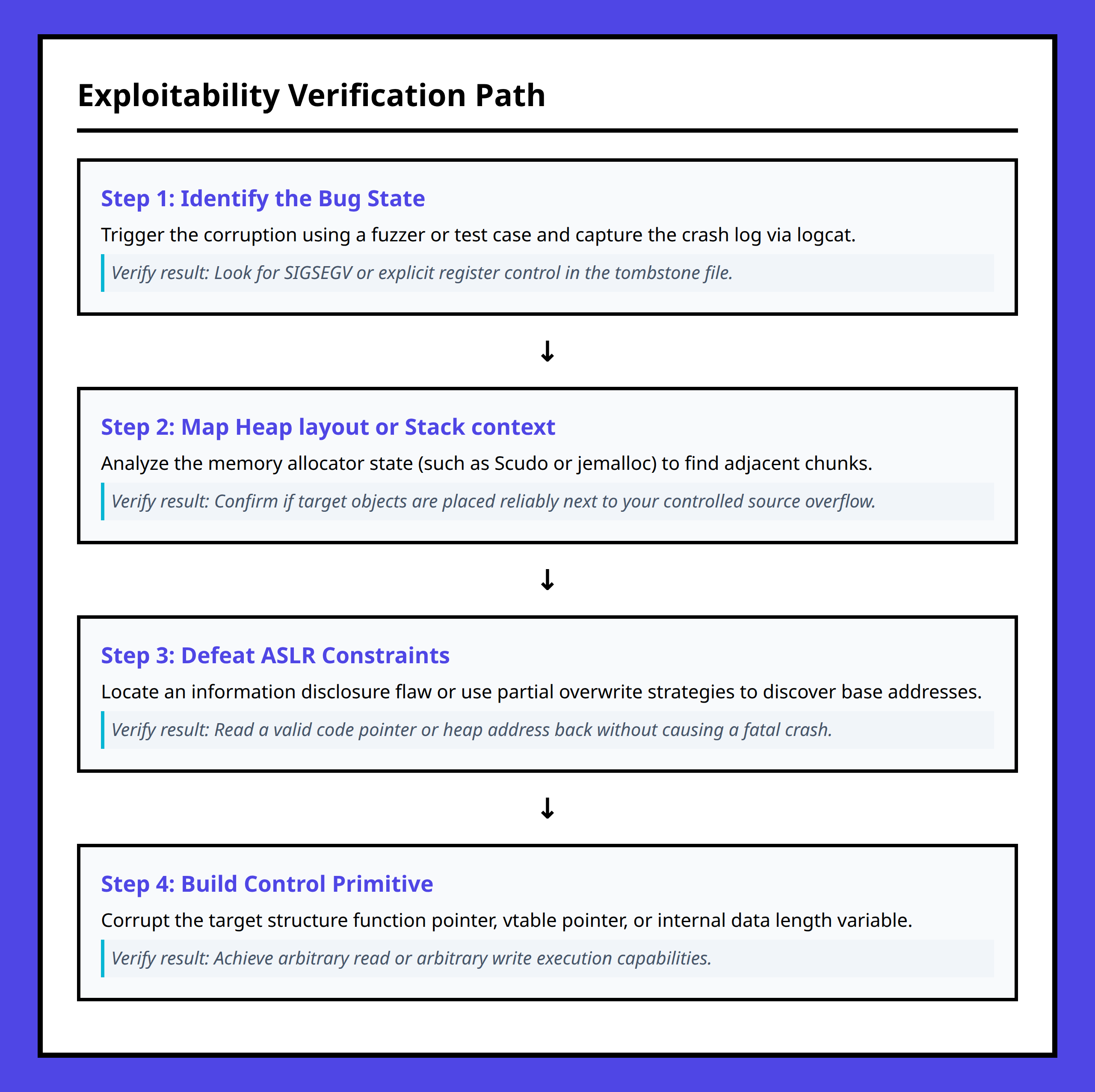
Memory corruption vulnerabilities appear when software reads from or writes to memory incorrectly.
This may happen because:
- Input exceeds expected buffer sizes
- Pointers reference invalid locations
- Memory gets reused unsafely
- Bounds checking fails
- Objects are accessed after release
At a basic level, the software loses reliable control over how memory should behave.
What matters from an exploitation perspective is whether that loss of control becomes predictable enough for attackers to influence execution.
I think beginners sometimes assume all memory corruption behaves similarly. In reality, different corruption types create very different conditions for attackers.
A harmless crash, a controlled overwrite, and reliable code execution are very different outcomes.
Stack Buffer Overflows Became Famous for a Reason
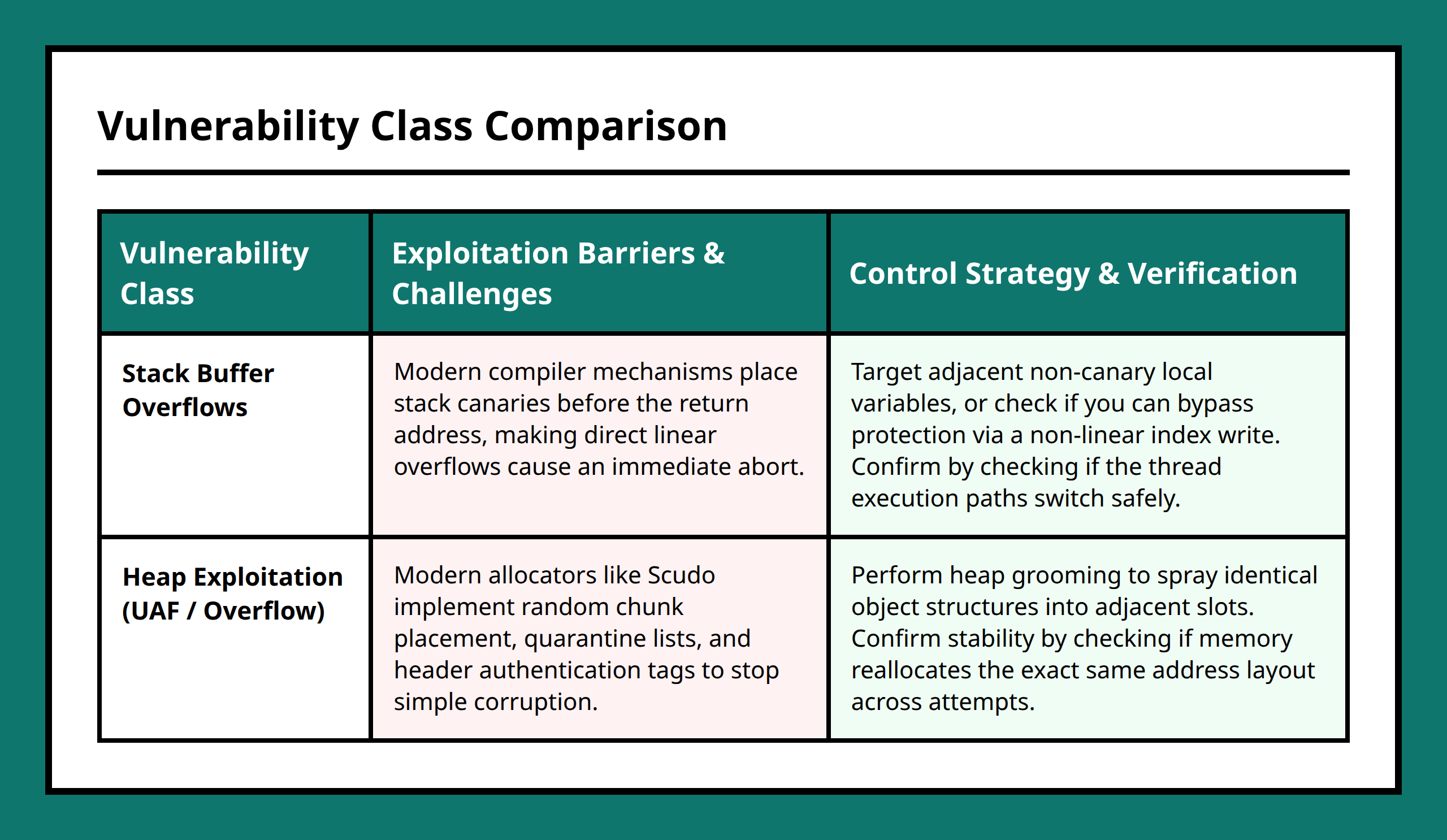
Stack-based memory corruption vulnerabilities became historically important because they could overwrite critical execution data directly.
The stack typically stores:
- Function call information
- Local variables
- Return addresses
- Execution state information
If a program writes beyond the boundaries of a stack buffer, nearby memory structures may become corrupted.
Historically, attackers often targeted return addresses because altering them could redirect program execution toward attacker-controlled behavior.
I think stack corruption examples remain useful educationally because they make exploit mechanics easier to visualize.
A vulnerable function accepts oversized input. The input exceeds the intended boundary. Adjacent memory changes unexpectedly. Execution flow eventually follows corrupted state instead of legitimate program logic.
That cause-and-effect chain helps explain why memory layout matters so much.
Modern Android systems include protections that make traditional stack exploitation harder, but the underlying principle still matters: corruption becomes dangerous when execution flow becomes influenceable.
Heap Exploitation Is More About Manipulating State
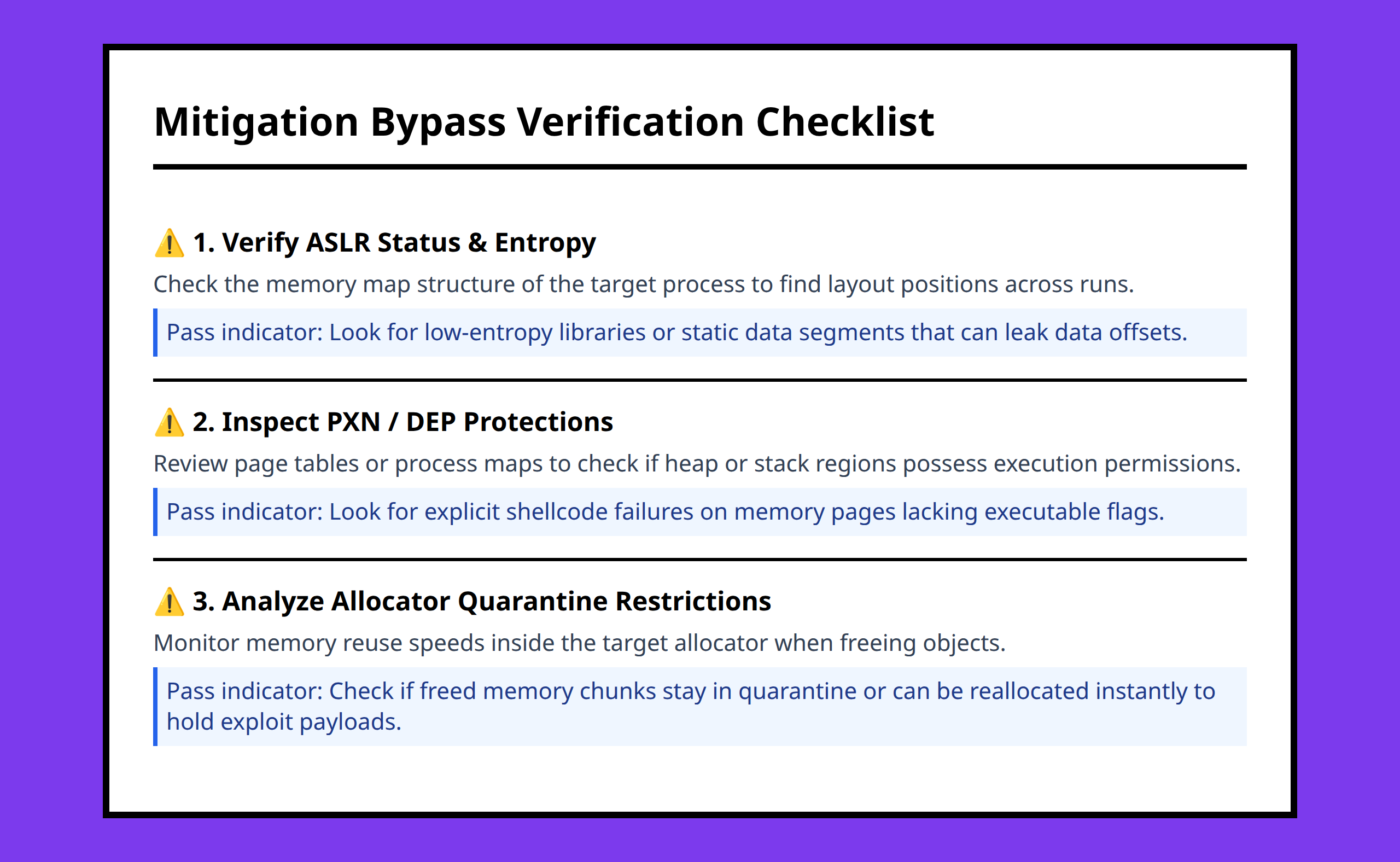
Heap exploitation behaves differently because heap memory is used for dynamic allocation during program execution.
Applications constantly allocate and release heap memory while processing data, rendering content, handling media, and interacting with users.
This creates a much more fluid environment than the stack.
I think heap exploitation feels less intuitive at first because attackers often manipulate allocator behavior indirectly rather than overwriting a single obvious execution structure.
Heap corruption may involve:
- Corrupting adjacent objects
- Manipulating allocation patterns
- Reusing freed memory incorrectly
- Influencing object metadata
- Triggering unsafe pointer reuse
The exploitability question becomes more complicated because heap state changes continuously during application runtime.
That complexity creates both opportunity and instability.
A realistic situation might involve a browser component processing malformed content repeatedly until heap memory reaches a predictable state where corrupted objects influence future execution behavior.
The vulnerability itself may be small. The exploitability comes from carefully shaping surrounding memory conditions.
Exploitability Depends on More Than the Bug Alone
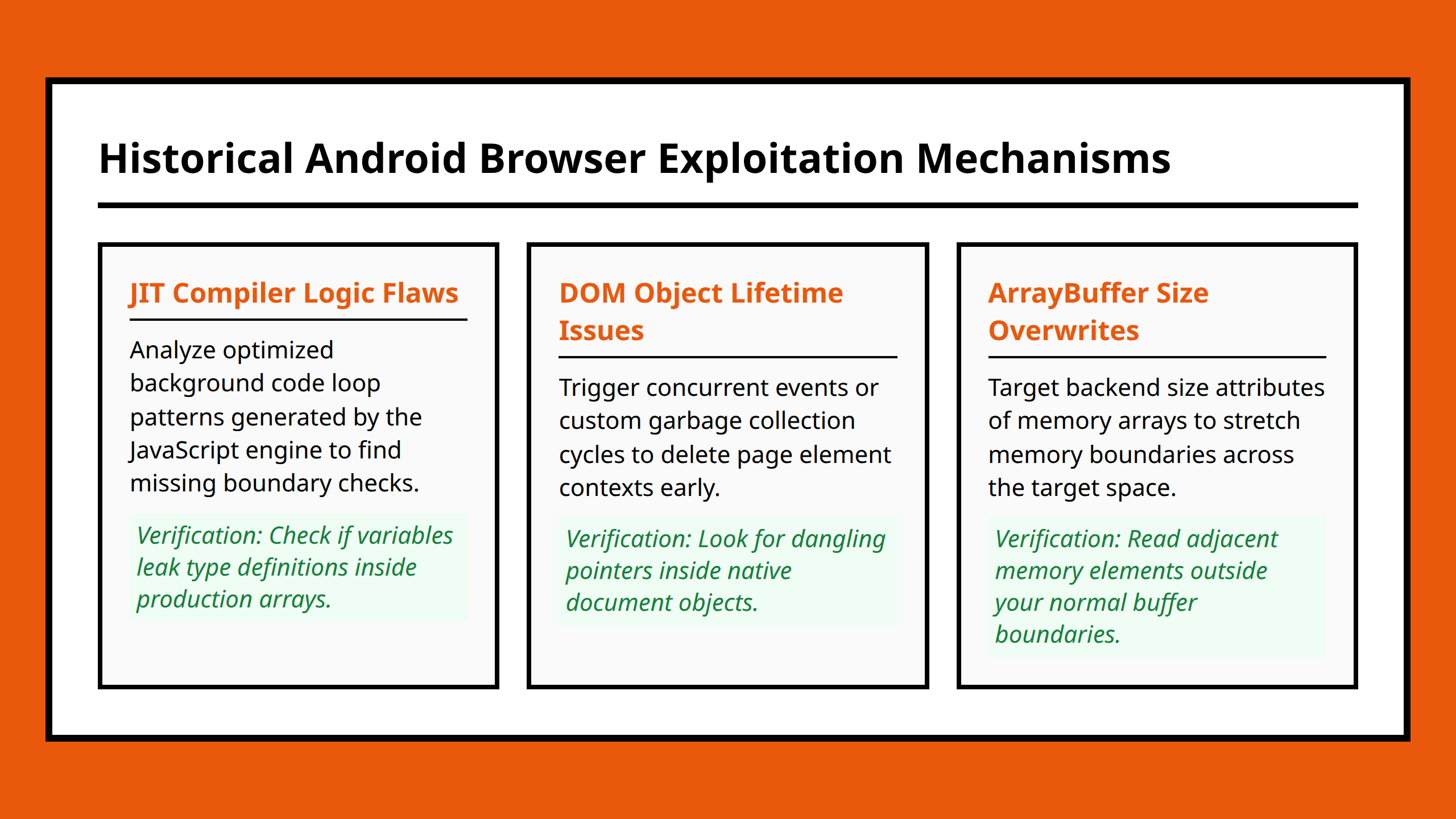
One of the biggest lessons in Android exploitation research is that identical vulnerability classes may produce completely different outcomes depending on context.
A memory corruption bug inside an isolated low-privilege process may have limited practical impact. The same corruption inside a privileged media service or browser renderer may create far more dangerous possibilities.
I usually evaluate exploitability through several questions:
- What privileges does the vulnerable process have?
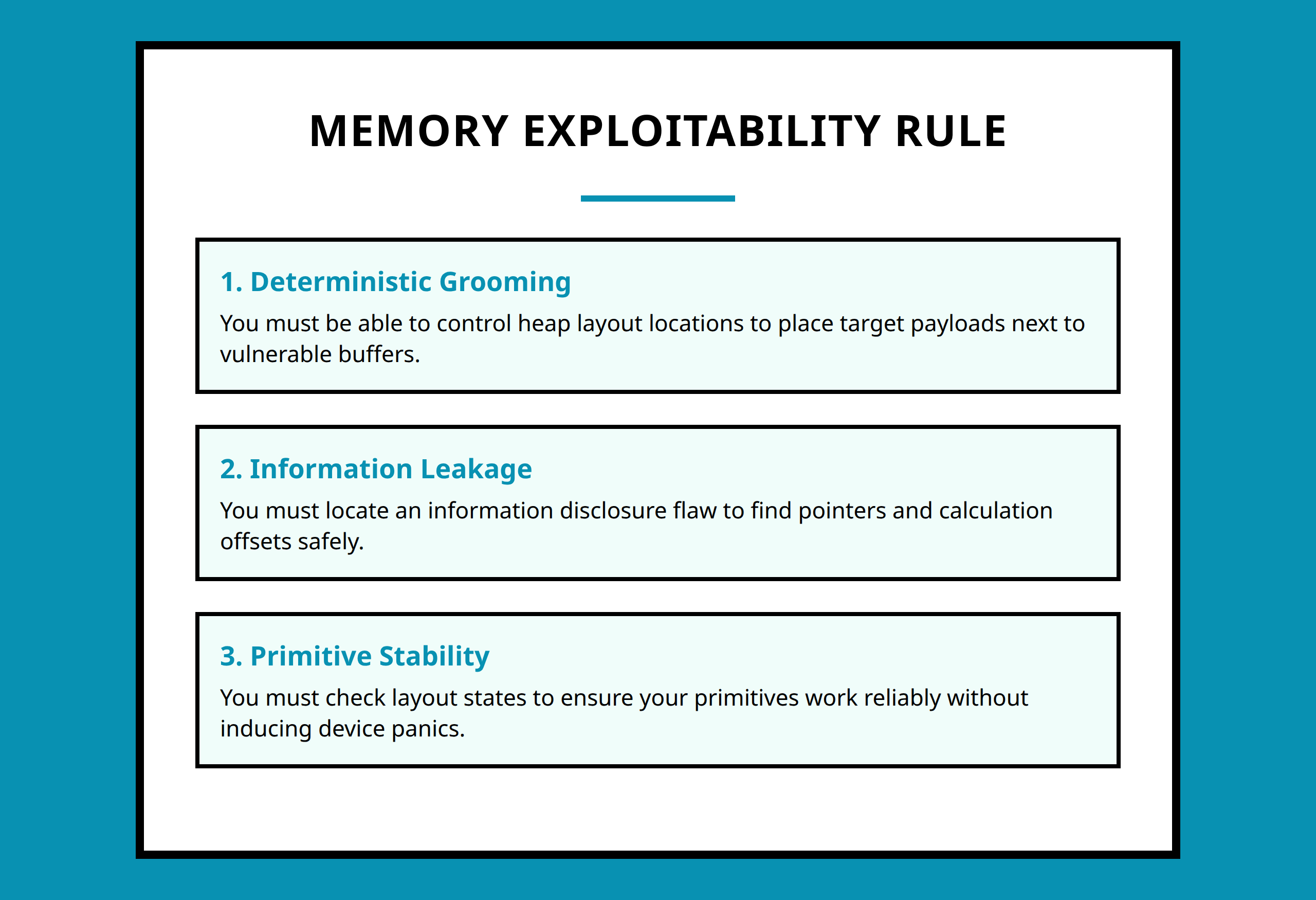
- Can attackers influence memory layout reliably?
- How reachable is the vulnerable code?
- What mitigations protect the target?
- Does the corruption affect meaningful execution structures?
Those questions matter because many vulnerabilities fail operationally even when the bug itself is technically real.
Exploitability depends on turning instability into controlled behavior.
Browser Exploitation Shows Why Complexity Increases Risk
Android browsers historically became important exploitation targets because they process large amounts of untrusted content through highly complex rendering engines.
Browsers handle:
- HTML parsing
- JavaScript execution
- Media decoding
- Font rendering
- Graphics processing
- Network content handling
Every additional subsystem introduces more parsing logic, more object management, and more memory interaction.
I think browser exploitation demonstrates a broader security lesson: complexity expands the number of assumptions software must enforce correctly.
A malformed webpage may trigger unusual object states, unexpected memory reuse, or corrupted rendering behavior deep inside the engine.
Most users never see the dangerous part directly. They only see the browser open a webpage normally while the vulnerable code executes underneath.
Modern Mitigations Changed Exploitation Economics
Older exploitation techniques often relied on predictable memory layouts and direct execution redirection.
Modern Android versions introduced protections specifically designed to disrupt that reliability.
These protections include:
- Address randomization
- Non-executable memory protections
- Stack protection mechanisms
- Heap hardening
- Sandboxing restrictions
The important point is not that exploitation became impossible.
The important point is that attackers now frequently need multiple conditions aligned simultaneously.
I think this is why exploitability analysis matters more than vulnerability headlines alone.
A reported memory corruption bug may sound severe publicly, but practical exploitation may still require bypassing randomization, stabilizing memory layout, avoiding crashes, and maintaining reliable execution control.
The technical difficulty changed significantly as Android defenses improved.
Reliable Exploitation Usually Requires Repeatability
A single unstable crash is rarely enough for meaningful exploitation.
Reliable exploits generally require repeatable behavior across multiple runs, devices, or memory conditions.
That repeatability challenge is one reason many memory corruption vulnerabilities remain difficult to weaponize consistently.
I pay attention to whether attackers can influence timing, allocation order, object placement, or execution sequencing repeatedly.
If corruption behaves differently every time, practical exploitation becomes much harder.
This is also why exploit developers spend significant effort shaping application state before triggering corruption. The vulnerability may exist already, but exploitability depends on turning chaotic memory behavior into something predictable enough to control.
The Real Skill Is Understanding the Conditions Around the Bug
I think the most important shift in advanced Android vulnerability research is realizing that memory corruption alone does not explain exploitability.
The surrounding conditions matter just as much:
- Architecture behavior
- Memory allocator behavior
- Privilege context
- Input reachability
- Mitigation strength
- Execution environment stability
That is why two vulnerabilities that look similar on paper may behave completely differently in practice.
One crashes harmlessly. Another becomes a reliable exploitation path.
The difference usually comes from how much control attackers gain after corruption starts, not from the corruption event alone.
- Memory corruption: A software flaw where memory is accessed or modified incorrectly, potentially causing crashes or unintended behavior.
- Stack: A memory region used to store temporary execution data such as function calls and local variables.
- Heap: A memory area used for dynamic allocation while a program runs.
- Buffer overflow: A condition where data exceeds the intended storage boundary and overwrites adjacent memory.
- Pointer: A variable that references a location in memory.
- Allocator: A system component responsible for assigning and managing memory usage.
- Address randomization: A security technique that changes memory locations unpredictably to make exploitation harder.
- Sandboxing: A security method that isolates processes or applications to limit damage if compromise occurs.
References:
- https://oversecured.com/blog/exploiting-memory-corruption-vulnerabilities-on-android
- https://www.reddit.com/r/ExploitDev/comments/pl28ot/does_android_have_no_vulnerabilities_and_exploits/
- https://www.reddit.com/r/ExploitDev/comments/pl28ot/does_android_have_no_vulnerabilities_and_exploits/hc7l4js/
- https://www.reddit.com/r/cybersecurity/comments/13m8ymw/how_are_exploits_such_as_memory_corruption_and/
- https://www.reddit.com/r/ExploitDev/comments/1ccp1a4/the_future_of_exploit_dev/
- https://www.usenix.org/publications/loginonline/choose-one-android-performance-or-security
- https://mas.owasp.org/MASTG-KNOW-0005/
- https://projectzero.google/2015/06/what-is-good-memory-corruption.html
- https://www.reddit.com/r/cybersecurity/comments/1c1abli/how_do_attackers_take_advantage_of_memory_leaks/
- https://security.stackexchange.com/questions/89927/how-does-memory-corruption-apply-to-android
- https://www.automox.com/blog/vulnerability-definition-memory-corruption
- https://www.mobilehackinglab.com/blog/damn-exploitable-android-app-abusing-info-leaks-to-bypass-aslr
- https://repository.gatech.edu/bitstreams/12f79bdf-bb3a-420e-946f-b8c69e1d8a26/download
- https://medium.com/@kritstudy15/common-vulnerabilities-in-android-applications-8320bbc19613
- https://owasp.org/www-community/vulnerabilities/Memory_leak