Writing about loss becomes difficult when emotion turns into content. The challenge is not simply expressing grief, but shaping it into something honest, readable, and emotionally responsible without flattening the experience into a brand.
I tend to distrust writing about grief when it becomes too polished too quickly. The problem is not emotional openness itself. The problem is when the writing starts sounding cleaner than the actual experience.
What makes certain grief writing feel authentic is usually not the sadness. It is the structure around the sadness: the hesitation, the contradiction, the unfinished thoughts, the moments where the writer clearly does not yet understand what they feel. That tension matters because grief rarely arrives as a neat narrative.
The most useful lesson I took from this story was not how someone survived loss. It was how someone slowly learned to translate private emotion into public writing without losing the emotional truth in the process.
The diary mattered because it was not written for an audience
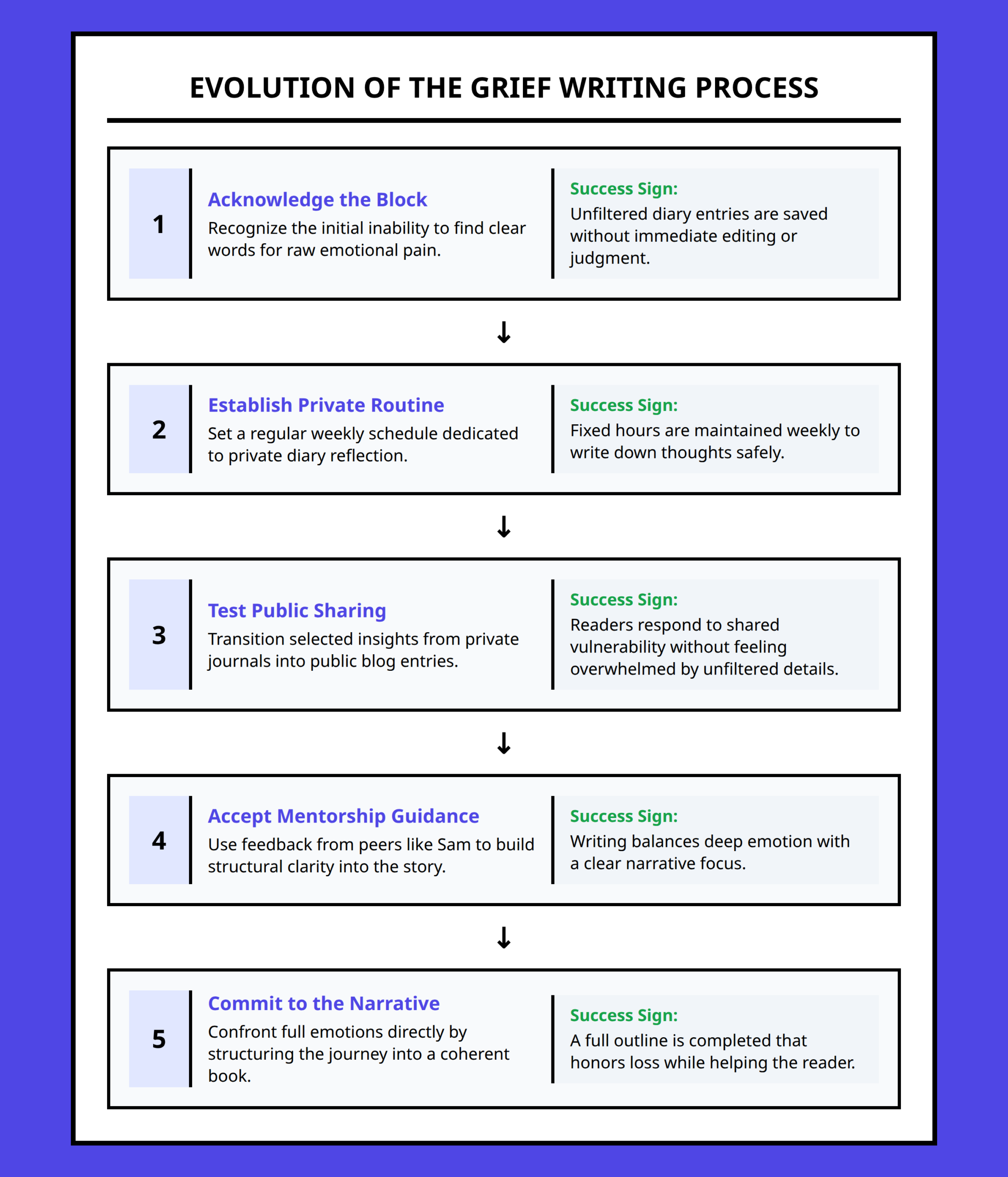
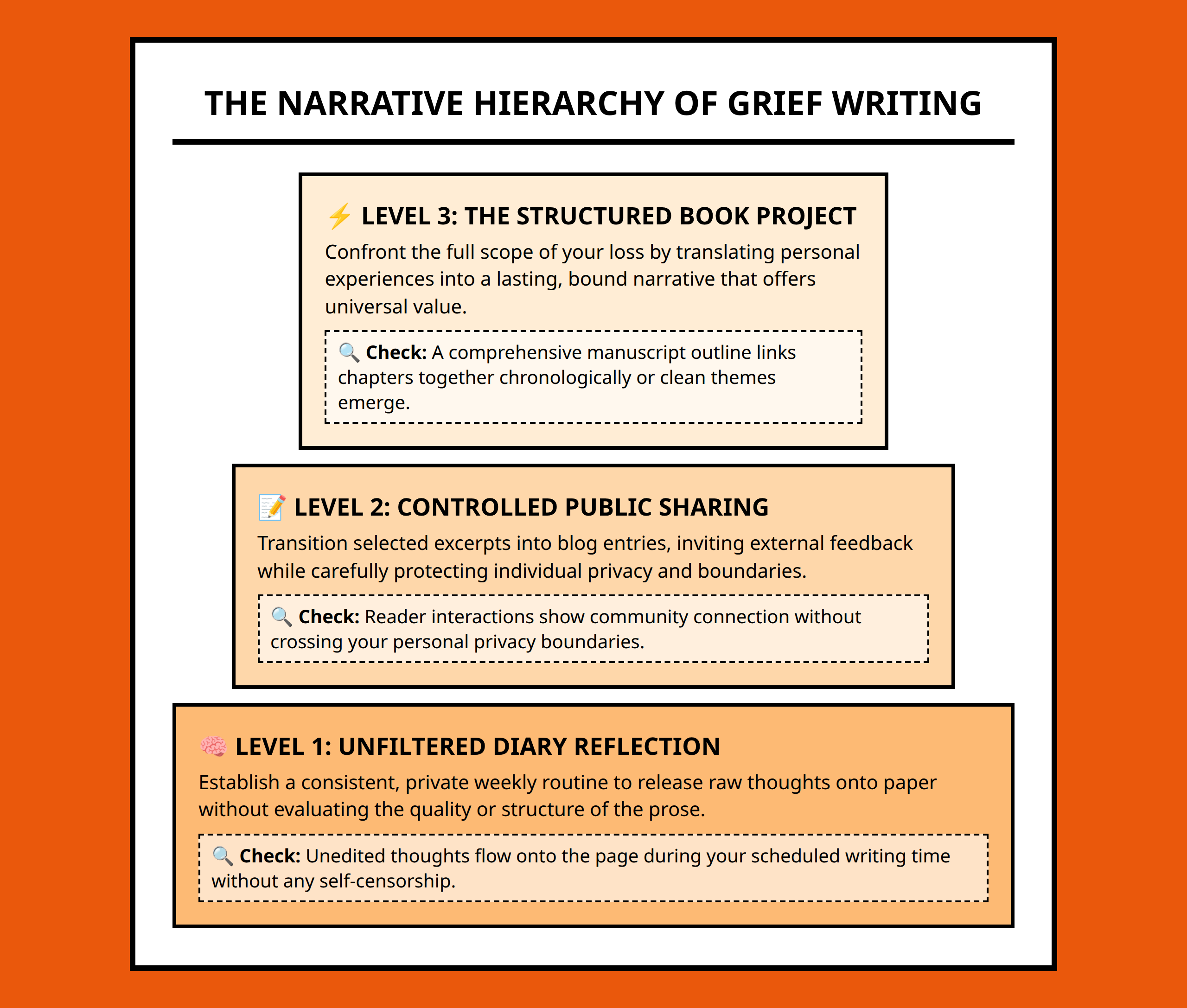
One of the clearest distinctions in the story is the difference between the protagonist’s private diary and her public blog. The diary contains the raw material: fragmented thoughts, anger, guilt, fear, repetition, confusion. The blog is shaped for readers.
That distinction is incredibly important for anyone trying to write about grief online.
A lot of people skip the private stage entirely. They open a notes app, write directly for social media, and unconsciously start performing before they have even processed what they feel. The emotional tone becomes curated almost immediately.
Here, the diary works differently. It acts as a pressure valve. The character writes things she would never publish, sometimes without punctuation or structure, simply to get the emotional reality onto the page. Later, when she writes publicly, she has somewhere deeper to pull from.
I think this is one of the healthiest practical models for grief writing. Not because journaling is magical, but because private writing removes the pressure to sound wise.
A simple real-world version of this might look ordinary: someone sits at a kitchen table after midnight typing angry, contradictory paragraphs into a document they never intend to share. The next morning, only two sentences survive into the actual article. But those two sentences feel alive because they came from somewhere emotionally honest.
Without that private layer, public grief writing often starts sounding strangely generic. It becomes emotionally recognizable but emotionally shallow.
Authentic grief writing usually begins before the writer understands the meaning

One of the strongest ideas running through the story is that the protagonist does not begin writing because she has clarity. She writes because she cannot contain the experience internally.
That is a very different starting point from “I have lessons to teach.”
The writing begins almost compulsively after her husband dies. She documents details obsessively because she fears forgetting him. The process is messy and emotionally unstructured. Only later does the writing evolve into something readers can follow.
I would pay attention to that sequence carefully if I were writing about loss myself:
- First comes emotional preservation
- Then reflection
- Then structure
- Then audience awareness
People often reverse this order online. They start by imagining the audience first. The result is writing that sounds emotionally optimized instead of emotionally lived.
The story also shows something many grief writers quietly experience: once writing becomes public, the writer can start feeling trapped inside the role readers expect.
The protagonist develops a large following because readers see her as someone who “understands grief.” But privately, she feels increasingly disconnected from the polished version of herself that readers consume. At one point, she admits that her diary contains the things that cannot survive public visibility.
That split between “what I feel” and “what I can publish” becomes emotionally exhausting.
I think this is where many grief blogs slowly become emotionally numb. The writer stops exploring and starts maintaining a voice.
Audience awareness matters, but it should not control the emotional core

The editor character introduces an important tension. She pushes for structure, narrative movement, and resolution because readers need something coherent to follow.
And honestly, she is not wrong.
Raw emotion alone does not automatically become good writing. Readers still need shape. They need movement. They need some sense that the writer is taking them somewhere emotionally meaningful.
But the story handles this tension carefully. The editor never asks the protagonist to fake healing. She asks her to keep digging until the emotional truth becomes clearer.
That distinction matters.
There is a huge difference between:
- forcing a happy ending
- finding emotional movement that genuinely exists
One practical thing I would take from this is that grief writing often becomes stronger when the writer stops trying to sound resolved.
Readers usually trust specificity more than inspiration.
A sentence describing someone sitting in a parked car unable to enter a familiar building can feel more emotionally honest than three paragraphs about “healing journeys.”
The story repeatedly returns to ordinary physical moments like grocery shopping, scrolling social media, sitting in silence, driving aimlessly, or struggling to write a single paragraph. Those details matter because grief often reshapes routine long before it reshapes philosophy.
Writing routines create emotional accountability
Another detail I found surprisingly useful was the protagonist’s writing routine.
Her process is not romanticized. She writes on Sunday mornings. Her mother brings breakfast. She sits in the same study. She struggles with distraction. She scrolls Instagram instead of writing. She changes fonts instead of finishing paragraphs.
That realism matters because many aspiring memoirists imagine emotionally powerful writing arrives in dramatic bursts.
In reality, much of the work is repetitive.
The interesting thing is that her routine also creates accountability. Even when she avoids the work emotionally, the structure keeps pulling her back toward it.
I think grief writing especially needs routine because grief itself is chaotic. Structure becomes the container that allows difficult material to surface safely.
A lot of people wait to “feel ready” before writing honestly about loss. But the story suggests something more practical: readiness often appears after repeated attempts, not before them.
The protagonist frequently sits down with no clarity at all. Sometimes the writing stalls completely. Other times the words suddenly arrive once she stops trying to sound coherent.
That pattern feels emotionally true to me.
The strongest grief writing acknowledges guilt and contradiction
One reason the writing in the story feels believable is that the protagonist rarely presents herself as emotionally pure.
She feels guilty about moving forward. Guilty about writing publicly. Guilty about new relationships. Guilty about audience attention. Guilty about turning personal pain into a book.
That complexity gives the writing weight.
I usually become skeptical when grief narratives remove contradiction entirely. Real grief tends to create emotionally uncomfortable combinations:
- love mixed with resentment
- relief mixed with shame
- loneliness mixed with avoidance
- attention mixed with discomfort
The story never fully cleans these contradictions away. Instead, the writing becomes more honest once the protagonist stops trying to hide them.
There is a useful lesson there for memoirists and bloggers: readers often connect more deeply with emotional conflict than emotional certainty.
Not because conflict is dramatic, but because it feels recognizable.
The goal is not emotional exposure. It is emotional translation.
I think this is the most important distinction in the entire writing process.
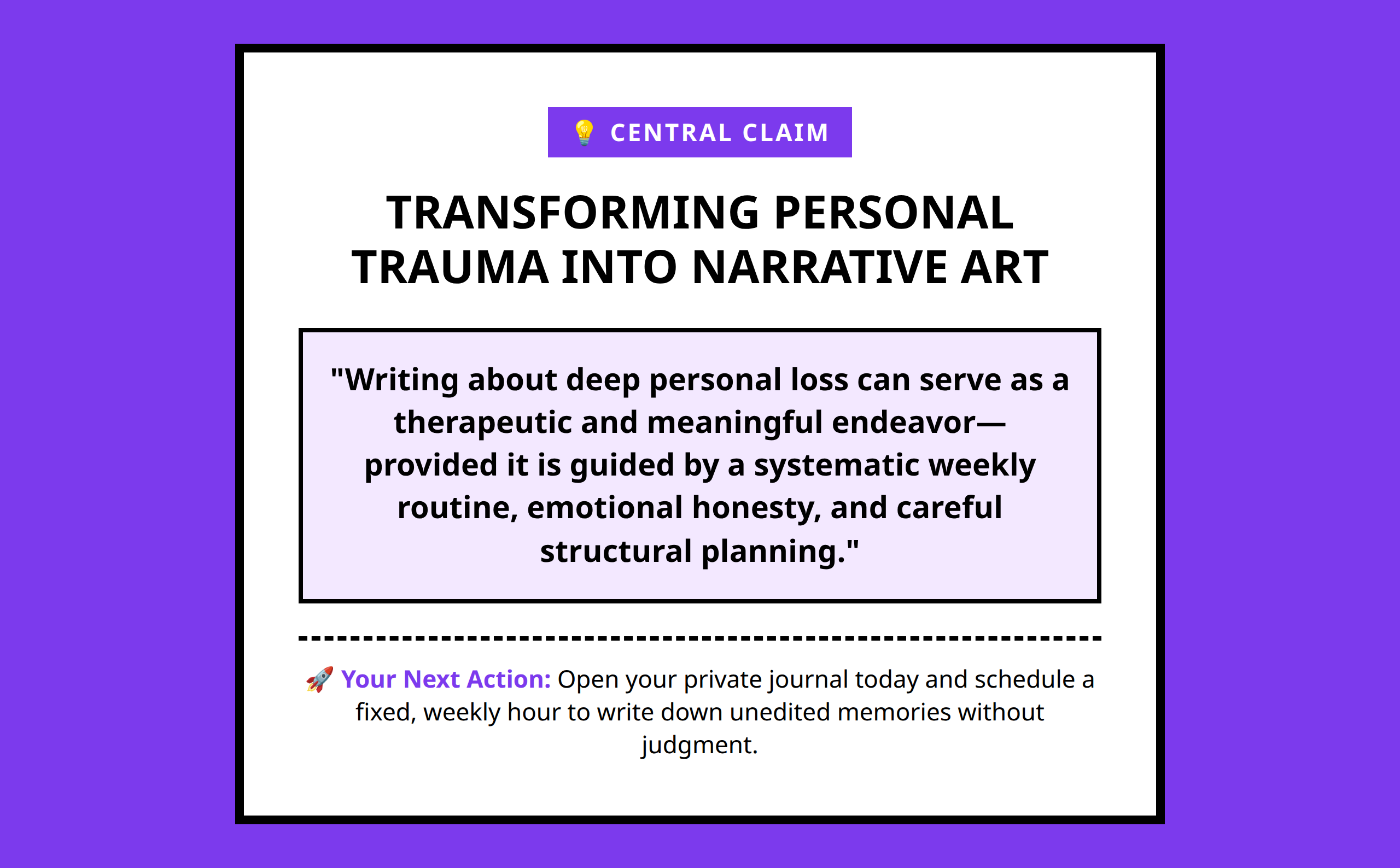
Authentic grief writing is not about revealing everything. It is about translating private emotional experience into something another person can emotionally enter.
That requires selection, structure, pacing, and restraint.
The protagonist eventually realizes that simply documenting grief is not enough. Readers need movement through the experience. Not a fake conclusion, but some form of emotional progression they can follow.
At the same time, the story warns against writing purely for reaction or validation. Once grief becomes audience-dependent, the emotional center can quietly disappear.
If I were approaching this kind of writing myself, I would keep returning to one question:
Am I trying to communicate something true, or am I trying to sound emotionally convincing?
Those are not always the same thing.
The difference usually shows up in the details: the unfinished thoughts, the ordinary routines, the awkward silences, the moments where the writer admits they still do not fully understand what they feel. That is often where authentic writing actually begins.
References:
- https://maximumz.blog/category/pilot/
- https://www.jamespreller.com/tag/jordan-sonnenblick/
- https://www.authorhouse.com/en/resources/writing/the-difficult-things
- https://goinswriter.com/writing-motivation/
- https://getfreewrite.com/blogs/writing-success/name-your-grief-how-to-use-writing-to-break-through-the-fog-of-loss