Most lists of cognitive biases are too long to remember and too abstract to use. The “3 S’s” framework reduces many common biases into three recurring patterns that are easier to recognize in everyday decisions.
I used to read long lists of cognitive biases and feel like I understood them while reading, then forget most of them a few days later. There are simply too many. Once the list grows past a certain size, the brain stops treating it like something practical and starts treating it like trivia.
What helped me more was finding a smaller structure underneath the list. Many biases may look different on the surface, but they often come from the same few mental habits repeating themselves in slightly different ways.
The “3 S’s” framework works because it compresses complexity into something usable. Instead of memorizing dozens of separate biases, you start looking for three deeper tendencies that keep appearing across different situations.
Takeaways
- Many cognitive biases come from the same small set of mental shortcuts.
- The “3 S’s” are self-esteem, stories, and snap judgments.
- This framework is more useful for real decisions than memorizing long psychology lists.
- The goal is not perfect thinking. The goal is recognizing distorted thinking faster.
Why Most Cognitive Bias Lists Become Hard to Use
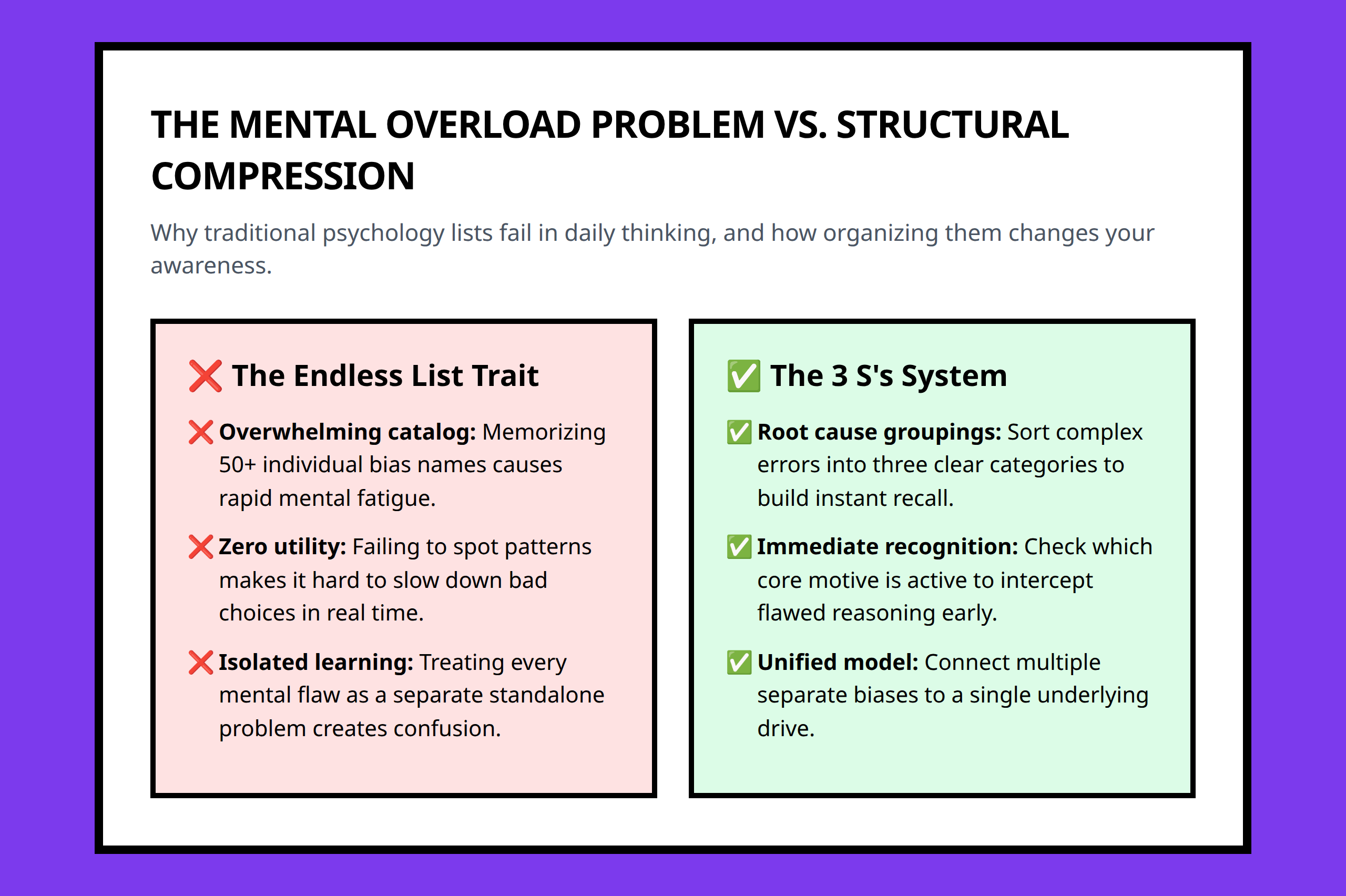
Cognitive bias research is valuable, but it can quickly become overwhelming.
One article explains confirmation bias. Another discusses framing effects. Then you encounter anchoring, hindsight bias, availability bias, herd mentality, survivorship bias, and dozens more. After a while, many readers stop seeing a practical system and start seeing disconnected vocabulary.
I think this is one reason people struggle to apply psychology concepts in real life. Information without structure is difficult to retrieve under pressure.
Imagine a manager dealing with a tense hiring decision. They are unlikely to pause and mentally review a catalog of fifty biases. But they may remember something simpler, such as:
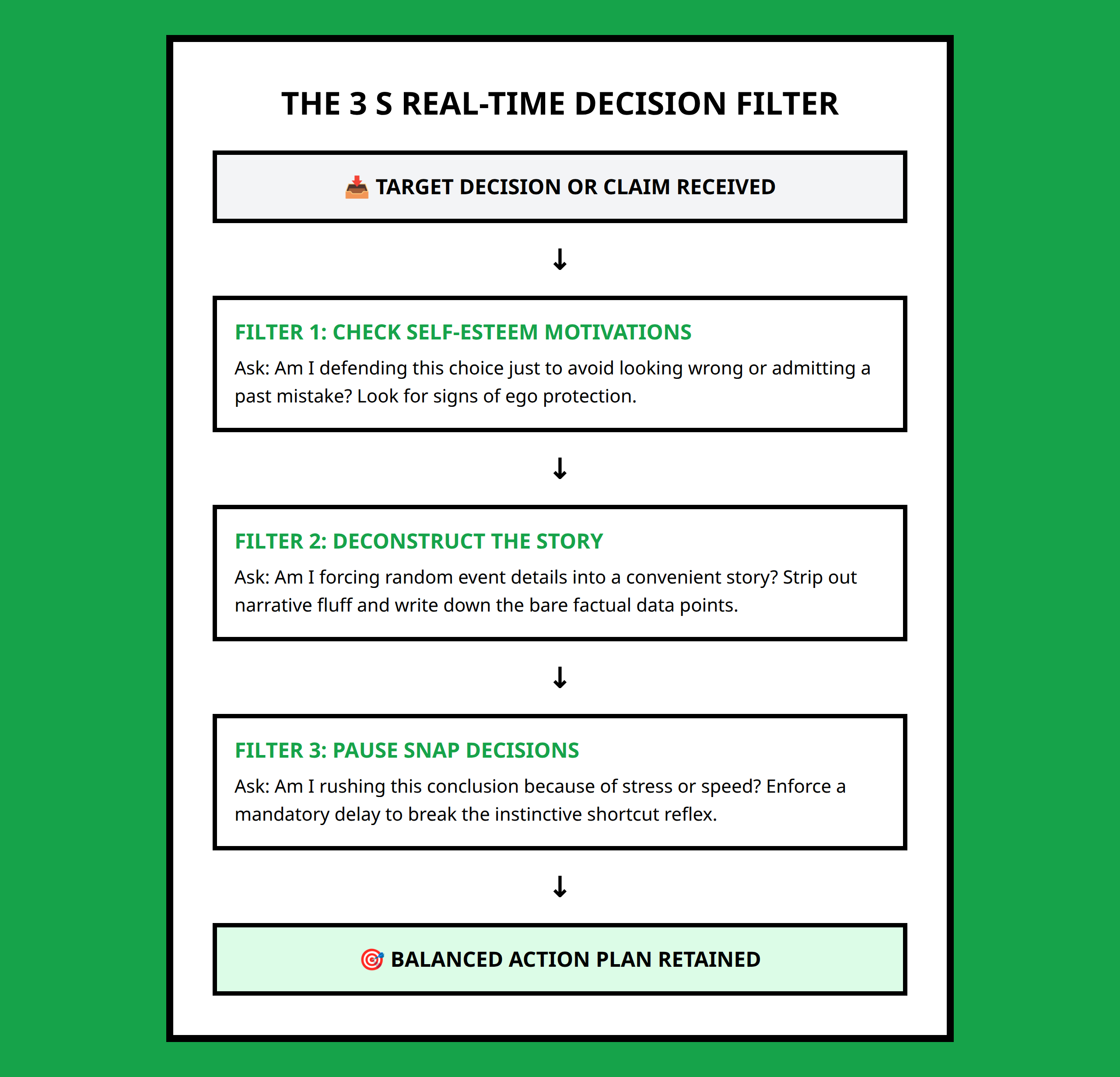
Am I protecting my ego, believing a convenient story, or reacting too quickly?
That question is practical because it compresses many separate distortions into a smaller decision lens.
The value of the “3 S’s” framework is not academic precision. The value is usability.
The First “S”: Self-Esteem
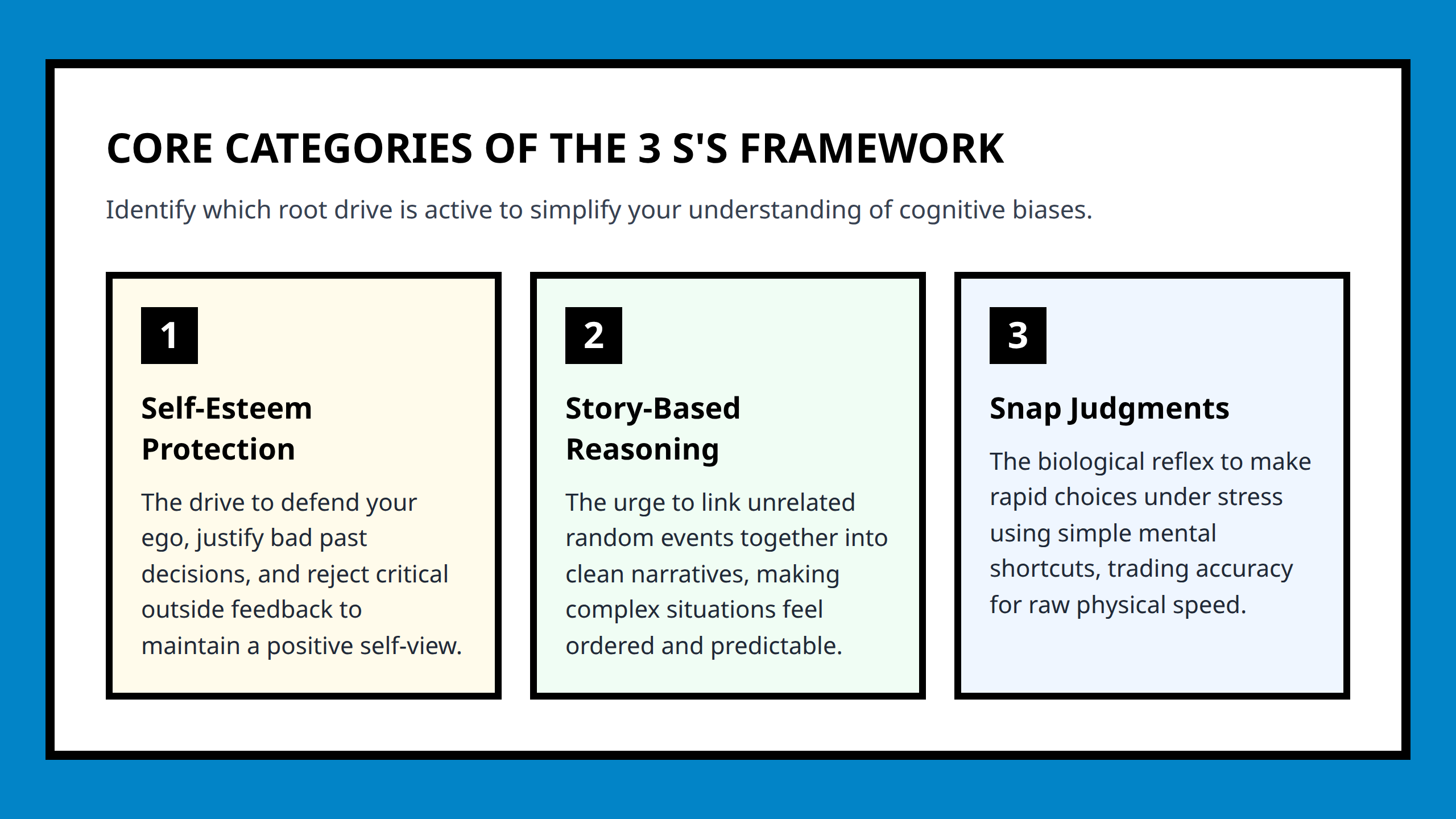
The first major driver behind many biases is self-esteem protection.
People naturally want to feel intelligent, competent, moral, and justified. That emotional need quietly changes how information gets interpreted.
Overconfidence is one obvious example. Many people believe they are better-than-average drivers, decision-makers, or investors, even though that cannot statistically be true for everyone.
Hindsight bias often grows from the same root.
After a successful outcome, people reinterpret the past in ways that make the success feel predictable or deserved. After a failure, the explanation changes. Luck, bad timing, or external circumstances suddenly become more important.
I notice this pattern most clearly after small wins.
A person gets one investment right and starts feeling unusually confident. A manager makes one successful hiring decision and begins trusting instinct more aggressively. A student performs well on one exam and assumes the next will be easy.
The emotional reward attached to success pushes the brain toward flattering interpretations.
Once I started seeing self-esteem as the underlying mechanism, many separate biases began looking connected rather than random.
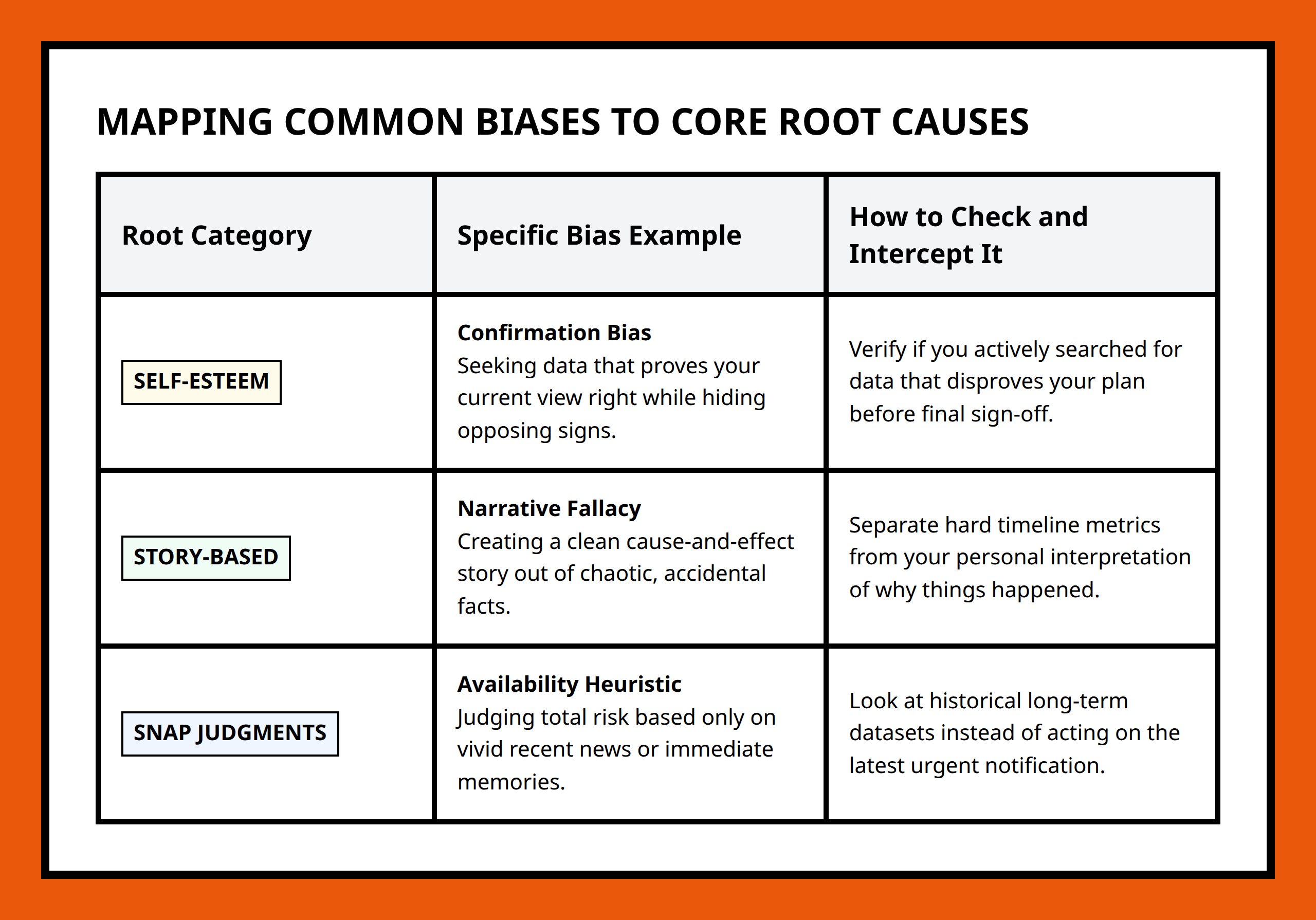
Some biases tied closely to self-esteem include:
- Overconfidence bias
- Confirmation bias
- False uniqueness bias
- Hindsight bias
- Dunning-Kruger effect
Each one protects a preferred self-image in some way.
The Second “S”: Stories Instead of Statistics
The brain prefers stories because stories feel understandable.
Statistics, probabilities, and uncertainty require more mental effort. Stories simplify reality into something emotionally satisfying.
This becomes dangerous when people start trusting narrative clarity more than evidence quality.
I think this happens constantly in business and public discussion.
A startup succeeds and people immediately build a polished explanation about visionary leadership, culture, timing, or innovation. Another startup fails and a completely different narrative appears with equal confidence.
What often gets ignored is randomness, incomplete information, or hidden variables that never became visible.
The human brain dislikes messy explanations. It wants causes to feel clean and coherent.
This tendency connects several biases together:
- Narrative fallacy
- Clustering illusion
- Probability neglect
- Illusory correlation
- Gambler’s fallacy
These biases all involve forcing meaning, patterns, or certainty onto situations that may actually contain noise, coincidence, or uncertainty.
A simple example appears in sports.
If a basketball player makes several shots in a row, many people start believing the player is “hot.” They assume a pattern exists that predicts future shots more reliably. Sometimes that pattern is real. Often it is simply random variation that the brain converted into a story.
I try to become cautious whenever an explanation feels emotionally complete too quickly. Reality is often less tidy than the explanation makes it sound.
The Third “S”: Snap Judgments
The third category is snap judgments.
The brain constantly makes fast interpretations before careful reasoning has time to begin. Once those first impressions form, they become difficult to dislodge.
This is where anchoring, framing, stereotyping, and availability bias become especially important.
One early impression changes everything that follows.
A common example is pricing.
If someone first sees a product priced at $300, a later $120 option may suddenly feel reasonable, even if $120 was originally outside their budget. The initial number creates the anchor.
The same thing happens socially.
A coworker makes one awkward comment in a meeting, and people unconsciously start interpreting future behavior through that first impression. The brain prefers consistency once it settles on an initial judgment.
I think this is one reason emotional first reactions deserve more skepticism than many people give them.
Some snap-judgment biases include:
- Anchoring bias
- Availability bias
- Halo effect
- Stereotyping
- Default bias
They all involve fast simplification before deeper analysis happens.
Why the Framework Matters More Than Memorizing Definitions
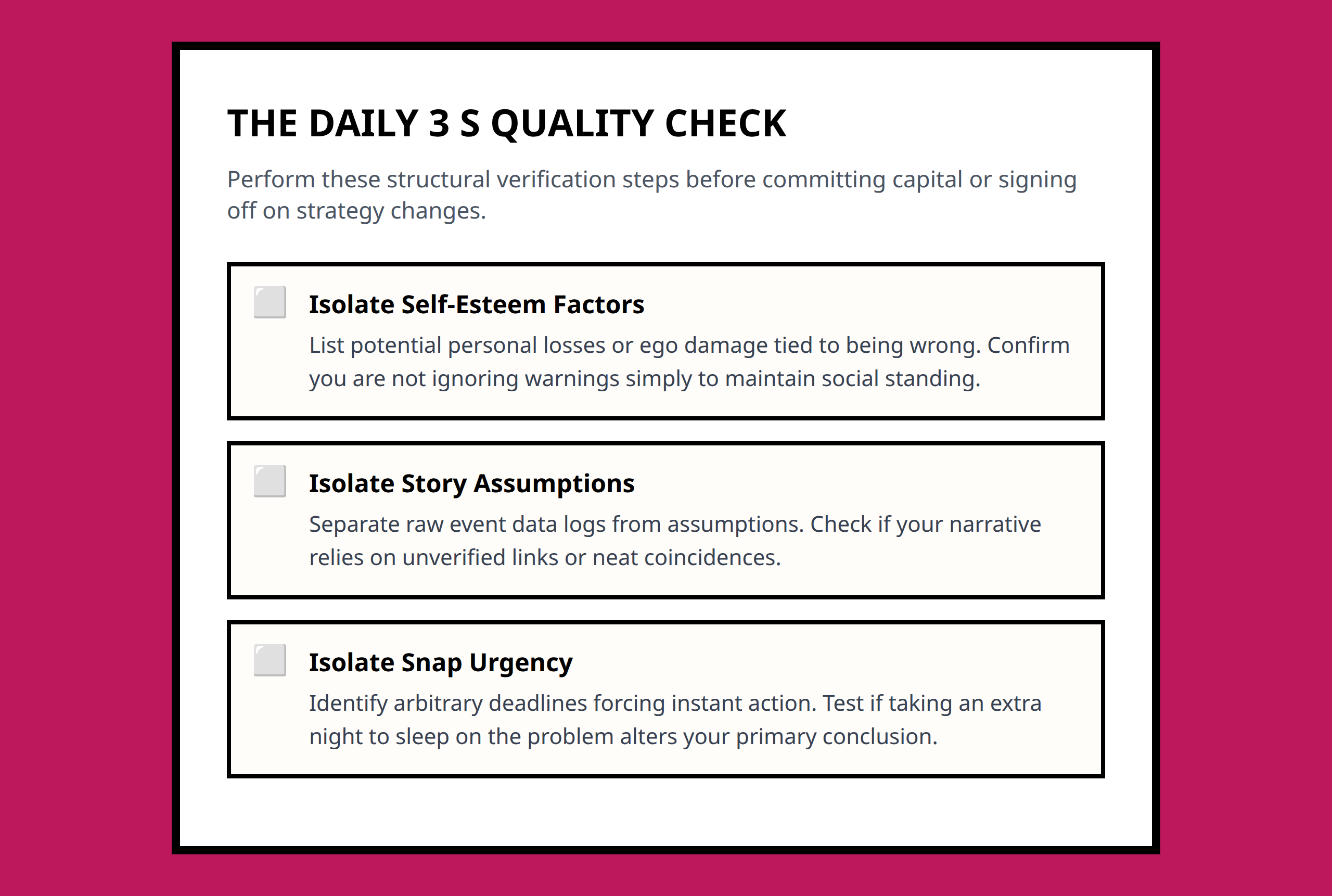
The point of the “3 S’s” framework is not to replace psychology research with a catchy shortcut.
The point is making cognitive bias awareness usable under real conditions.
I rarely find myself thinking:
This exact moment reflects conjunction fallacy combined with survivorship bias.
But I often catch myself asking:
- Am I protecting my ego here?
- Am I trusting a neat story too quickly?
- Did I form this judgment too fast?
Those questions are easier to remember during stressful or emotional moments.
That matters because most distorted thinking happens under pressure, speed, or uncertainty. A framework that only works in calm study conditions is less useful in real life.
I also think categorization improves memory.
The brain handles grouped ideas more efficiently than scattered information. Once biases become connected to larger mental patterns, they stop feeling like isolated psychology trivia and start feeling like recurring human behavior.
The Real Goal Is Awareness, Not Perfection
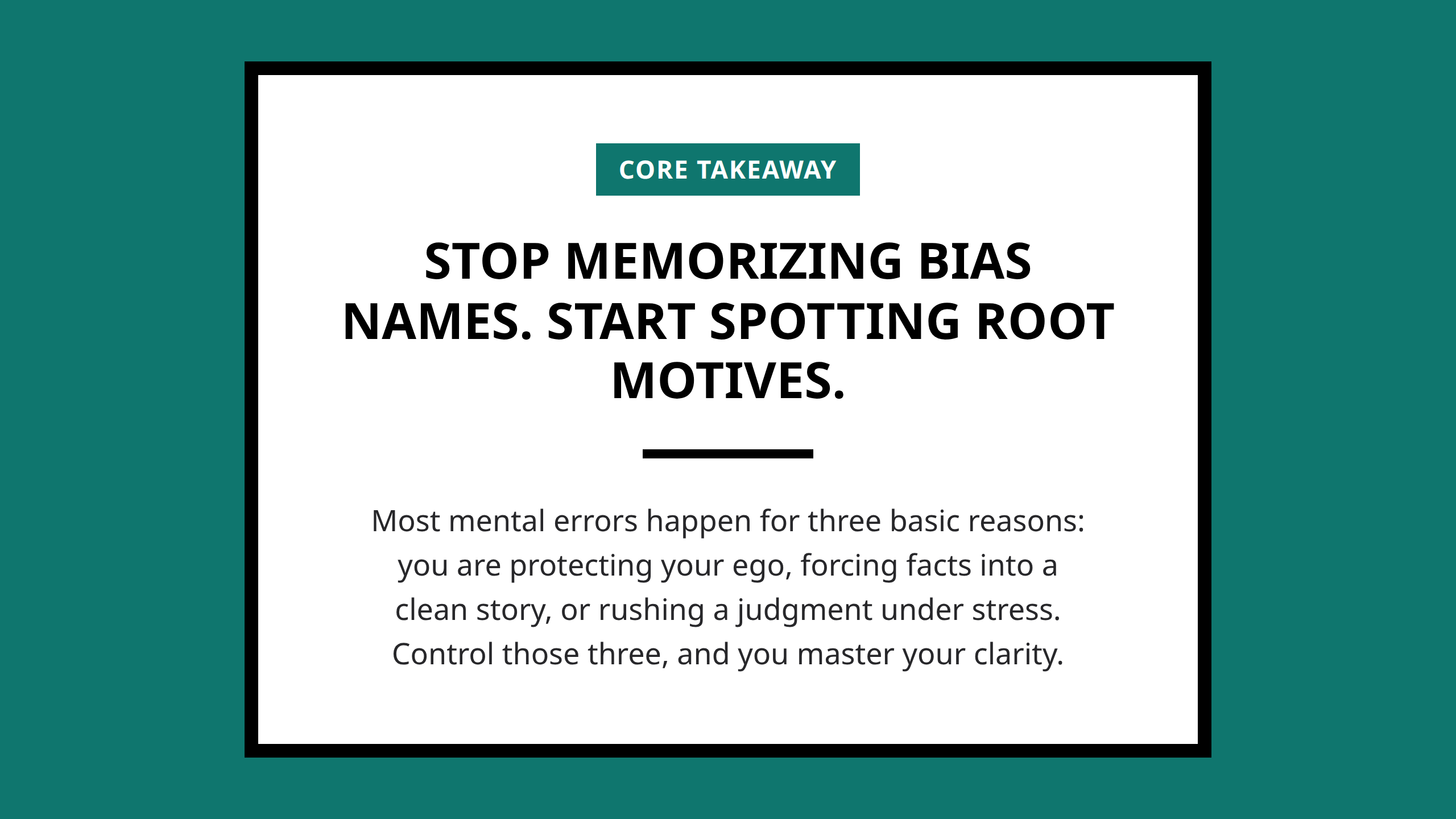
No framework eliminates bias completely.
The human brain will always rely partly on shortcuts because shortcuts save time and energy. Many of them exist for evolutionary reasons tied to survival and rapid decision-making.
The practical goal is becoming harder to fool.
I do not expect myself to think perfectly. What I want is a better chance of catching distorted reasoning before acting on it.
Sometimes that means slowing down before sending an angry message. Sometimes it means questioning a confident narrative that lacks evidence. Sometimes it means noticing when success is feeding ego more than judgment.
The “3 S’s” framework helps because it creates a smaller mental checklist that can actually be remembered and used.
Most cognitive biases look complicated when treated separately. Many become easier to recognize once you realize the same three mental habits keep reappearing underneath them.
- Cognitive bias: A predictable mental distortion that affects how people judge situations and make decisions.
- Confirmation bias: The tendency to search for or favor information that supports existing beliefs.
- Anchoring bias: A bias where the first piece of information strongly influences later judgment.
- Narrative fallacy: The habit of creating simple stories to explain complicated events.
- Availability bias: A tendency to rely too heavily on recent or memorable information.
- Dunning-Kruger effect: A bias where people with low skill or knowledge overestimate their competence.
- Halo effect: A bias where one positive impression influences broader judgments about a person or thing.
- Probability neglect: Ignoring actual odds because emotions or stories feel more convincing.
References:
- https://journalspress.com/ejournal/ejournal_LJRHSS_Vol_24_Issue_7.pdf
- https://www.jstor.org/stable/20464385
- https://www.linkedin.com/posts/nataraj-sasid_most-times-it-is-not-that-you-have-failed-activity-7434590017253113856-bKe7
- https://link.springer.com/content/pdf/10.1007/978-1-4020-8220-7.pdf
- https://www.scribd.com/document/257608739/Case-Writing-Tips-2
- https://www.researchgate.net/publication/43489162_Scope_goals_and_methods_in_CALL_research_Questions_of_coherence_and_autonomy
- https://philpapers.org/archive/MACDNU.pdf
- https://research.em-lyon.com/esploro/fulltext/journalArticle/Where-is-Negotiation-in-Hybrid-Warfare/9917839309453
- https://lup.lub.lu.se/search/files/5373629/7762385.pdf