Good judgment depends on more than intelligence. Stress, fatigue, hunger, emotional pressure, and even physical surroundings can quietly change how the brain processes information and reacts to problems.
Many people talk about thinking as if the mind operates separately from the body. I used to think that way too. If someone was intelligent, disciplined, and experienced, I assumed their decision-making would stay mostly stable unless they lacked information.
The more I paid attention to real behavior, the less convincing that idea became. Smart people often make poor choices when they are exhausted, emotionally overloaded, stressed, hungry, or mentally drained. The issue is not usually a sudden loss of intelligence. The issue is that physical and emotional strain changes how the brain functions.
That shift is easy to miss because the person still feels like themselves while it is happening.
Takeaways
- Decision quality is strongly tied to physical and emotional condition.
- Stress hormones can narrow thinking and increase impulsive reactions.
- Sleep deprivation weakens reasoning long before people recognize it.
- Mental clarity often improves when the body recovers first.
The Mind and Body Are Not Separate Systems
People often describe the mind and body as if they operate independently. The mind thinks. The body carries out instructions.
In reality, the relationship works in both directions constantly.
Physical conditions shape emotional and cognitive performance, while emotional states create physical changes throughout the body.
I think many people underestimate how deeply connected these systems are because the effects appear gradually instead of dramatically.
Consider a normal workday example.
A person sleeps badly for several nights, skips lunch because meetings run long, then spends the afternoon handling tense conversations and deadlines. By evening, they may feel impatient, emotionally reactive, mentally foggy, and strangely certain about conclusions they normally would question.
That does not happen because intelligence disappeared. It happens because physical strain altered how the brain processed stress, attention, and emotion.
The body is not just supporting the brain in the background. It is actively shaping the quality of thinking.
Stress Changes Thinking Before People Realize It
One of the clearest examples of the mind-body connection is stress.
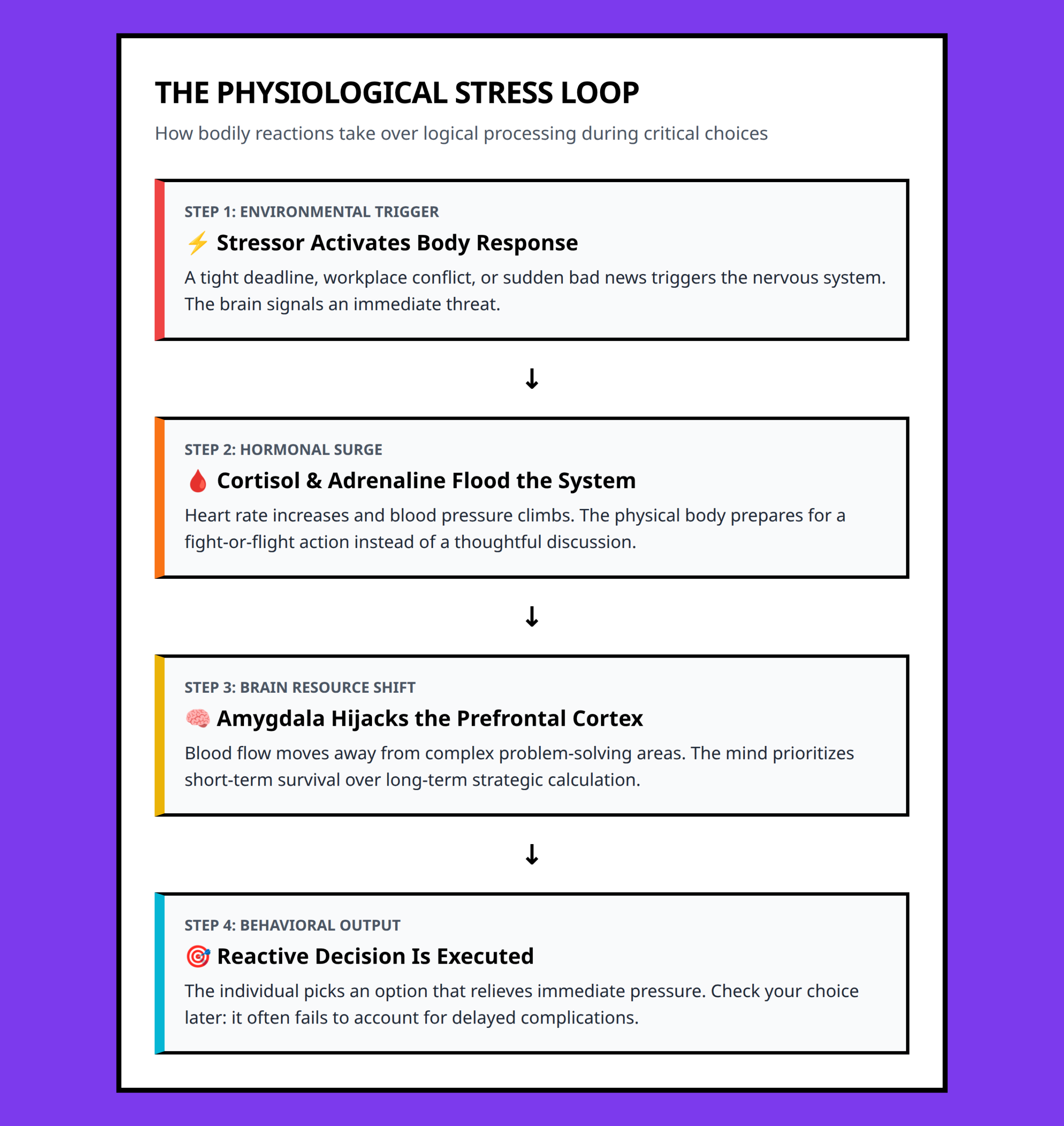
When people experience stress, the body releases hormones like cortisol. Those chemicals help prepare the body for immediate action. That response can be useful during short-term emergencies.
The problem appears when stress becomes constant.
Long periods of pressure narrow attention and increase emotional reactivity. Under stress, people often become more impulsive, more defensive, and less willing to slow down and evaluate alternatives carefully.
I notice this most during periods of continuous urgency.
When everything feels important at once, the brain starts prioritizing speed over accuracy. Decisions become shorter, harsher, and more emotionally loaded.
A manager under pressure may suddenly interpret neutral messages as criticism. A student approaching exams may catastrophize minor setbacks. An investor watching falling markets may react emotionally instead of strategically.
Stress creates a feedback loop.
The emotional pressure changes physical state, and the physical state then intensifies emotional reactions. Once that cycle starts, even small problems can begin feeling unusually large.
That is why highly stressed people often make decisions that look irrational later, even though those decisions felt emotionally reasonable in the moment.
Sleep Loss Quietly Damages Judgment
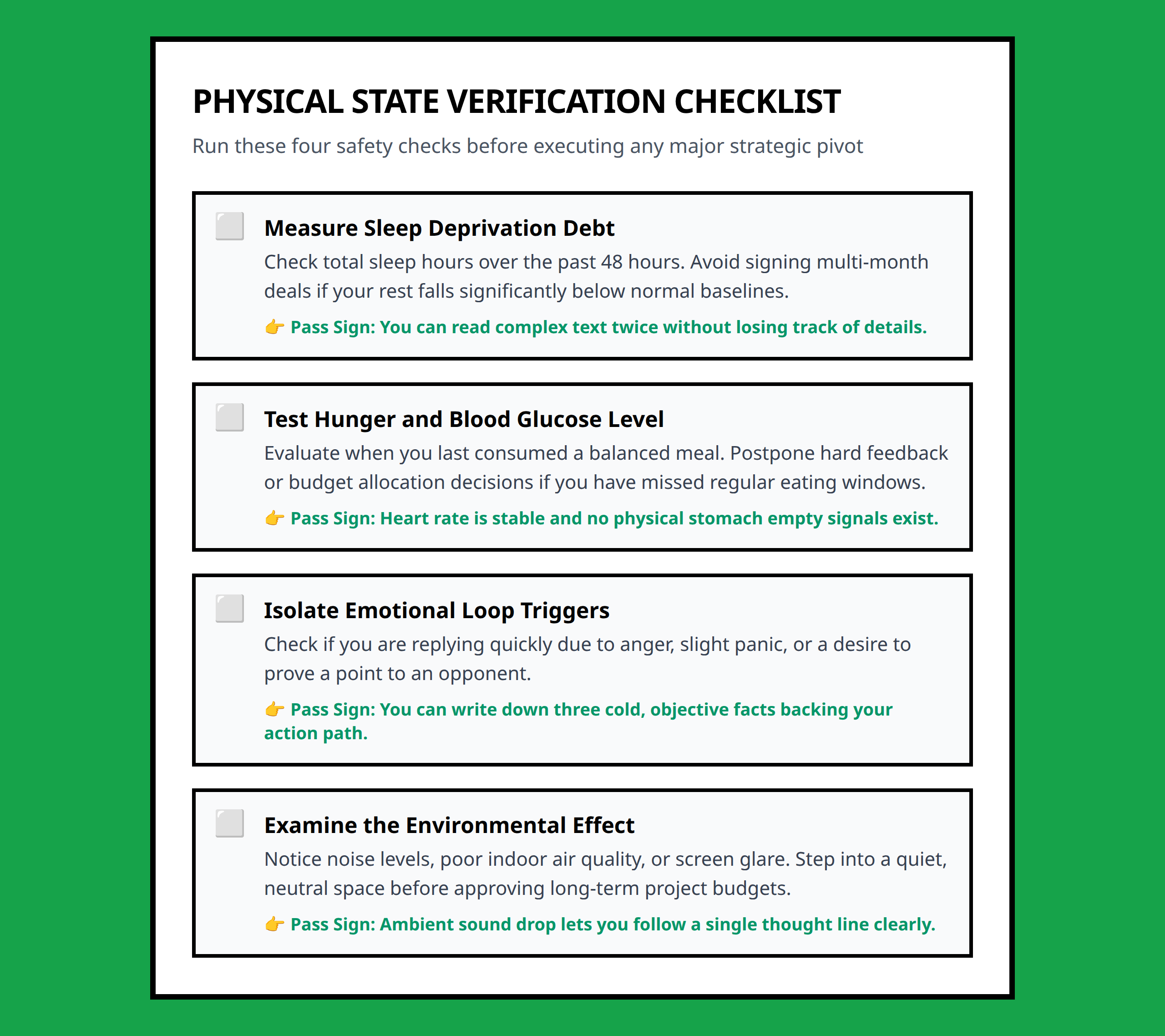
Sleep deprivation is especially dangerous because people often fail to recognize how impaired they have become.
Most people understand that lack of sleep causes tiredness. Fewer people appreciate how strongly it affects reasoning, emotional regulation, memory, and decision quality.
I have seen this pattern in ordinary situations many times.
Someone works late for several nights, starts relying heavily on caffeine, becomes emotionally reactive during small disagreements, and gradually loses patience for careful thinking. They still believe they are functioning normally because the decline happened slowly.
But the warning signs usually appear before complete exhaustion.
Some common signs include:
- Overconfidence in quick decisions
- Difficulty evaluating tradeoffs calmly
- Increased irritability
- Stronger emotional reactions to small frustrations
- Reduced willingness to reconsider first impressions
- Mental fog during complex tasks
What makes sleep deprivation particularly risky is that exhausted people often become less aware of their own decline.
That combination is dangerous: weaker judgment paired with high confidence.
Emotion Alters Perception, Not Just Mood
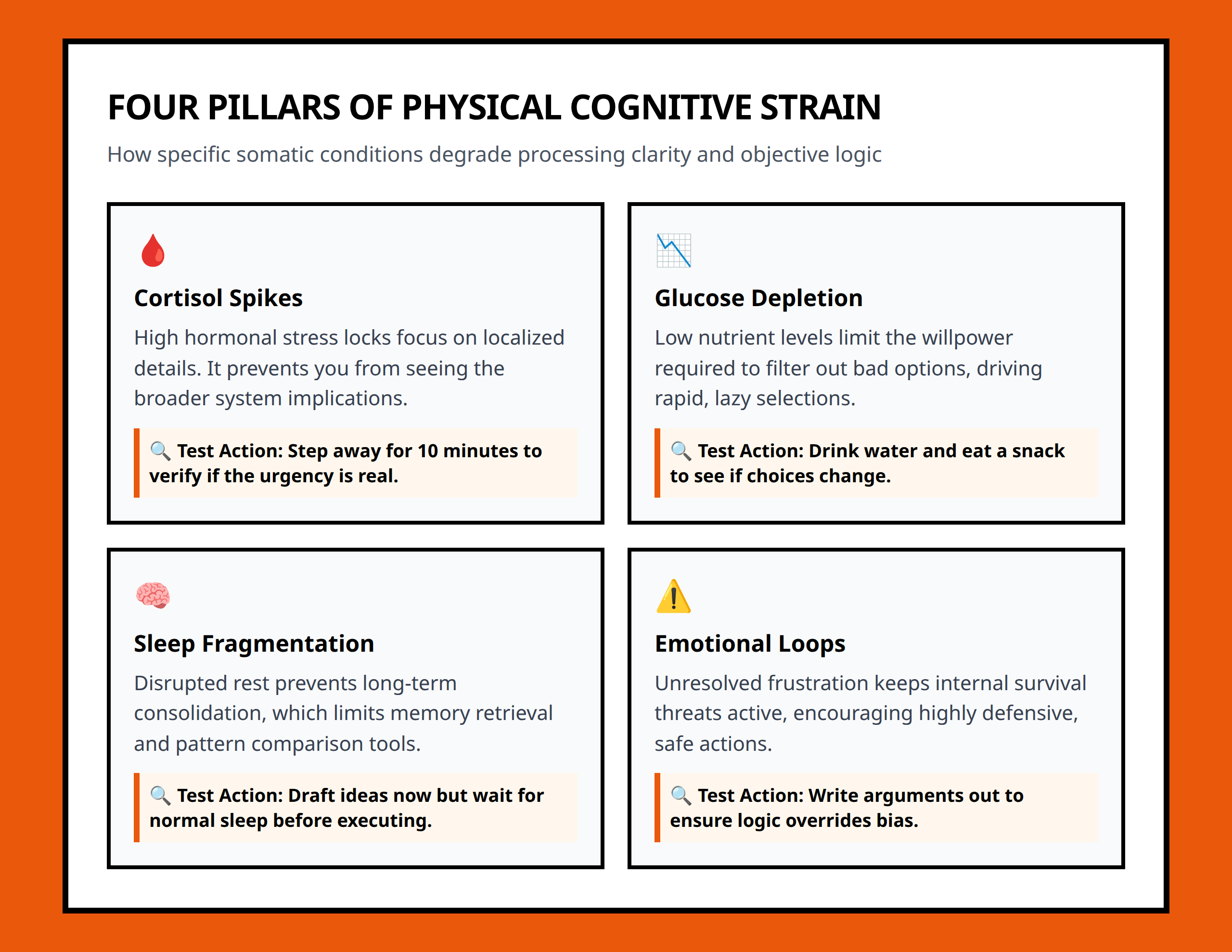
People often talk about emotion as if it only affects feelings. In practice, emotion changes perception itself.
An anxious person notices threats more quickly. An angry person interprets ambiguity more aggressively. A discouraged person may start assuming negative outcomes are inevitable.
The external situation may not have changed much at all. The interpretation changed.
I think this is one reason emotionally charged decisions deserve caution even when they feel deeply justified.
Imagine someone receiving a short message from a coworker late at night:
“We should talk tomorrow.”
Under calm conditions, that message could mean almost anything. Under stress or exhaustion, the brain may instantly create a negative story around it.
The person may lose sleep, rehearse defensive arguments, or mentally escalate a situation that never actually existed.
The emotional state quietly fills gaps in information.
This also explains why emotional regulation matters for thinking quality. Calmness is not just a personality trait. It changes how information gets interpreted.
The Placebo Effect Shows How Powerful the Mind-Body Link Really Is
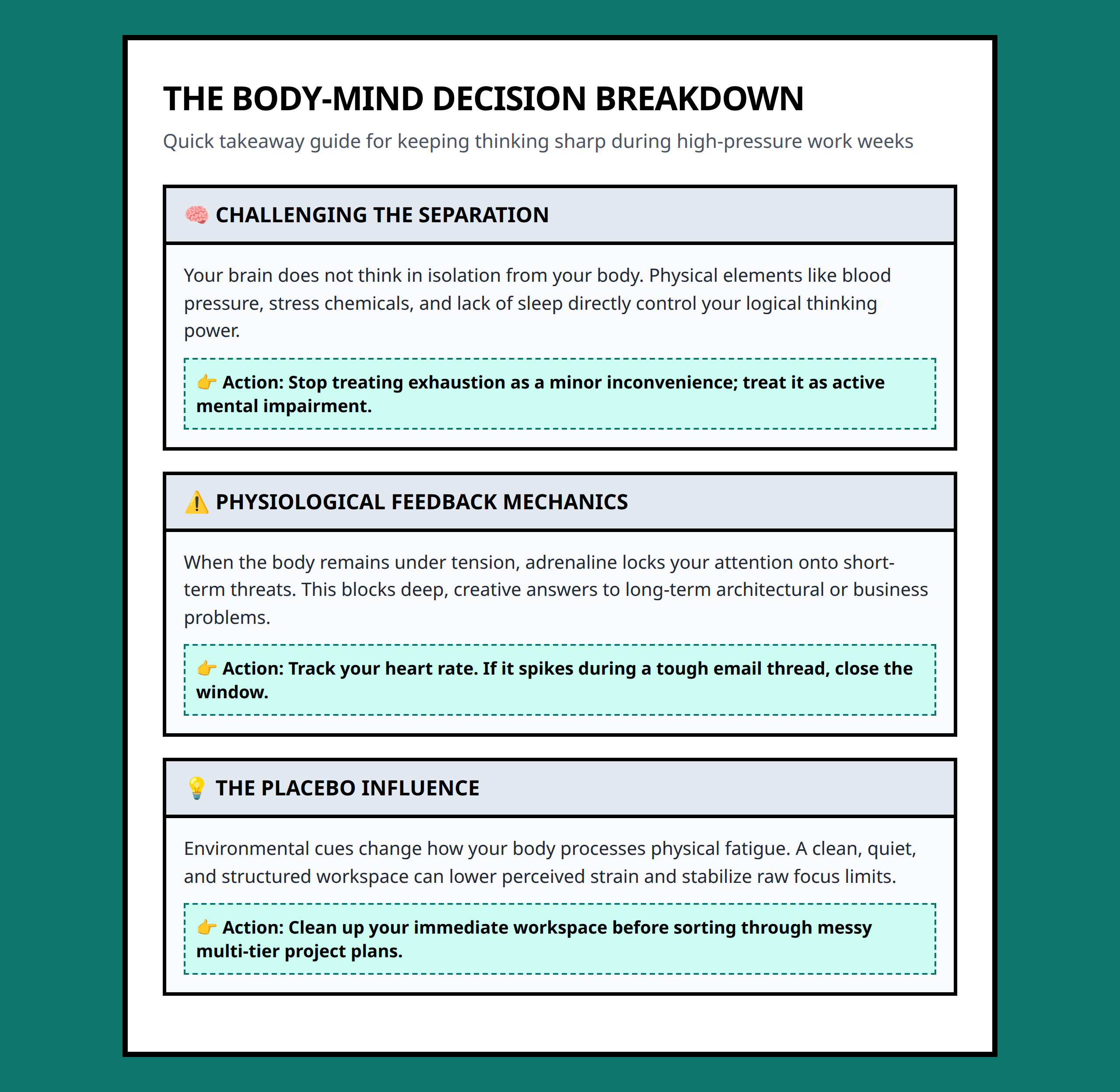
One of the most fascinating examples of the mind-body connection is the placebo effect.
A placebo is a treatment with no active medical ingredient, such as a sugar pill. Yet people can still experience real symptom relief after taking it.
That outcome surprises many people because it feels irrational at first. But it reveals something important:
The brain is not merely observing physical experience. It actively influences physical experience.
I do not think the placebo effect means people can simply “think away” illness. The more useful lesson is that expectation, belief, and mental state can influence physical responses in measurable ways.
That connection works in both positive and negative directions.
If positive expectation can reduce pain or stress, then chronic anxiety, fear, emotional overload, and hopelessness can also shape physical condition over time.
The brain and body continuously interact with each other whether people notice it or not.
Your Environment Affects Thinking More Than Most People Admit
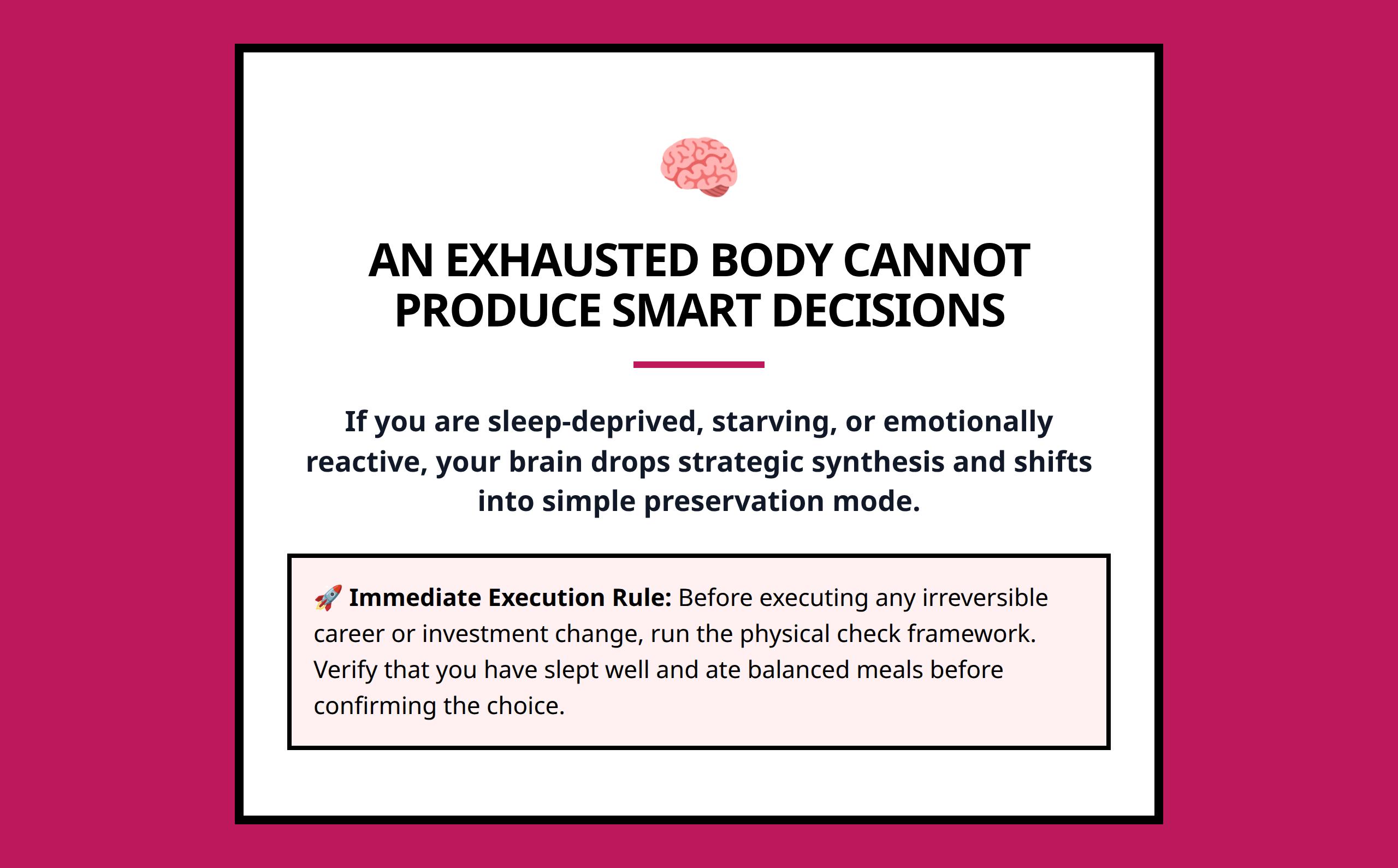
Mental performance is also shaped by surroundings.
People often imagine cognition as something fully internal, but environment influences stress levels, emotional state, and clarity of thought.
A noisy, tense, overcrowded setting tends to increase mental fatigue faster than a calm environment.
I notice this difference clearly after long periods indoors under pressure. Even a short walk outside can reduce mental friction and improve clarity.
The important point is not productivity optimization. The important point is recognizing that thinking quality is affected by physical context.
Someone making an important decision after hours of stress, noise, poor sleep, and emotional overload is not evaluating the situation under neutral conditions.
Their environment is already shaping the outcome.
How I Try to Protect Decision Quality During High-Stress Periods
I do not think it is realistic to eliminate stress, fatigue, or emotional pressure completely. Modern work and life make that impossible for many people.
What matters more is recognizing when those conditions are distorting thinking.
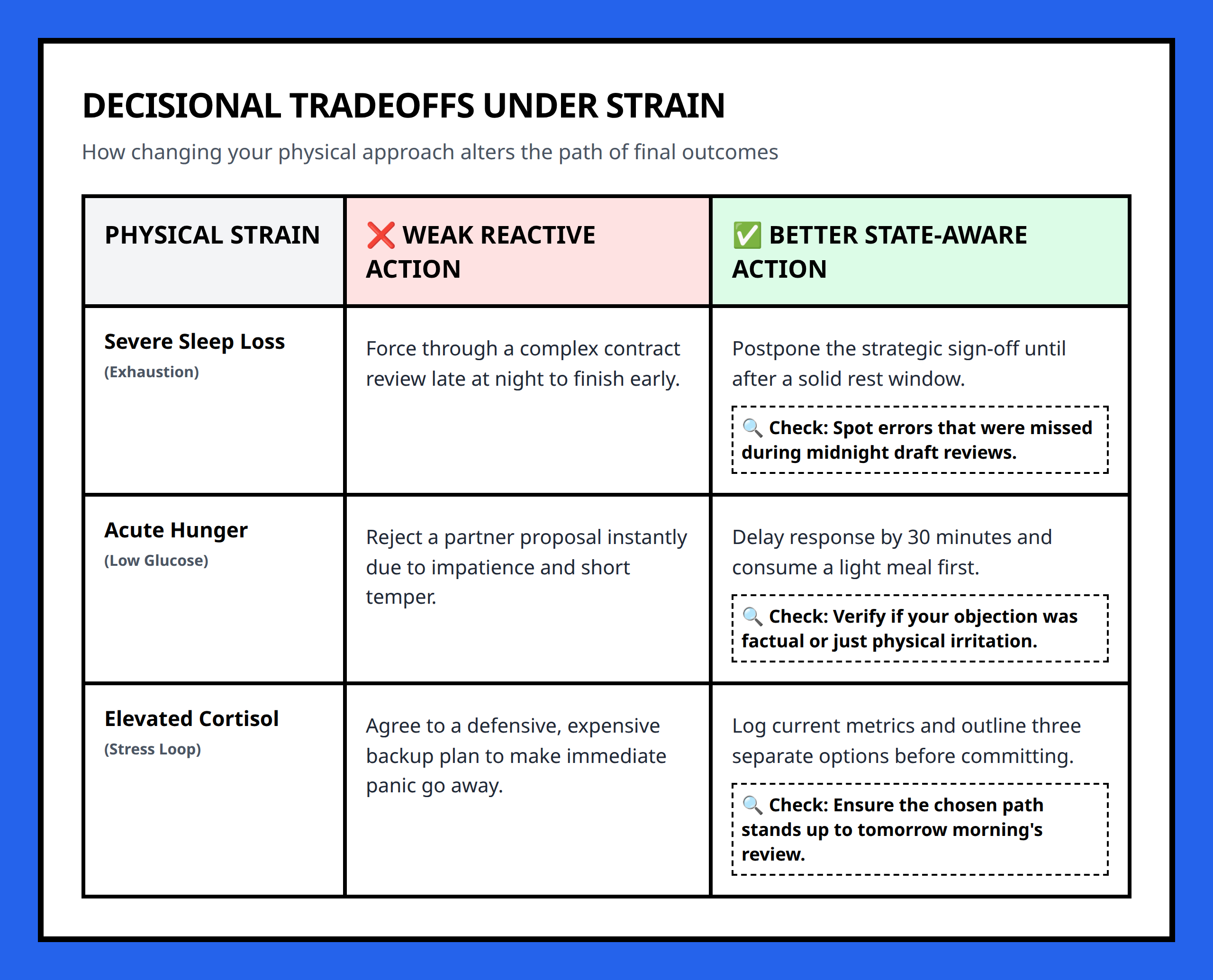
When I notice signs of emotional overload or exhaustion, I try to avoid treating immediate reactions as reliable conclusions.
That may mean:
- Delaying important responses until after rest
- Avoiding major decisions late at night
- Questioning emotionally satisfying conclusions
- Separating urgency from importance
- Taking breaks before conflict escalates
- Recognizing when physical strain is shaping interpretation
I also think it helps to stop viewing recovery as laziness.
Sleep, rest, calm environments, and emotional decompression are not only comfort mechanisms. They protect cognitive quality.
Many bad decisions do not begin with lack of intelligence. They begin with a tired brain trying to operate under conditions it was never designed to handle continuously.
That is why some of the smartest people still make poor decisions during stressful periods. The issue is often not what they know. The issue is the condition their mind and body are in while trying to use that knowledge.
- Cortisol: A stress hormone released by the body during pressure or perceived danger.
- Sleep deprivation: A condition where a person does not get enough sleep, reducing mental and physical performance.
- Placebo effect: Improvement in symptoms caused by belief or expectation rather than an active medical treatment.
- Cognitive performance: The brain’s ability to think, remember, focus, reason, and make decisions.
- Emotional regulation: The ability to manage emotional reactions instead of being controlled by them.
- Mental fatigue: Reduced thinking quality caused by prolonged stress, concentration, or exhaustion.
- Feedback loop: A cycle where one effect strengthens the condition that caused it.
References:
- https://www.youtube.com/watch?v=yUTGEkKv2KM
- https://www.youtube.com/watch?v=kjp4n3ViFrI
- https://www.youtube.com/watch?v=kXVYwmdUmO8
- https://www.theacpgroup.com/blog/why-smart-people-still-make-bad-decisions
- https://www.linkedin.com/pulse/why-smart-people-make-bad-career-decisions-under-spyros-ctb5e
- https://medium.com/@radhakrishna3111995/why-smart-people-still-make-bad-decisions-0eedb100d032
- https://www.under30ceo.com/people-make-dangerous-decisions-under-stress/
- https://nesslabs.com/decision-making
- https://profrjstarr.com/the-psychology-of-us/why-smart-people-make-dumb-emotional-decisions
- https://finance.yahoo.com/news/why-smart-people-make-bad-decisions-132828672.html
- https://news.ycombinator.com/item
- https://theotherclinic.sg/2025/11/03/stress-and-decision-making-understanding-the-impact-and-finding-solutions/
- https://pmc.ncbi.nlm.nih.gov/articles/PMC4117081/
- https://www.waldenu.edu/online-masters-programs/ms-in-clinical-mental-health-counseling/resource/how-stress-impacts-decision-making
- https://medium.com/@wisdom.peace.happiness/why-even-highly-intelligent-people-struggle-with-emotional-control-4f9ecd618525